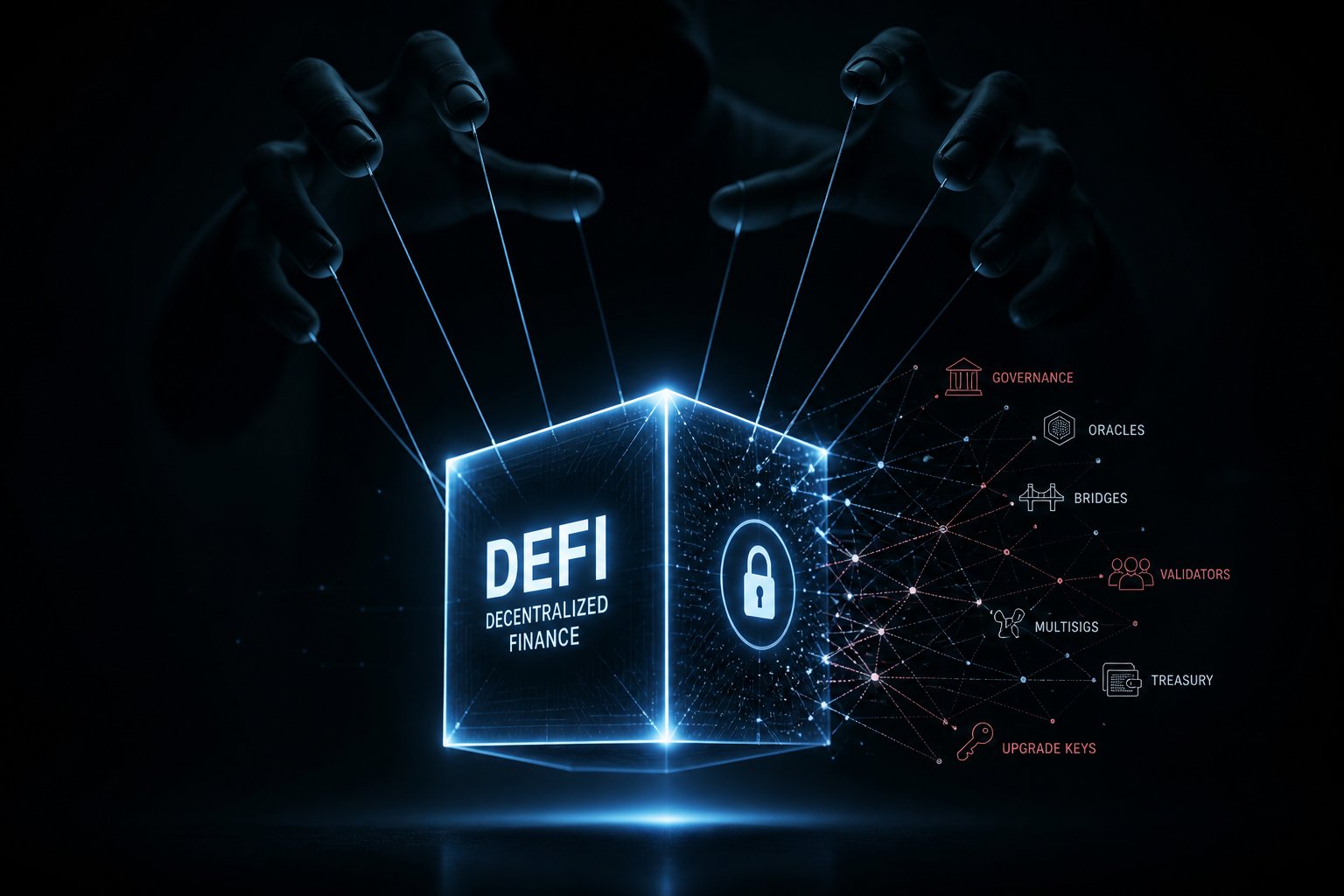
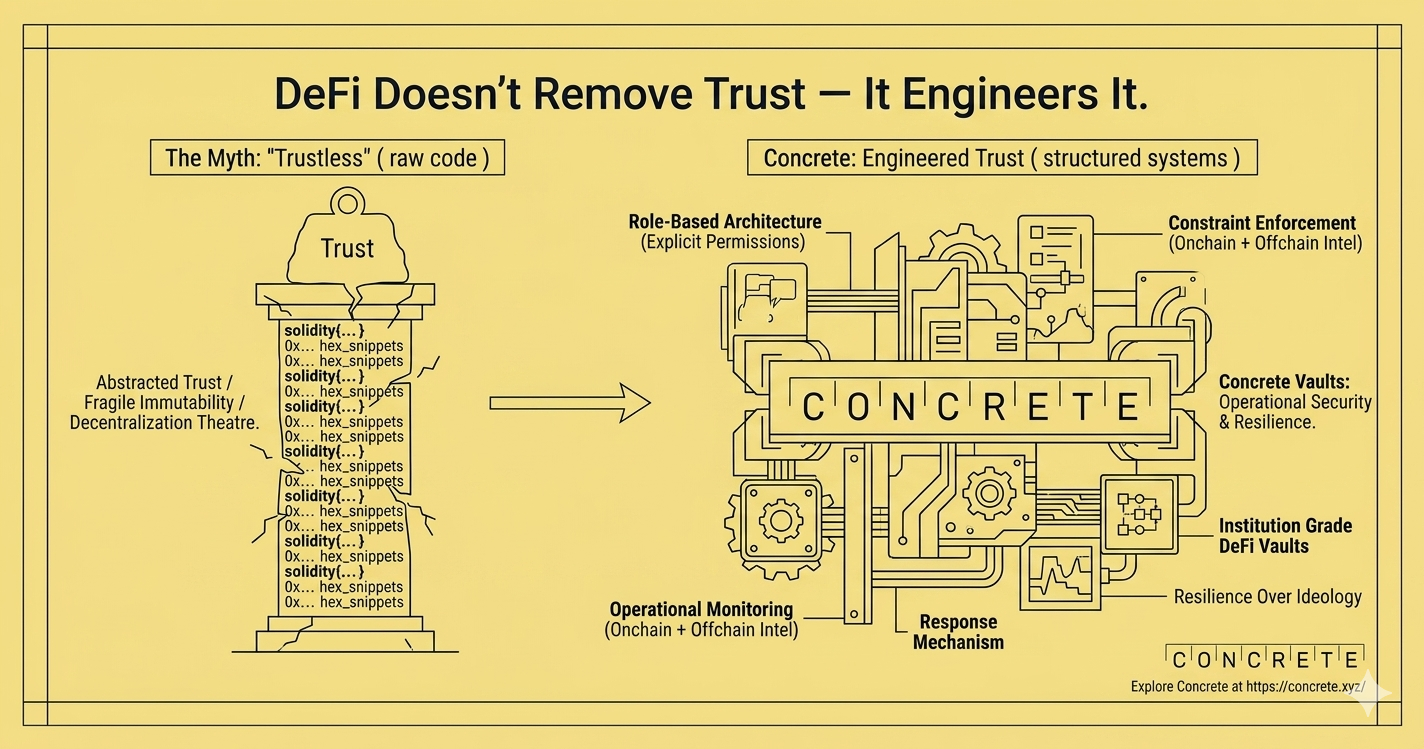
DeFi Doesn’t Remove Trust — It Engineers It
--
DeFi was built on a powerful idea:
“Don’t trust people. Trust code.”
For a while, that felt revolutionary.
Smart contracts replaced intermediaries.
Transactions became transparent.
Systems ran automatically.
It looked like trust had been removed.
But as DeFi evolved, something became clear:
Trust didn’t disappear. It just moved.
Today, every DeFi user still trusts something. The real question is not whether trust exists, but where it exists and how it’s managed.
The Myth of “Trustless” Systems
DeFi popularized phrases like:
- “Trustless systems”
- “Code is law”
- “No intermediaries needed”
These ideas helped bootstrap a new financial paradigm.
But in reality, no system is fully trustless.
Even in DeFi, you are relying on assumptions:
- That the code works as intended
- That governance decisions are rational
- That data inputs are accurate
- That infrastructure behaves under stress
Trust was never eliminated.
It was redistributed across the system.
Where Trust Actually Lives in DeFi
If you look closely, trust exists in multiple layers of DeFi infrastructure:
Smart Contracts
You trust that the code is secure, audited, and free of critical bugs.
Governance Systems
You trust that token holders or DAOs make decisions that don’t harm the protocol.
Oracles
You trust external data feeds to provide accurate pricing and information.
Bridges
You trust cross-chain systems to securely move assets between networks.
Execution Layers
You trust the network to process transactions reliably and without manipulation.
None of these layers are trustless.
They are simply abstracted.
The complexity is hidden, not removed.
The Problem With “Decentralization Theatre”
As DeFi matured, a new issue emerged:
Some systems look decentralized, but aren’t necessarily resilient.
This is often referred to as decentralization theatre.
Examples include:
- Multisigs presented as full decentralization
- DAOs with low participation and concentrated control
- Timelocks that delay actions but don’t prevent harmful ones
- Systems that lack the ability to respond during critical failures
These structures create the appearance of safety, but not always the reality.
There’s a big difference between:
Being decentralized
and
Being secure and resilient
Engineered Trust: A Better Model
If trust cannot be removed, the solution is not to ignore it.
The solution is to design it intentionally.
This is where the idea of engineered trust comes in.
Engineered trust means:
- Clearly defined roles and responsibilities
- Explicit permissions and controls
- Enforced constraints within the system
- Mechanisms to respond to failure and edge cases
This is how mature financial systems operate.
And increasingly, it’s how modern DeFi infrastructure is being built.
Why Operational Security Matters
Real-world systems don’t just prevent failure.
They are designed to handle it.
That requires more than code.
It requires operational security, including:
- Continuous monitoring of system activity
- Rapid response mechanisms during incidents
- Human judgment in complex or unforeseen scenarios
- Layered security models across infrastructure
Code alone cannot anticipate every edge case.
Resilient systems combine automation with controlled intervention.
How Concrete Approaches Engineered Trust
This is where Concrete vaults take a different approach.
Instead of hiding trust assumptions, Concrete makes them explicit and structured.
Concrete is built around the idea that:
Trust should not be removed. It should be engineered.
This is reflected in its design:
- Trust is explicit, not abstracted away
- Systems are built for response, not just prevention
- Onchain enforcement is combined with off-chain intelligence
- Role-based architecture defines who can do what
- Controlled execution environments reduce unpredictable behavior
Rather than relying on decentralization theatre, Concrete prioritizes operational security and system resilience.
This is what enables institutional DeFi to function at scale.
Not by pretending trust doesn’t exist,
but by managing it properly.
The Bigger Shift
DeFi is entering a new phase.
The narrative is shifting from:
“Trustless systems”
to
“Well-designed trust systems”