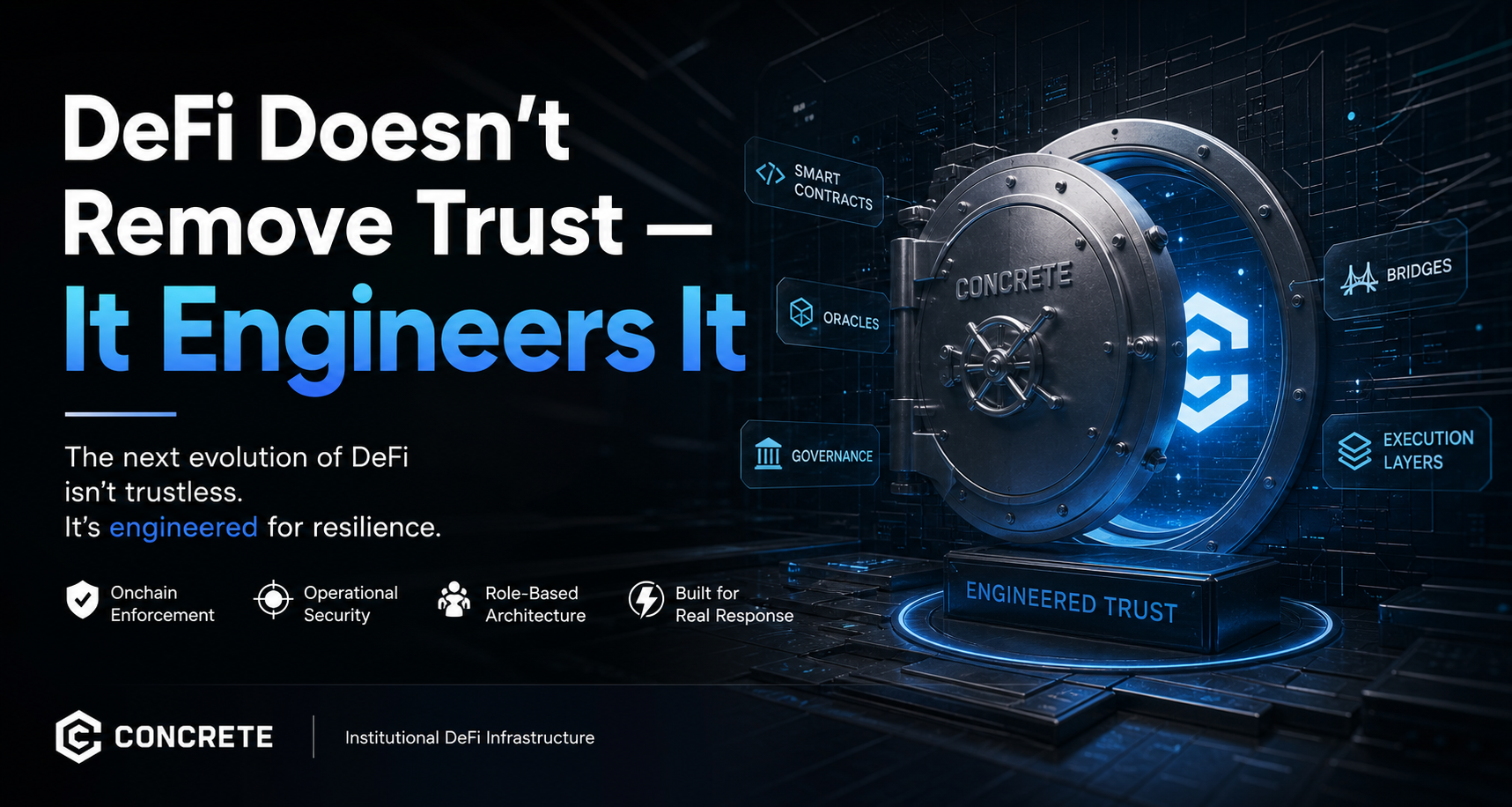
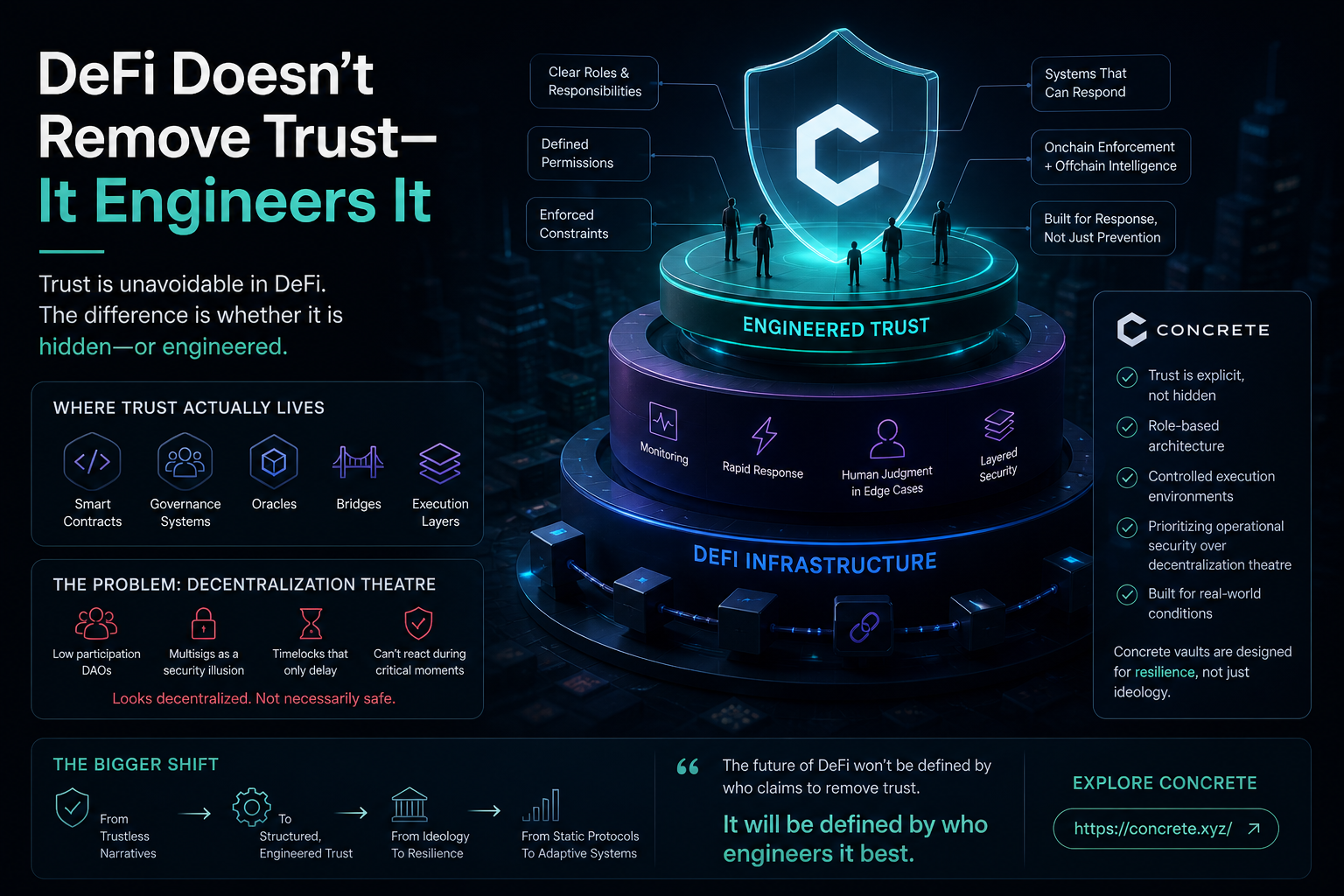
DeFi Doesn’t Remove Trust It Engineers It
--
DeFi didn’t eliminate trust. It changed who — and what — you trust.
One of the most repeated ideas in crypto is simple:
“DeFi is trustless.”
No banks.
No intermediaries.
No need to rely on people.
Just code.
And for a while, that framing made sense.
But as DeFi matured, reality caught up with the narrative:
There is no such thing as a fully trustless system.
There are only systems where trust is hidden — or designed.
The Misunderstanding Behind “Trustless”
When people say DeFi is trustless, what they usually mean is:
- you don’t need to trust a central authority
- rules are enforced automatically
- outcomes follow code
That’s true — to a point.
But code doesn’t exist in isolation.
It is written by humans.
Deployed by teams.
Maintained through governance.
Connected to external systems.
So while trust in people may be reduced, it is not removed.
It is redirected.
Where Trust Actually Sits
Every DeFi system relies on layers of trust — even if they’re not obvious.
You trust:
- smart contracts to be secure and bug-free
- governance to act responsibly and not introduce harmful changes
- oracles to provide accurate external data
- bridges to safely move assets across chains
- execution layers to process transactions correctly
Each layer is a potential point of failure.
And each requires confidence from users.
The system works not because trust is gone —
but because it is distributed.
The Risk of Surface-Level Decentralization
As DeFi expanded, many systems adopted the language of decentralization.
But not all implementations are equally robust.
Some rely on:
- small multisigs controlling key functions
- DAOs with low participation rates
- delayed governance that cannot react in real time
- structures that appear decentralized but lack coordination
This creates a gap between perception and reality.
A system can look decentralized —
while still being fragile.
This is where decentralization theatre emerges.
It focuses on appearance instead of resilience.
Why Real Systems Engineer Trust
In mature financial systems, trust is not ignored.
It is structured.
Responsibilities are defined.
Permissions are controlled.
Constraints are enforced.
Failures are anticipated.
This is what engineered trust looks like.
Instead of assuming everything will work perfectly, systems are designed to:
- handle unexpected conditions
- respond to risk events
- maintain stability under stress
Trust becomes something that is built into the architecture.
Beyond Code: The Need for Operational Security
Code is powerful, but it has limits.
It cannot:
- anticipate every market condition
- adapt instantly to unforeseen risks
- make judgment calls in ambiguous situations
That’s why real systems rely on more than code.
They require:
- continuous monitoring
- rapid response mechanisms
- layered defenses
- human oversight in critical moments
This is the foundation of operational security.
It complements automation with adaptability.
How Concrete Structures Trust
This is where Concrete takes a different approach.
Instead of claiming to remove trust, it acknowledges it — and structures it.
Concrete is built around:
- explicit trust models, not hidden assumptions
- role-based architecture with defined responsibilities
- onchain enforcement combined with off-chain intelligence
- controlled execution environments
- systems designed to respond, not just prevent
This creates a more resilient form of DeFi infrastructure.
In this model, Concrete vaults are not just tools for yield.
They are systems for managing capital within a framework of engineered trust and DeFi security.
The Direction DeFi Is Heading
As the space evolves, the narrative is shifting.
Early DeFi focused on eliminating trust.
Next-generation DeFi focuses on structuring it.
This matters especially as institutional DeFi grows.
Larger pools of capital require:
- predictable systems
- clear accountability
- reliable behavior under stress
These requirements cannot be met by ideology alone.
They require design.
Final Thought
Trust is not something DeFi can remove.
It is something DeFi must handle correctly.
The real innovation is not in pretending trust doesn’t exist.
It’s in making it:
- visible
- structured
- enforceable
Because in the end, the strongest systems are not the ones that claim to be trustless.
They are the ones that are designed to be trusted.
Explore Concrete at https://concrete.xyz/ 🚀