DeFi doesn’t Remove Trust, it Engineers it
 Naza3 min read·Just now
--
DeFi launched with a powerful rallying cry: “Don’t trust people. Trust code.” “Code is law.” “No intermediaries needed.”
For years, this narrative drove innovation and attracted capital seeking freedom from traditional finance. But as the ecosystem matured through hacks, exploits, cascading liquidations, and governance failures, a clearer truth emerged:
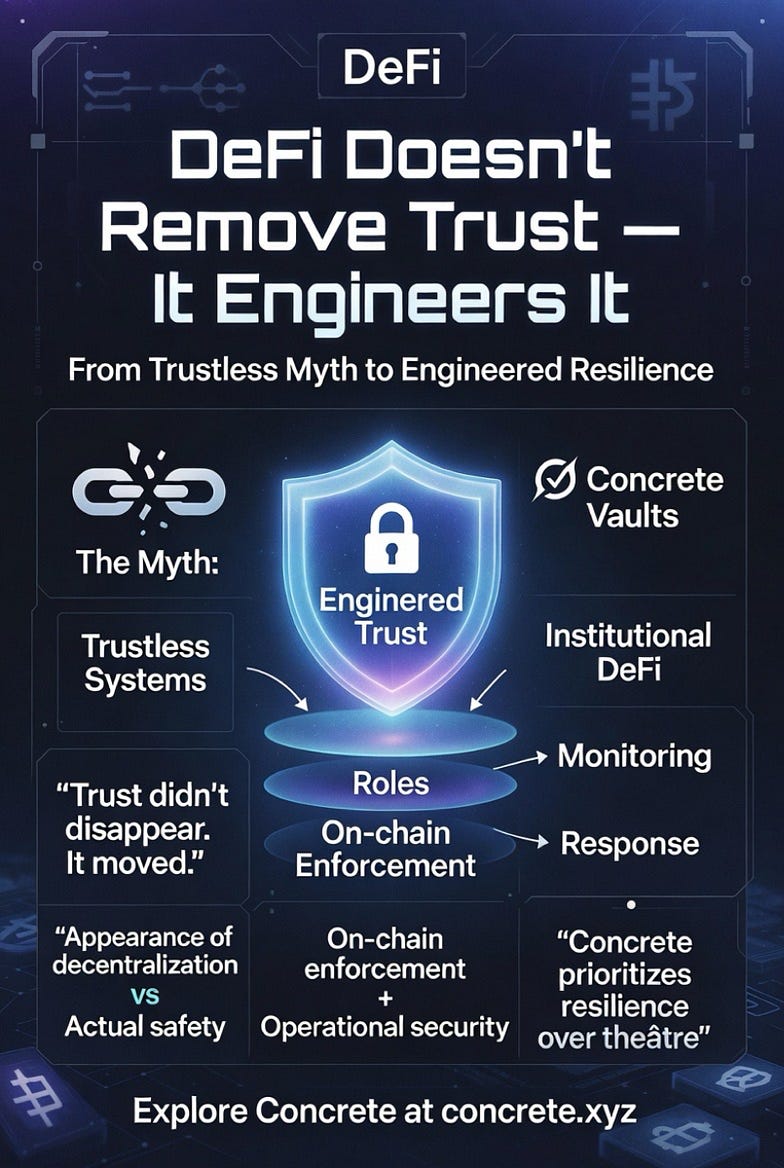
Trust didn’t disappear, it simply moved. And in many cases, it hid behind the illusion of decentralization.
The next phase of DeFi won’t be defined by who claims to be the most “trustless.” It will be defined by who engineers trust most effectively: making it explicit, structured, auditable, and resilient under stress.
Where Trust Actually Lives in DeFi
Even the purest on-chain systems rely on layers of trust:
- Smart contracts: You trust the code is bug-free, the audit was thorough, and the assumptions (e.g., no unforeseen interactions) hold.
- - Oracles: Price feeds, which can be manipulated or delayed.
- - Governance: Token weighted voting often leads to low participation or capture by a few large holders.
- - Bridges and execution layers: Cross-chain movement introduces sequencer trust, validator sets, and complex security models.
- - Underlying protocols: When you deposit into a vault or lending market, you trust collateral quality, liquidation logic, and counterparty behavior.
These dependencies aren’t eliminated, they’re abstracted. Users often don’t see them until something breaks.
The Problem with Decentralization Theatre
Many projects optimize for the appearance of decentralization rather than actual safety and resilience:
- Multisigs controlled by anonymous teams or small groups.
- - DAOs with quorum requirements so low that a handful of voters decide outcomes.
- - Timelocks that provide delay but no real prevention during fast-moving crises.
- - Systems that freeze or fail to respond when human judgment or rapid intervention is needed.
This creates fragile infrastructure. When stress hits, market crashes, exploits, or black swan events ideology gives way to reality. Capital flows to systems that actually protect it, not those that sound most pure.
Engineered Trust: Designing Trust Instead of Hiding It
Mature financial systems don’t pretend trust doesn’t exist. They define roles, enforce constraints, add checks and balances, and build mechanisms for accountability and response.
Engineered trust means:
- Clear separation of duties.
- - Defined permissions and escalation paths.
- - On-chain enforcement combined with intelligent monitoring.
- - Systems capable of responding to failure rather than just preventing it in theory.
This is how real resilience is built, not through slogans, but through deliberate architecture.
Operational Security in Practice
Code alone cannot handle every scenario. Real world DeFi infrastructure needs:
- Continuous monitoring and anomaly detection.
- - Rapid response capabilities for emerging threats.
- - Layered security (audits, bug bounties, simulations, circuit breakers).
- - Human oversight in edge cases, bounded by code-enforced rules.
This blend of on-chain guarantees and off-chain intelligence creates systems stronger than either approach in isolation.
How Concrete Engineers Trust Differently
This philosophy sits at the heart of Concrete institutional grade on-chain yield infrastructure.
Concrete rejects decentralization theatre in favor of explicit, role-based architecture. Its vaults use a tripartite separation of powers (e.g., Allocator, Strategy Manager, Hook Manager) that mirrors institutional risk management while enforcing boundaries directly in code. High-impact actions require multi-party authorization or timelocks, while routine operations stay automated and efficient.
Trust is made transparent:
- Role-based controls prevent single points of failure.
- - On-chain enforcement + real-time monitoring (e.g., partners like Hypernative for anomaly detection).
- - Automated accounting, NAV updates, and risk-invariant checks.
- - Focus on operational security alongside smart contract security including ongoing bug bounties and layered defenses.
The result? Concrete vaults that optimize yield across lending, restaking, delta-neutral strategies, and more, while prioritizing capital protection and institutional standards. With over $1B in assets on platform and billions processed, it demonstrates that engineered trust scales.
The Bigger Shift Ahead
DeFi is growing up. The future belongs to infrastructure judged not by how loudly it rejects trust, but by how effectively it engineers it.
Resilience under stress will matter more than ideological purity. DeFi security, operational security, and institutional DeFi will drive adoption as institutions and sophisticated users demand systems they can actually rely on.
In the end, the winners won’t be the most “trustless.” They’ll be the ones who best acknowledge where trust lives and design it deliberately.
Explore concrete at https://concrete.xyz/