Aave V3: 365-Day Protocol Overview Report
 CryptoPanda8 min read·Just now
--
Dashboard: Dune Analytics
Protocol: Aave V3
Author: Cryptopanda (Dandy)
Executive Summary
This report analyzes lending, borrowing, and liquidity activity on Aave V3 using a custom analytics dashboard built on Dune Analytics.
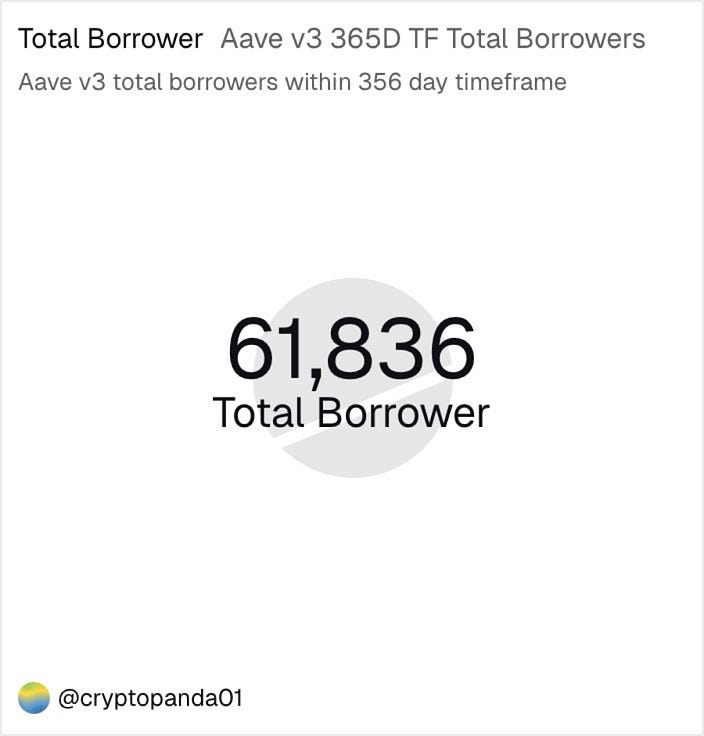
The analysis focuses on key protocol metrics including Total Value Locked (TVL), lender and borrower participation, net flows, liquidation trend and liquidity flow trends over a 365-day period. Findings show strong protocol utilization, with TVL surpassing $13B during peak periods, with a noticeable decrease in the negative effects in recent records, alongside 119,450 total lenders and 61,836 total borrowers, highlighting sustained participation within the lending ecosystem.
Overall, the dashboard demonstrates Aave V3’s importance as a core decentralized lending infrastructure facilitating liquidity access, capital efficiency, and borrowing activity within DeFi.
Context / Protocol Overview
a. What is Aave?
Aave is a decentralized non-custodial liquidity protocol that enables users to lend and borrow cryptocurrencies without intermediaries.
Users can:
• Deposit assets into liquidity pools to earn yield
• Borrow assets using collateral
• Access liquidity permissionlessly
Aave V3 introduced improvements such as:
• Better capital efficiency
• Cross-chain functionality
• Risk isolation mechanisms
• Enhanced liquidity management
b. What is a DeFi Lending Protocol?
A decentralized finance (DeFi) lending protocol allows users to lend and borrow digital assets directly through smart contracts.
Lenders earn interest from deposited assets, while borrowers access liquidity by providing collateral.
c. The Role of Aave in DeFi
Aave is one of the largest and most influential lending protocols in decentralized finance.
The protocol serves as:
• A major on-chain liquidity market
• A source of leverage for traders
• A yield-generation platform for lenders
• Infrastructure for other DeFi applications
Its lending markets support liquidity circulation across the broader DeFi ecosystem.
Key Findings
a. Activity Metrics
Protocol participation remained consistently active throughout the observed period.
The lender count significantly exceeds the borrower count, indicating strong liquidity supply across the protocol.
Daily lender activity fluctuated throughout the year, with several spikes surpassing 4,000 — 8,000 lenders during periods of heightened market activity.
Borrower participation remained relatively stable, generally ranging between:
• 300 — 1,400 daily borrowers
This suggests sustained borrowing demand across the ecosystem.
b. Liquidity & TVL Analysis
Total Value Locked (TVL)
TVL growth demonstrates strong capital inflow into the protocol during the analyzed period.
Key observations:
• TVL surpassed $13B during peak growth periods
• Strong upward growth occurred between mid-2025 and early-2026
• TVL later declined due to the aftermath of the April 8th KelpDAO exploit, which resulted in losses exceeding $293M and triggered a wave of outflows from the protocol, alongside broader market fluctuations.
Notwithstanding the recent events, the sustained high TVL indicates:
• Strong confidence from liquidity providers
• Significant capital allocation into Aave lending markets
• Continued protocol relevance within DeFi
c. Liquidity Flow Analysis
Liquidity flow analysis provides deeper insight into capital movement within Aave V3 over the 365-day period.
c.i Net Inflow and Outflow
The protocol recorded approximately:
These figures indicate extremely high levels of capital movement through the protocol, reflecting active liquidity recycling between deposits, withdrawals, lending, and borrowing activities.
Although outflows slightly exceeded inflows during the observed period, the relatively balanced relationship between deposits and withdrawals suggests:
• Continuous liquidity circulation
• Active capital utilization
• Sustained user engagement within the protocol
c.ii Deposit and Withdrawal Trends
The deposit and withdrawal visualization reveals periods of intense liquidity activity, particularly during mid-2025 where:
• Deposit spikes exceeded $12B
• Withdrawal spikes approached -$13B
This behavior suggests:
• Increased market participation during high-volatility periods
• Large-scale liquidity repositioning by users
• Active treasury and whale-level capital movement
Over time, both deposit and withdrawal magnitudes gradually declined, with few recent spikes as a result of the recent market downturn and the KelpDAO exploit.
c.iii Liquidity Provider Distribution
Analysis of the top 10 liquidity providers shows that liquidity contribution is moderately distributed rather than concentrated within a single entity.
The largest provider accounted for approximately:
• 15% of total liquidity among the top 10 providers
While the remaining providers contributed between:
• 6% — 14% each
This distribution suggests:
• Reduced overdependence on a single liquidity provider
• Healthier liquidity diversification
• More balanced capital allocation across major participants
Overall, the liquidity flow analysis highlights Aave V3’s ability to sustain large-scale capital movement while maintaining active participation from liquidity providers across the ecosystem.
d. Top Borrowed Assets Analysis
The borrowing activity on Aave V3 over the last 365 days was heavily concentrated around stablecoins and major blue-chip assets. USDT led borrowing demand with over $77B borrowed, followed by USDC at $53B and USDe at $33B, highlighting strong market preference for stable-value assets in lending and leverage strategies. ETH-based assets also maintained significant borrowing activity, with WETH recording over $25B in borrowed volume.
Other assets such as DAI, wstETH, WBTC, GHO, USDS, and PYUSD contributed smaller but still notable volumes, indicating diversified borrowing behavior across both stable and yield-bearing assets.
The dominance of stablecoins indicates that users primarily relied on Aave V3 for liquidity access, leveraged positions, and capital-efficient trading strategies, while limiting exposure to market volatility.
e. Net Debt Creation Analysis
The net debt creation chart shows sustained borrowing demand across the year, with several sharp increases in debt issuance exceeding multi-billion-dollar levels during peak activity periods. Borrowing activity was strongest during mid-to-late 2025, where debt creation spikes aligned with periods of elevated liquidity inflows and TVL growth.
Although borrowing demand moderated toward the later part of the timeframe, debt activity remained consistently positive, demonstrating continued utilization of Aave V3’s lending infrastructure.
This trend suggests that the protocol remained a preferred liquidity source for both retail and institutional participants throughout changing market conditions.
f. Liquidation Trend Analysis
The liquidation trend on Aave V3 remained relatively controlled throughout most of the 365-day period, with liquidation volumes generally staying below major stress thresholds.
However, the dashboard recorded several sharp liquidation spikes, including events exceeding $100M in liquidated positions, particularly around late 2025. These spikes likely coincided with periods of heightened market volatility, rapid asset price movements, and leveraged position unwinds.
Despite these temporary surges, liquidation activity was not persistent across the full timeframe, indicating that most borrowers maintained healthy collateral positions under normal market conditions.
The data suggests that Aave V3’s collateral and risk management framework remained effective in absorbing market stress while sustaining overall protocol stability and liquidity efficiency.
Visualization Choices
Several visualization methods were used to improve interpretation of protocol activity.
a. Line Charts
Line charts were used for:
• Daily lender activity
• Daily borrower activity
These charts effectively illustrate:
• User participation trends
• Activity spikes
• Market cycles over time
b. Bar Charts
Bar charts were used for:
• TVL growth
• Borrow volume
• Repay volume
• Top borrowed assets
This visualization style highlights:
• Magnitude of capital movement
• Liquidity growth trends
• Borrowing intensity over time
c. KPI Cards
KPI cards were used to display:
• Total lenders
• Total borrowers
• Total Net inflow
• Total Net outflow
These provide quick summary insights into overall protocol participation.
Recommendations
Based on the findings from the dashboard analysis, the following recommendations are proposed for improving protocol efficiency, liquidity stability, and long-term ecosystem growth on Aave V3:
1. Strengthen risk management mechanisms
Continuously optimize collateral factors, liquidation thresholds, and borrowing parameters to improve protocol stability during periods of market volatility.
2. Improve liquidation efficiency
Enhance liquidation infrastructure and monitoring systems to ensure faster response to sharp market movements and reduce systemic risk exposure.
3. Expand support for high-demand assets
Increase liquidity incentives and market support for heavily utilized assets such as USDT, USDC, USDe, and ETH-based assets to sustain borrowing demand.
4. Encourage broader liquidity distribution
Promote wider participation among liquidity providers to reduce concentration risk and improve overall market depth across the protocol.
5. Increase monitoring of liquidity flows and debt activity
Continuously track net inflows, outflows, and debt creation trends to better understand market behavior and support data-driven protocol adjustments.
Conclusion
The dashboard findings confirm that Aave V3 remains one of the most actively utilized lending protocols within decentralized finance. Over the 365-day period, the protocol recorded substantial liquidity inflows, sustained borrowing demand, strong TVL performance, and significant user participation across lending and borrowing activities.
Stablecoins such as USDT and USDC dominated borrowing demand, reinforcing Aave’s role as a critical liquidity infrastructure layer for leverage, trading, and capital management strategies. While liquidation spikes appeared during periods of market stress, the protocol maintained overall resilience through effective collateralization and liquidity management mechanisms.
Overall, the analysis demonstrates that Aave V3 continues to play a central role in DeFi lending markets by enabling efficient capital access, supporting large-scale liquidity movement, and sustaining ecosystem activity across varying market conditions.
View the complete dashboard on Dune: Aave V3 Dashboard: 365-Day Protocol Overview