DeFi Doesn’t Remove Trust — It Engineers It 。◕‿◕。
 Bankai || v0013 min read·Just now
--
The founding myth of decentralized finance is built on a seductive four-word mantra: “Don’t trust, just verify.” We were told that DeFi is inherently "trustless," that "code is law," and that the messy, biased intermediaries of TradFi would be permanently replaced by cold, objective mathematics.
It’s a beautiful vision. But as the industry matures, we are discovering a complex truth: DeFi doesn’t actually remove trust—it engineers it.
1. The Myth of the Trustless System
The "trustless" narrative suggests that by removing a central bank or a clearing house, trust simply evaporates from the equation. In reality, trust is like energy in a closed system—it cannot be destroyed, only transformed or moved.
When you interact with a "trustless" protocol, you aren’t removing trust; you are shifting it. You are placing your faith in the developer’s logic, the compiler’s accuracy, and the assumption that the economic incentives will hold under extreme volatility. The question isn’t whether trust exists, but where it lives and how it is managed.
2. Where Trust Truly Lives 😊
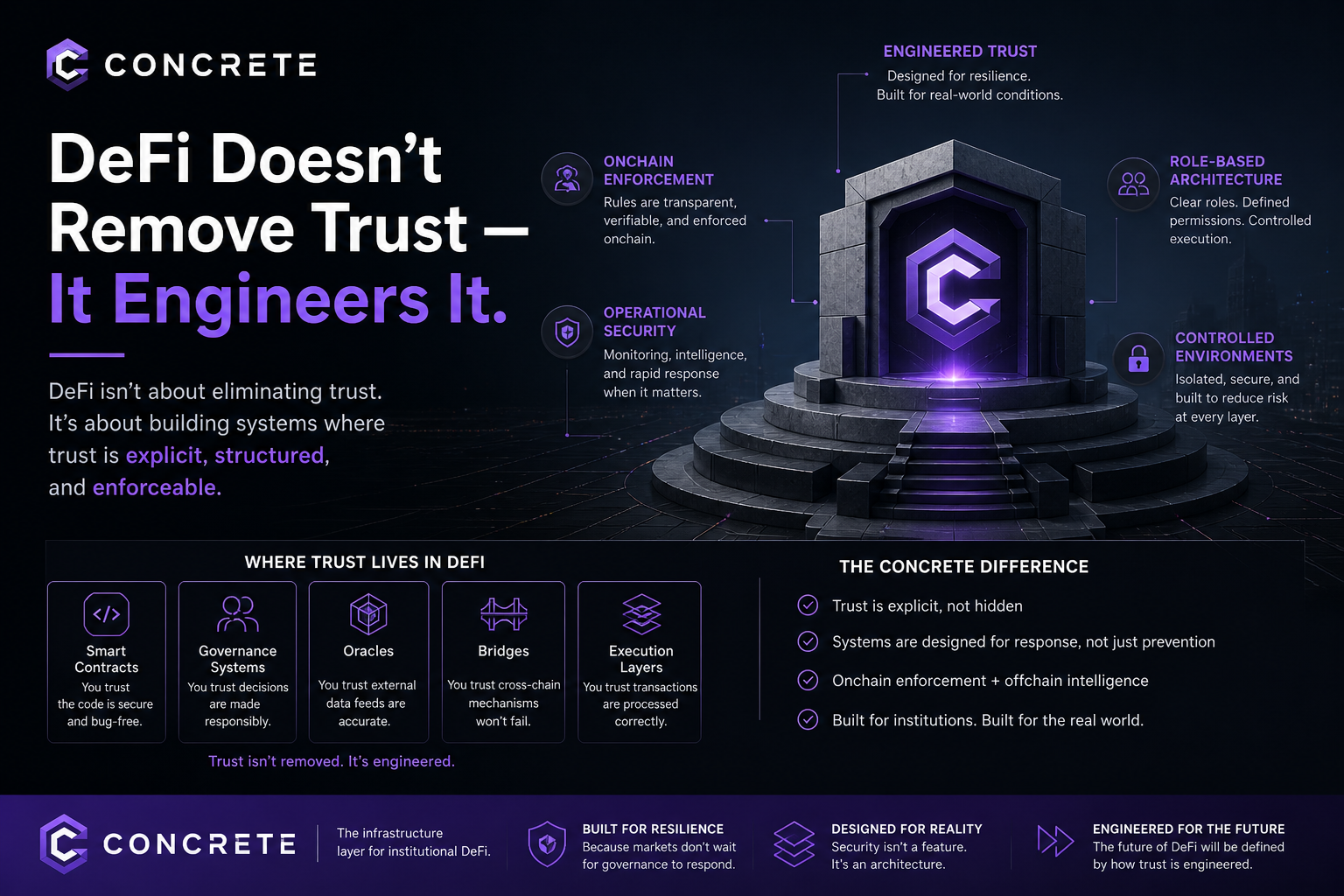
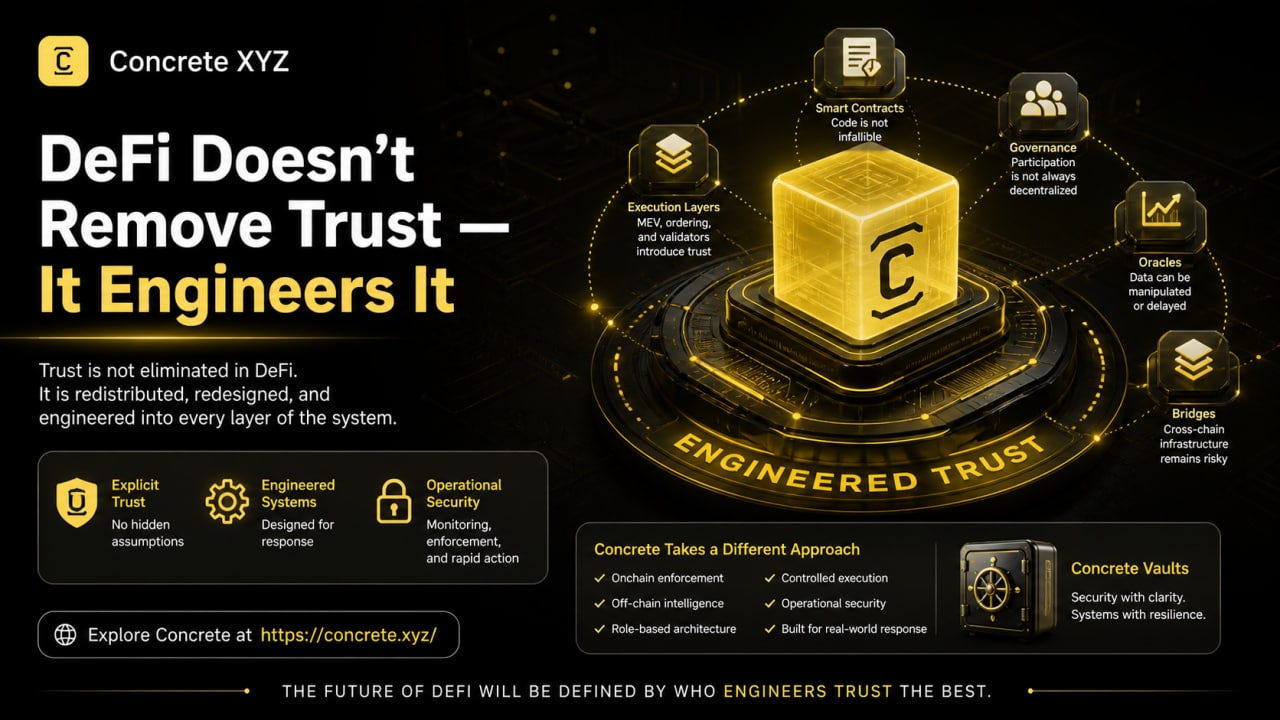
In modern DeFi infrastructure, trust is often abstracted away into layers that the average user rarely sees. These hidden dependencies include:
- Smart Contract Assumptions: Trusting that the logic handles edge cases and lacks backdoors.
Oracle Dependencies: Trusting that external price feeds won’t be manipulated or lag during a crash. - Governance Decisions: Trusting that a small group of token holders (or a multisig) won’t prioritize their exit liquidity over protocol health.
- Bridge Security: Trusting that the "wrapped" asset on your chain is actually backed by collateral on another.
3. The Danger of "Decentralization Theatre"
For too long, the industry has settled for Decentralization Theatre—the appearance of being hands-off while hiding significant risks. We see DAOs with 2% participation making billion-dollar decisions, or "timelocks" that offer a false sense of security but cannot stop a flash-loan exploit in real-time.
When a system claims to be fully decentralized but lacks the tools to react during a crisis, it isn’t "pure"—it’s fragile. Actual safety requires more than just an ideological stance; it requires resilience.
4. Moving Toward Engineered Trust??
If we want Institutional DeFi to scale, we must move toward Engineered Trust. This means recognizing that trust is a design element. Instead of pretending it isn’t there, we must make it:
- Explicit: Defining exactly who has permission to do what.
- Structured: Creating roles and responsibilities within the protocol.
- Enforceable: Using code to set hard boundaries on what is possible
Mature financial systems don’t work because they are "trustless"; they work because trust is meticulously engineered through layers of redundant protections.
5. Operational Security: Beyond the Code
Code alone cannot handle every "black swan" event. Real-world DeFi security requires Operational Security (OpSec) — the fusion of automated monitoring, rapid response mechanisms, and structured human judgment for edge cases. A protocol that cannot defend itself in the seconds following an anomaly isn’t a breakthrough; it’s a liability.
6. How Concrete Engineers the Future
This is where Concrete changes the narrative. While others hide behind the "trustless" label, Concrete prioritizes transparency and operational excellence.
Concrete understands that the next phase of DeFi requires infrastructure that behaves predictably under stress. Our approach to Concrete Vaults and credit markets is built on several key pillars:
- Explicit Trust: We don’t hide behind complex jargon. The rules of engagement are clear and role-based.
- On-chain Enforcement + Off-chain Intelligence: By combining the immutable speed of the blockchain with sophisticated, real-time monitoring, Concrete ensures that the system can react to market shifts before they become catastrophes.
- Controlled Execution Environments: We move away from the "chaos-monkey" style of open DeFi toward a structured architecture where risk is siloed and managed.
At Concrete, we choose operational security over decentralization theatre, ensuring that capital is protected by design, not just by hope.
7. The Bigger Shift: Resilience Over Ideology
The industry is hitting a turning point. We are moving beyond the era of "trustless" slogans and into an era of Engineered Trust.
The future of finance won’t be defined by who claims to remove trust the most loudly. It will be defined by the infrastructure that manages it most effectively. Infrastructure will be judged not by its ideological purity, but by its resilience under pressure.
Explore the future of engineered trust and Concrete at https://concrete.xyz/
thanks guys have nice days , and keep building Concrete ◉‿’c🙏🙏🏻🗿