DeFi Doesn’t Remove Trust — It Engineers It.
 Na3 min read·Just now
--
DeFi Doesn’t Eliminate Trust — It Reconstructs It
DeFi started with a compelling narrative:
“Remove human trust. Replace it with code.”
At first glance, it looked like a breakthrough. Smart contracts execute deterministically. Protocols present themselves as neutral. Middlemen disappear.
But that framing doesn’t survive contact with reality.
As the ecosystem evolved, a more accurate picture emerged:
Trust never left the system, it was redistributed.
And in many cases, it became less visible, not less important.
The Problem With “Trustless” as a Concept
“Trustless” is one of the most repeated ideas in DeFi and also one of the least examined.
You’ll hear:
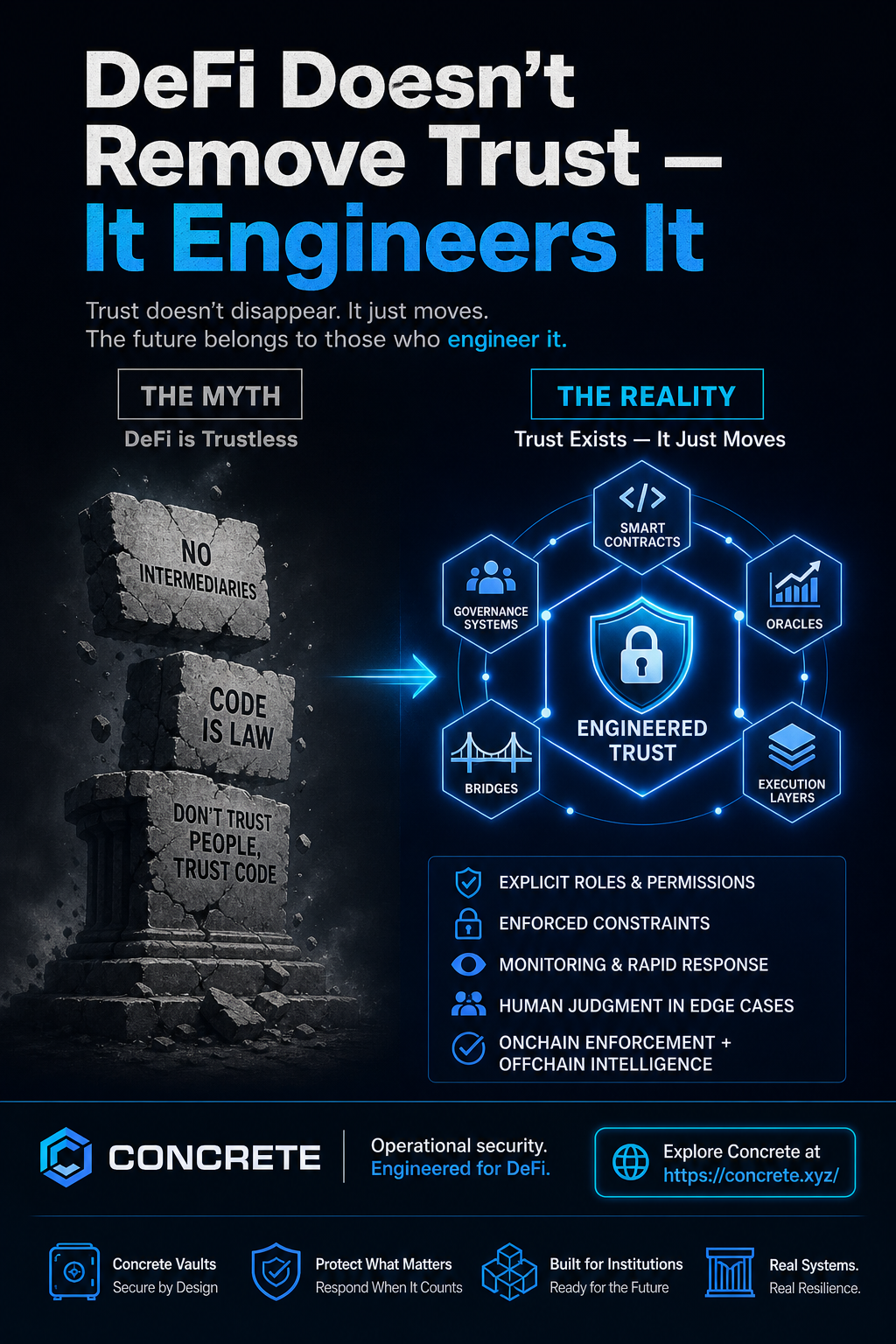
- “Code is law”
- “No intermediaries”
- “Fully decentralized”
These statements aren’t entirely wrong. They’re incomplete.
No system operates without assumptions. Every protocol, regardless of design quality, relies on dependencies that require trust at some level.
So the real question is not:
“Is this trustless?”
But rather:
“Where does trust exist and is it transparent?”
How Trust Is Distributed in DeFi Systems
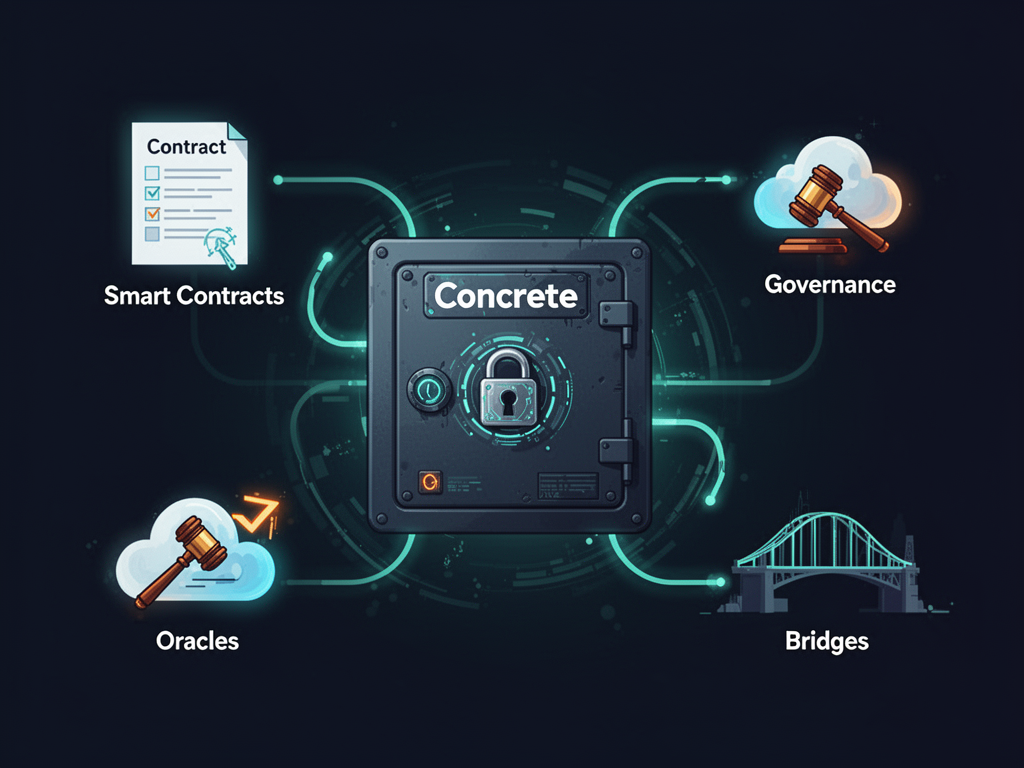
Interacting with DeFi doesn’t remove trust. It fragments it across multiple layers:
Smart Contracts
You assume the code is secure, audited, and behaves as intended. But audits reduce risk they don’t eliminate it.
Governance
You assume token holders will act in the system’s long-term interest. That assumption weakens when voting power is concentrated or participation is low.
Oracles
You rely on external data being accurate and manipulation-resistant. In practice, this is one of the most exploited surfaces.
Cross-Chain Bridges
You depend on infrastructure to correctly validate and transfer assets between chains. Historically, this layer has repeatedly failed.
Execution Layer
You assume validators or sequencers will include and order transactions fairly, which is not always guaranteed.
This isn’t trustless. It’s modularized trust.
When Decentralization Becomes Performance
There’s a growing gap between how systems present themselves and how they actually behave.
Call it “decentralization as optics.”
Examples:
- Multisigs → Marketed as distributed control, but often concentrated among a small group
- DAOs → Exist in structure, but not always in active governance
- Timelocks → Provide delay, not necessarily protection
- Rigid architectures → Too “decentralized” to respond quickly in crisis situations
These elements create confidence signals, but not necessarily real resilience.
Decentralization alone does not equal security.
The Shift Toward Designed Trust
If trust cannot be removed, the only viable path forward is to design it intentionally.
This is where engineered trust becomes relevant.
Instead of hiding trust assumptions, engineered systems:
- Define roles explicitly
- Limit what each actor can do
- Enforce constraints at the system level
- Include mechanisms for intervention and recovery
Traditional finance has always operated this way. Not by eliminating trust, but by structuring and controlling it.
DeFi is now moving toward the same realization.
Why Code Alone Is Not Sufficient
Smart contracts are static by nature. Markets are not.
That mismatch creates risk.
Real systems require:
- Continuous monitoring
- The ability to react quickly
- Human oversight in edge cases
- Multiple layers of defense
No deployment can anticipate every failure mode. Black swan events, exploits, and unexpected behaviors are inevitable.
If a system cannot respond, it will eventually break.
Concrete: Making Trust Explicit
A different design philosophy is starting to emerge one that treats trust as something to expose and control, not hide.
Concrete takes this approach.
Instead of relying on assumptions, the system is built around:
- Explicit role definitions
- Controlled execution environments
- Observable system behavior
- Integration of onchain enforcement with offchain intelligence
The focus shifts from prevention-only models to response-capable systems.
Within this framework:
- Permissions are clearly structured
- Critical actions can be constrained or intercepted
- Systems are built with failure scenarios in mind
Concrete vaults, in this context, are not passive storage.
They are part of a broader operational security layer, where behavior is not just defined, but enforced.
This represents a move away from ideology toward practical resilience.
Where DeFi Is Actually Heading
The next phase of DeFi won’t be defined by who claims to eliminate trust.
It will be defined by who manages it most effectively.
That requires:
- Accepting that trust is unavoidable
- Making it visible and auditable
- Designing for stress conditions, not just ideal ones
- Prioritizing system survivability over narrative purity
Because ultimately, users don’t optimize for ideology.
They optimize for outcomes.
Does the system hold up under pressure or not?
That’s the only metric that matters.