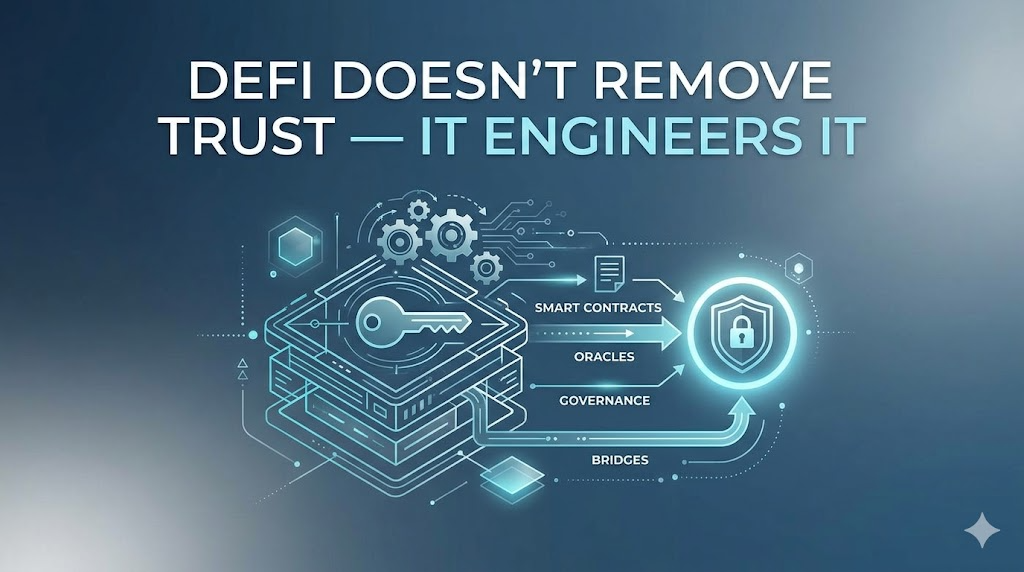
DeFi Doesn’t Remove Trust — It Engineers It
--
There is a founding myth in decentralized finance, and it goes something like this: remove the intermediary, deploy the contract, and you have eliminated trust from the equation entirely. The phrase "trustless" became a rallying cry — a technical descriptor that doubled as ideology. It implied that the old world of counterparty risk, institutional gatekeeping, and opaque financial machinery could be replaced by deterministic code and nothing else. Code is law. Math doesn't lie. No one can rug you if there's no one there.
This was always a useful simplification. But now, It is no longer a sufficient one.
The Myth of the Trustless System
To be fair to the people who built DeFi’s early architecture, the original framing wasn’t wrong so much as it was incomplete. What they correctly identified was that human discretion at the point of transaction was a vector for corruption, censorship, and extraction. A smart contract that executes identically regardless of who you are or what jurisdiction you inhabit is genuinely remarkable. It is not, however, trustless.
What "trustless" actually describes is the relocation of trust — from named intermediaries to a distributed set of assumptions. When you interact with a DeFi protocol, you are trusting the smart contract to have been written correctly. You are trusting the audit process to have been thorough. You are trusting the oracle feeding price data to be accurate and manipulation-resistant. You are trusting the governance system controlling the upgrade keys to behave in the interest of users rather than large token holders. You are trusting the bridge you used to move funds across chains to not be holding a multisig controlled by five pseudonymous individuals. You are trusting the execution layer itself — the sequencer, the validator set, the MEV infrastructure — to not extract value from your transaction in ways you cannot see.
None of these are trivial trust assumptions. Several of them have already failed catastrophically, on numerous occasions times, at scale. The trust didn’t disappear. It was abstracted, redistributed, and in many cases made harder to evaluate precisely because it was dressed up in the language of decentralization.
Where Trust Actually Lives
The architecture of trust in a modern DeFi protocol is layered and frequently invisible. Consider the oracle problem. A lending protocol that prices collateral using a single on-chain oracle is not trustless — it is dependent on whoever controls the price feed, and on the assumptions baked into how that feed is constructed and updated. The Mango Markets exploit in 2022 was not a code failure in the traditional sense. The contract executed exactly as written. The oracle was manipulated. The trust assumption — that market prices would not be artificially controlled — failed.
Governance presents a similar problem. Protocols that vest upgrade authority in a DAO are often described as decentralized. In practice, governance participation rates are frequently in the low single digits by token count, and concentrated holdings mean that proposals can pass with the support of a handful of wallets. Timelocks — the standard mitigation — delay execution but do not prevent it. A seven-day timelock on a malicious governance proposal is not a meaningful security guarantee for a protocol holding nine-figure TVL. It is a notice period.
Bridges, meanwhile, represent perhaps the clearest case of trust being hidden behind infrastructure branding. The Ronin bridge, which lost over $600 million in 2022, was secured by nine validator keys — five of which were sufficient to authorize withdrawals. The keys were compromised. The trust model was, in effect, a 5-of-9 multisig managed by a gaming studio. This is not decentralized security. It is centralized security wearing a decentralized label.
What these failures share is not malicious design — most of these systems were built by competent, well-intentioned engineers. What they share is the gap between apparent decentralization and operational resilience. The appearance was prioritized. The architecture of trust was not made explicit, and so it could not be properly managed.
The Problem With Decentralization Theatre
I want to be precise about what I mean by decentralization theatre, because the term can read as cynical in a way I don’t intend. I am not suggesting that decentralization is a fraud or that it provides no value. I am suggesting that the performance of decentralization — the presence of a DAO, the existence of a timelock, the distribution of tokens to a broad holder base — does not automatically produce resilient systems. These mechanisms can provide genuine safety guarantees. They can also provide the cosmetic appearance of safety while the actual trust surface remains concentrated and unexamined.
The more technically precise framing is this: decentralization is a property of decision-making distribution, not of operational safety. A system can be maximally decentralized in its governance and still be catastrophically vulnerable if its oracle is a single point of failure, if its smart contract contains an unaudited reentrancy vector, or if its emergency response capabilities are limited to wait for governance to pass a proposal. Decentralization and resilience are related but distinct properties. The DeFi industry has historically optimized for the former while underweighting the latter.
The consequence is that a significant portion of existing DeFi infrastructure cannot respond proportionally to failure events in real time. When an exploit begins, the protocol's only options are often to do nothing, or to trigger a pause function controlled by a multisig whose keyholders may be in different time zones, asleep, or unable to coordinate in the minutes that determine whether a loss is contained or total.
This is the core problem with treating decentralization as a terminal goal rather than a design constraint. Mature financial infrastructure is not characterized by the *absence* of decision-making — it is characterized by decision-making that is clearly assigned, appropriately authorized, and capable of executing under pressure.
Engineered Trust as Infrastructure Design
The reframe that I think is necessary — and that the more serious corners of the industry are beginning to adopt — is moving from removing trust to engineering trust. These are not semantically equivalent. Removing trust is a goal that cannot be fully achieved and, pursued too literally, produces systems that are brittle precisely in the moments when they need to be robust. Engineering trust means acknowledging that trust assumptions are unavoidable, making them legible, assigning them to accountable components, and designing systems that behave predictably when those assumptions are tested.
Engineered trust has identifiable structural properties. It involves clear delineation of roles and permissions — who can do what, under what conditions, subject to what constraints. It involves on-chain enforcement of those constraints, so that the rules are not merely policy but code. It involves layered security: prevention as the first line, detection as the second, and response capability as the third. It involves the recognition that human judgment is not an impurity to be eliminated from a financial system but a necessary component of any system sophisticated enough to handle edge cases that were not anticipated at deployment.
This is how institutional finance has always operated. Not by removing discretion, but by structuring it — by building systems in which the right people have the right authorities at the right moments, with sufficient constraints to prevent abuse and sufficient flexibility to respond to novel conditions. DeFi's next phase will be defined by how well it learns this lesson.
What Concrete Actually Does Differently
I've used Concrete's vaults, and the design philosophy is apparent at the infrastructure level in ways that are worth articulating precisely rather than gesturally.
The core distinction is that Concrete treats operational security not as an add-on to financial infrastructure but as a primary architectural concern. The trust model is explicit by design. Rather than abstracting away the question of who can do what, Concrete builds that question into the system — role-based architecture that defines permissions granularly, controlled execution environments that constrain what actions are possible at each layer, and on-chain enforcement mechanisms that make the rules legible and auditable rather than implicit and assumed.
This matters particularly in the context of yield infrastructure, where the complexity of underlying strategies — allocating across multiple protocols, rebalancing positions, managing exposure to oracles and liquidity conditions — creates a large operational surface. The Concrete model incorporates both on-chain enforcement and off-chain intelligence: monitoring systems capable of detecting anomalous conditions, and response mechanisms that can act within the timeframes that matter during a live exploit or market stress event. This is not decentralization theatre. It is the acknowledgment that a system holding institutional-scale assets needs to be able to respond to the world as it actually behaves, not merely as it was modeled at deployment.
The audit stack — Cantina, Code4rena, Halborn, Zellic, Hypernative, ZeroShadow — reflects the same orientation. Security is treated as a continuous property, not a one-time certification. The combination of pre-deployment auditing, real-time monitoring through partners like Hypernative, and architectural constraints on execution reflects a layered security model that matches the complexity of the trust surface it is managing.
What Concrete's vaults offer, in the language I've been using throughout this piece, is yield infrastructure in which the trust assumptions are engineered rather than hidden. You know what the system can do, what it cannot do, who can authorize changes, and under what conditions. That legibility is not a cosmetic feature. It is the structural property that makes institutional participation possible, because institutional capital cannot enter systems whose risk profile cannot be formally characterized.
The Next Phase of DeFi
The trustless narrative served its purpose. It established the conceptual independence of on-chain finance from the intermediary-dependent structures of traditional finance, and it attracted the builders and capital that made the space real. But it has outlived its usefulness as a design philosophy, and in some contexts it has become actively counterproductive — providing ideological cover for infrastructure that is not as robust as its decentralization aesthetic implies.
The next phase will be characterized by something harder and more interesting: the serious engineering of trust. This means systems whose assumptions are legible, whose roles are defined, whose permissions are enforced on-chain, and whose response capabilities match the speed and complexity of the environments in which they operate. It means acknowledging that resilience — the ability to fail gracefully, to detect anomalies, to respond to conditions that were not anticipated — is at least as important as decentralization, and possibly more so for the class of infrastructure that is going to hold meaningful amounts of institutional and retail capital over the long term.
DeFi will not be judged by how effectively it claimed to remove trust. It will be judged by how well it engineered it — and by whether the systems built on that engineering held up when the conditions that test them finally arrived.
The infrastructure that survives the next decade will be the infrastructure that answered that question honestly from the beginning.
Explore Concrete at [https://concrete.xyz/](https://concrete.xyz/)