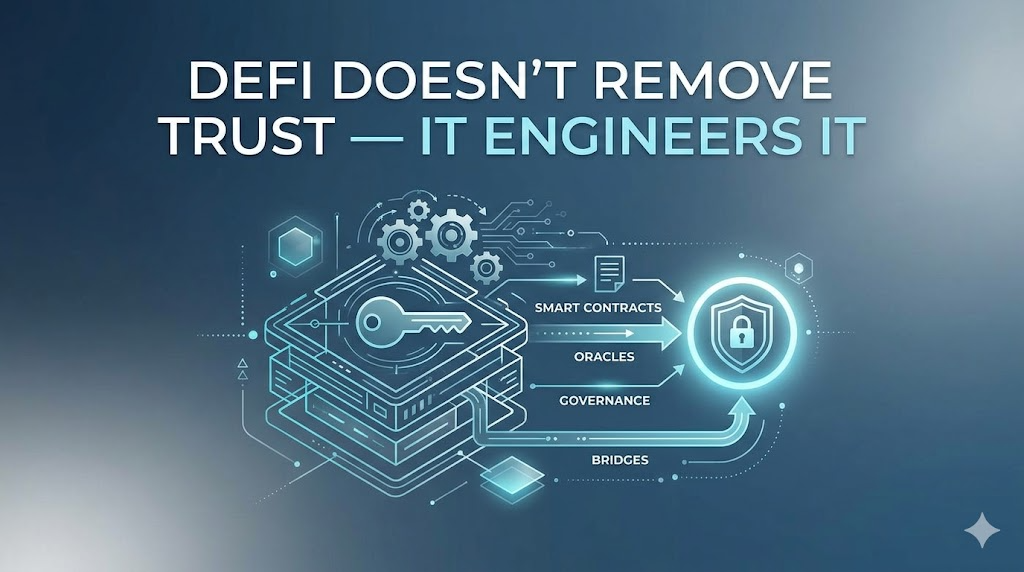
DeFi Doesn’t Remove Trust — It Engineers It
--
For years, the rallying cry of the decentralized world has been simple: “Trustless.” We are told that in Decentralized Finance (DeFi), intermediaries are obsolete, “Code is Law,” and the need for human trust has been completely eradicated by the blockchain.
But as the industry matures in 2026, we are forced to confront a more nuanced reality. No financial system is truly trustless. The tension lies in the fact that trust hasn’t disappeared; it has merely shifted. The question facing the next generation of institutional DeFi isn’t whether trust exists — it’s where that trust lives and how effectively it is managed.
The Hidden Layers: Where Trust Actually Lives
When a user interacts with a “trustless” system, they are actually placing a massive amount of implicit trust in several abstracted layers:
- Smart Contract Assumptions: You trust that the code is bug-free and that the logic won’t fail under extreme market conditions.
- Governance Decisions: You trust that a handful of large token holders won’t vote in favor of a proposal that compromises the protocol’s safety.
- Oracle Dependencies: You trust that off-chain data feeds provide accurate prices and cannot be manipulated.
- Execution Layers: You trust that the underlying network will remain liveness-persistent and that transactions will be processed fairly.
Trust in DeFi is often abstracted away behind a UI, but it is never eliminated. It is baked into the very DeFi infrastructure we use daily.
The Problem With “Decentralization Theatre”
The industry has long suffered from “Decentralization Theatre” — systems that appear decentralized on the surface but lack true resilience.
We see protocols governed by multisigs that act as a proxy for security, or DAOs with such low participation that a minority can dictate the fate of the majority. Timelocks may delay a malicious change, but they don’t prevent the underlying risk. These systems often fail during critical moments because they lack a structured way to react to black swan events.
There is a vast difference between the appearance of decentralization and the actual safety of a protocol.
Introducing Engineered Trust
The shift from “trustless” to engineered trust marks the transition of DeFi into a mature financial ecosystem. Trust shouldn’t be a mystery; it should be designed. Engineered trust means moving away from blind faith in code and toward a model defined by:
- Clear Roles and Responsibilities: Knowing exactly who (or what) is responsible for specific actions.
- Defined Permissions: Restricting what accounts or agents can do within the system.
- Enforced Constraints: Using onchain enforcement to ensure that even if a participant acts maliciously, the damage is mathematically capped.
- Response Mechanisms: Systems that don’t just hope for the best but are designed to respond to failure in real-time.
Operational Security: Beyond the Code
Code alone cannot handle every edge case. Real-world systems require operational security that includes active monitoring and the ability to apply human judgment when algorithms encounter “unknown unknowns.”
A resilient system requires layered security — a combination of immutable code and rapid response mechanisms that can pause, pivot, or protect capital during a crisis.
How Concrete Engineers Trust
Concrete takes a fundamentally different approach to this problem. We prioritize transparency and operational resilience over the slogans of the past. In the Concrete ecosystem:
- Trust is Explicit: We don’t hide the layers of trust; we structure them through a role-based architecture.
- Designed for Response: Concrete systems are built for response, not just prevention. Through our Hook Manager, we can enforce risk parameters on-chain in real-time.
- Hybrid Intelligence: We combine the ironclad nature of on-chain enforcement with sophisticated off-chain intelligence to monitor market health.
- Controlled Execution: Concrete vaults operate in controlled environments where every action is mapped against a strategy manager and risk enforcement hooks.
By making trust structured and enforceable, Concrete offers a level of safety that “Decentralization Theatre” simply cannot match.
The Bigger Shift: Resilience Over Ideology
DeFi is moving beyond the “trustless” narrative. The future of the industry will be defined by infrastructure that acknowledges the necessity of trust and seeks to engineer it with precision.
In 2026, the resilience of a protocol under stress matters more than its ideological purity. Infrastructure will no longer be judged by how many intermediaries it claims to remove, but by how it behaves when the market turns.
The future of DeFi won’t be defined by who claims to remove trust — it will be defined by who engineers it best.
Experience the next level of engineered trust.
Explore Concrete at https://concrete.xyz/