DeFi After the Hype: Building Strategies That Don’t Expire
 Ermabuchanan4 min read·Just now
--
There’s a moment in every DeFi cycle where everything feels easy.
Dashboards are green. Yields look absurdly high. New opportunities seem endless. Capital moves fast, almost instinctively, toward whatever promises the biggest return.
And then — quietly at first — things begin to shift.
The yields soften. Liquidity thins out. The same strategy that looked dominant a week ago starts to feel fragile. Soon after, attention moves elsewhere, chasing a new narrative.
If you zoom out, this isn’t chaos. It’s a pattern.
Which leads to a more important question than “what’s trending right now”:
What actually survives in DeFi once the momentum fades?
A Market Built on Rotation
DeFi doesn’t stand still — it rotates.
Capital is constantly searching for efficiency, and that creates a repeating structure:
- Incentives attract early liquidity
- Returns spike due to limited participation
- More users enter, compressing yields
- Rewards decline or become less attractive
- Capital exits and reallocates
This cycle is not inherently negative. It’s how experimentation happens in an open financial system.
But it also explains why so many strategies feel temporary. They’re designed to capture attention — not to endure pressure.
Rethinking Sustainability in DeFi
Sustainability is often misunderstood.
It doesn’t mean “safe” or “low risk.” It means a strategy has the ability to keep functioning even when external conditions change.
A sustainable approach to yield typically:
- Produces repeatable returns, not just one-off spikes
- Doesn’t collapse when incentives are reduced
- Maintains relevance across different market phases
This is where the idea of risk-adjusted yield becomes critical.
Because earning 50% for a week and losing consistency afterward is very different from earning 8% steadily for a year.
One is exciting. The other is usable.
Where Yield Really Comes From
To understand durability, you have to look beneath the surface.
Some yields are built on activity:
- Users trading on DEXs
- Borrowers paying interest
- Markets creating arbitrage inefficiencies
Others are built on distribution:
- Token emissions
- Liquidity incentives
- Growth subsidies
The difference is subtle — but powerful.
Activity-based yield exists because users are doing something valuable. As long as that behavior continues, the yield has a reason to exist.
Incentive-based yield exists because it is being paid for. When the payments slow down, so does the opportunity.
This is why many high-APY strategies feel like they “expire.” Because structurally, they were never meant to last.
The Environment Shapes the Outcome
Even the best-designed strategy can fail in the wrong environment.
Sustainability depends on external conditions such as:
- Depth of liquidity — thin markets amplify risk
- User demand — no usage means no yield
- Volatility levels — too much or too little can break certain models
- Capital behavior — fast-moving liquidity changes everything
Some strategies are highly sensitive — they perform only under perfect conditions.
Others are resilient — they adapt as conditions evolve.
The latter is where long-term capital tends to settle.
The Quiet Impact of Friction
One of the biggest gaps between theory and reality in DeFi is cost.
Not visible at first glance, but always present:
- Execution fees that accumulate over time
- Slippage during trades
- Inefficiencies from constant rebalancing
- Changing relationships between assets
Individually, these seem small. Collectively, they reshape outcomes.
A strategy that advertises strong returns may deliver far less once these frictions are included. That’s why experienced participants prioritize net yield, not headline numbers.
Designing for Longevity, Not Moments
As DeFi evolves, strategy design is becoming more intentional.
Instead of chasing isolated opportunities, sustainable systems are built with structure:
- Spreading capital across multiple yield sources
- Continuously adjusting allocations
- Monitoring performance in real time
- Prioritizing stability over spikes
This is the foundation of managed DeFi — where strategies are not static, but actively maintained.
It’s a shift from reacting to the market… to working with it.
Where Concrete Vaults Fit In
This mindset is reflected in how Concrete vaults approach yield.
Rather than optimizing for the highest short-term returns, they focus on building strategies that can persist.
That includes:
- Selecting yield sources tied to real onchain activity
- Allocating capital dynamically across opportunities
- Reducing dependency on temporary incentives
- Continuously adapting to market conditions
The goal isn’t to win the current cycle — it’s to remain effective across many of them.
A Closer Look: Concrete DeFi USDT
A practical example of this philosophy is Concrete DeFi USDT.
Instead of chasing volatile, high-risk strategies, it targets a more stable return profile — around ~8.5%.
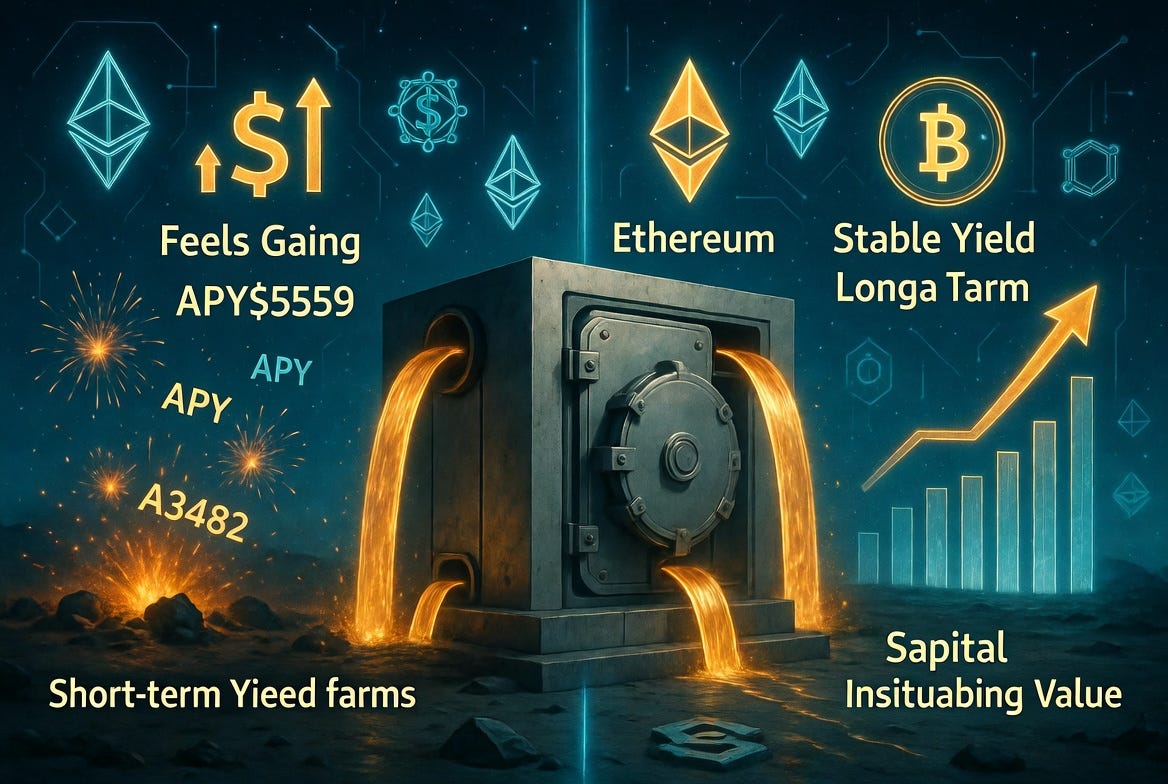
At first, that may not seem impressive compared to triple-digit APYs.
But over time, consistency becomes a competitive advantage:
- Less exposure to sudden drawdowns
- More predictable performance
- Greater appeal to long-term, onchain capital
This is where DeFi begins to intersect with institutional DeFi — favoring reliability over hype.
The Direction of the Market
DeFi is maturing.
The conversation is slowly shifting:
- From “how high can yields go?”
- To “how long can yields last?”
From chasing incentives…
To building infrastructure.
From temporary opportunities…
To durable systems.
In this new phase, sustainability is not optional — it’s foundational.
Closing Thought
The highest APY will always attract attention.
But attention doesn’t build longevity.
The strategies that define the next phase of DeFi will be the ones that continue working — quietly, consistently, and reliably — long after the hype moves on.
Explore Concrete at: https://app.concrete.xyz/earn