Crypto Exchange vs Crypto Wallet: Understanding the Key Differences and Choosing the Right Setup
 ARMUP4 min read·Just now
--
Introduction
The crypto industry has grown rapidly, with global users surpassing 560 million. While getting started is easier than ever, many users still struggle with one fundamental question: how to manage digital assets securely.
At the center of this confusion are two essential tools — crypto exchanges and crypto wallets. Although they are closely related, they serve entirely different purposes. Misunderstanding how they work can lead to weak security practices, reduced control over assets, or even financial loss.
In simple terms, a crypto exchange is used to buy, sell, and trade digital assets, while a crypto wallet is used to store and manage access to those assets.
This guide explains how crypto exchanges work, what crypto wallets do, the differences between them, and how to choose the right combination based on your needs. As the industry evolves, platforms like ARMUP are simplifying this experience by combining trading functionality with advanced security frameworks.
What Is a Crypto Exchange?
A crypto exchange is an online marketplace platform that enables buying, selling, and trading of cryptocurrencies. It acts as a marketplace where transactions take place between buyers and sellers.
How Does a Crypto Exchange Work?
Crypto exchanges operate through an order-matching system. When a user places a buy or sell order, the platform matches it with a corresponding order and executes the trade.
Crypto exchanges offer multiple features including fiat on-ramps, allowing users to convert traditional currency into crypto. This makes exchanges the primary entry point for beginners.
Types of Crypto Exchanges
Centralized Exchanges (CEX):
These platforms act as intermediaries, handling transactions, asset custody, and liquidity. They are user-friendly and widely used but require trust in the platform.
Decentralized Exchanges (DEX):
DEX platforms operate without intermediaries, allowing peer-to-peer trading through smart contracts. They offer more control but can be complex and less liquid.
Crypto exchanges are widely preferred for their accessibility, liquidity, and advanced trading tools. However, storing large amounts of crypto exchanges for long periods can expose users to risks.
What Is a Crypto Wallet?
A crypto wallet is a tool that allows users to store and manage access to their digital assets. Instead of holding the assets themselves, wallets store private keys that provide access to funds on the blockchain.
Losing a private key means losing access to your assets permanently, making security critical.
Types of Crypto Wallets
Hot Wallets:
Online wallets available as mobile apps, desktop software, or browser extensions. They are convenient but more exposed to risks.
Cold Wallets:
Offline hardware devices designed for maximum security. Ideal for long-term storage.
Custodial Wallets:
Managed by third parties such as exchanges. Users do not control their private keys.
Non-Custodial Wallets:
Users have full control over their private keys and assets. This offers greater security but requires responsibility.
It’s important to note that while all cold wallets are non-custodial, not all non-custodial wallets are cold wallets.
How Crypto Wallets Work
Crypto wallets interact with blockchain networks using a public address and a private key.
The public address acts like an account number, allowing users to receive assets. The private key is used to sign transactions, confirming ownership and enabling transfers.
Wallets are essential for users who prioritize long-term storage, security, and full control over their assets.
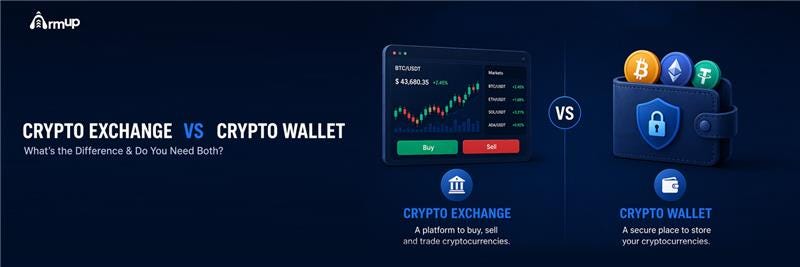
Crypto Exchange vs Crypto Wallet: Key Differences
Crypto exchanges and wallets serve different roles in the ecosystem, primarily differing in purpose, control, and risk exposure.
Crypto exchanges are built for accessibility and trading. They provide users with easy entry into the market, high liquidity, and fast transaction execution. Features like order matching, fiat on-ramps, and integrated trading tools make exchanges convenient, especially for beginners and active traders. However, since most exchanges are custodial, users rely on the platform to manage and secure their assets.
Crypto wallets, on the other hand, are designed for ownership and security. They allow users to store and manage access to their digital assets through private keys. Non-custodial wallets give users full control, reducing dependency on third parties, and lowering exposure to exchange-related risks. At the same time, this control comes with responsibility, as losing access credentials can result in permanent loss of assets.
In essence, exchanges are ideal for participating in the market and executing trades efficiently, while wallets are better suited for safeguarding assets and maintaining long-term control.
Do You Need Both?
In most cases, yes.
A typical crypto journey involves buying assets on an exchange and then transferring them to a wallet for secure storage. This approach balances convenience and control.
Frequent traders may prefer keeping funds on exchanges for quick transactions, while long-term investors usually move assets to wallets to reduce risk exposure.
Your choice depends on your goals, trading frequency, and risk tolerance.
The Shift Toward Integrated Platforms
As the crypto industry matures, newer platforms are addressing the gap between exchanges and wallets.
Platforms like ARMUP combine trading functionality with self-custody infrastructure, enabling users to trade while maintaining control over their assets.
With features such as MPC wallet technology, structured access controls, and real-time monitoring, ARMUP provides a more balanced approach — offering both convenience and security within a single ecosystem.
This evolution reflects a broader shift in the industry toward solutions that reduce complexity without compromising control.
Conclusion
Understanding the difference between a crypto exchange and a crypto wallet is essential for managing digital assets effectively.
Exchanges provide accessibility, liquidity, and ease of trading, while wallets ensure control, ownership, and long-term security.
Rather than choosing one over the other, users should define their goals and use both strategically.
As the ecosystem continues to evolve, platforms like ARMUP are making it easier to manage crypto assets by combining usability with strong security, helping users navigate the space with greater confidence