Consumer Crypto UX Breakthrough
--
For years, Web3 lost the UX war.
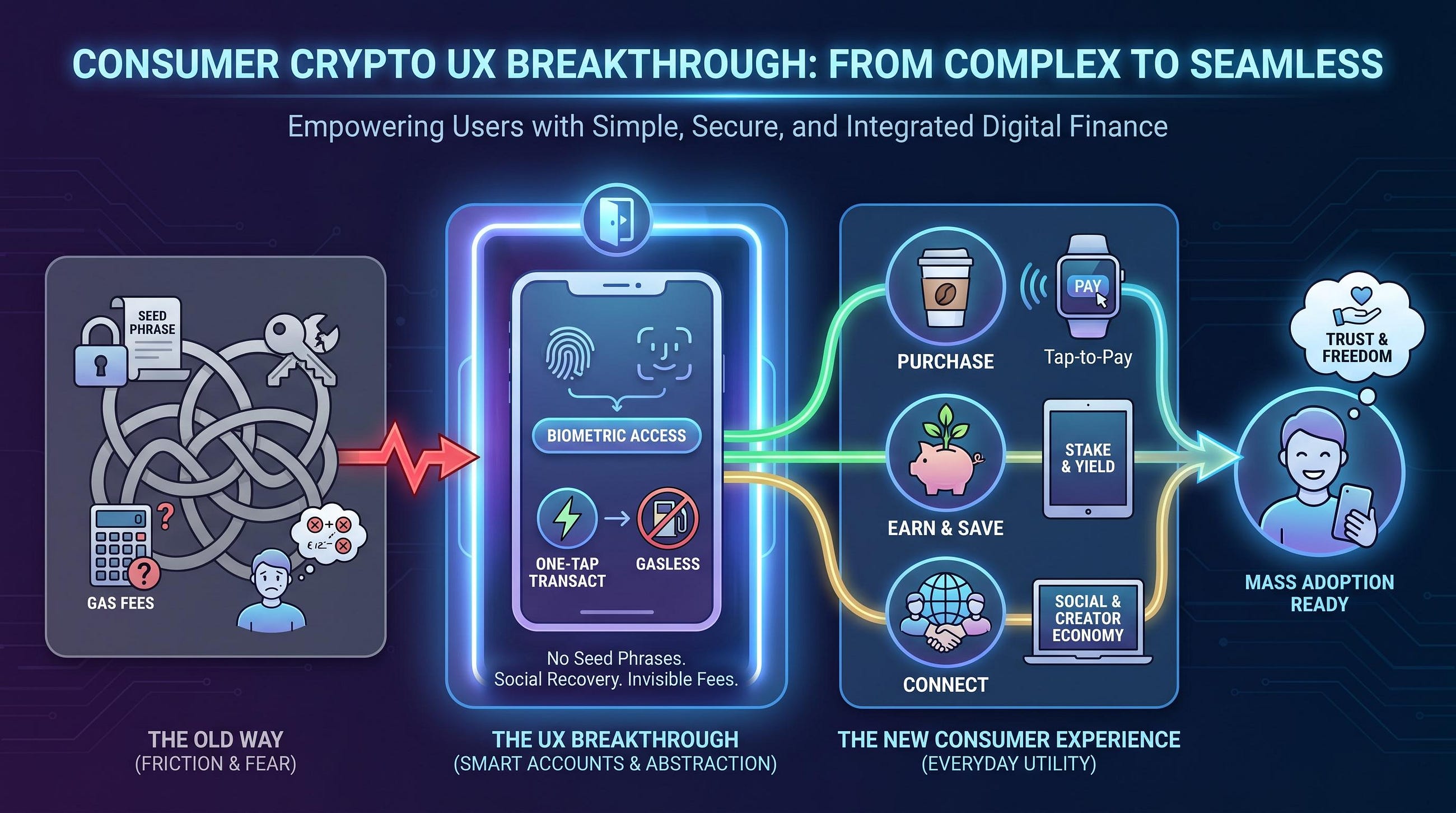
Not because the tech was weak — but because onboarding felt like punishment. Seed phrases, gas fees, wallet confusion, network switching… users didn’t leave Web2 apps. They ran away from Web3 ones.
That’s now changing faster than most founders realize.
We’re entering a phase where consumer crypto apps are starting to feel simpler, faster, and more intuitive than traditional Web2 products — especially in payments, identity, gaming, and social apps.
And this shift is not theoretical. It’s already happening in production apps shipping today.
The Problem: Web3 Lost Users at the First 30 Seconds
Let’s be honest about what broke Web3 UX:
- Wallet setup before value delivery
- Seed phrases that users are forced to “secure” without context
- Confusing gas fee mechanics
- Multi-chain complexity exposed to end users
- Signing transactions without understanding outcomes
Web2 won because it optimized for one thing: instant value.
Instagram doesn’t ask you to understand databases before posting a photo. Uber doesn’t explain routing algorithms before booking a ride.
Web3, until recently, did exactly that — it made users understand infrastructure before experience.
That mismatch killed adoption at scale.
The Shift: Web3 UX Is Now Hiding Complexity (Correctly This Time)
The breakthrough isn’t “better blockchain.”
It’s better abstraction layers.
Modern consumer crypto apps are finally doing what great systems always do:
They hide infrastructure completely unless absolutely necessary.
Key improvements driving this shift:
- Embedded wallets instead of external wallet installs
- Account abstraction removing seed phrase dependency
- Gas sponsorship (users don’t see fees at all)
- Social login replacing crypto-native onboarding
- Intents-based UX instead of transaction-level UX
In simple terms:
Users are no longer interacting with blockchain. They’re interacting with outcomes.
That is the moment Web3 UX starts beating Web2 UX in specific categories.
Why This Matters for Founders
If you’re building today, the opportunity is not “build on-chain.”
The opportunity is:
Build consumer apps where blockchain is invisible, but ownership is native.
This unlocks entirely new categories:
- Social apps with portable identity
- Gaming economies with real asset ownership
- Fintech apps with programmable money flows
- Creator platforms with direct value distribution
Most importantly, you’re no longer competing with “crypto apps.”
You’re competing with Web2 incumbents on UX — and Web3 on capability.
Step-by-Step Breakdown: How Winning Consumer Crypto Apps Are Built
1. Start With the User Journey, Not the Wallet
Bad approach:
- “User needs a wallet → then onboarding”
Good approach:
- “User wants to perform action → wallet is created invisibly”
Wallet becomes infrastructure, not a product decision.
2. Replace Transactions With Intents
Instead of:
- “Approve transaction”
- “Sign gas fee”
You design:
- “Buy item”
- “Join game”
- “Send money”
The system figures out execution.
This is the biggest UX leap in Web3.
3. Eliminate Friction Through Embedded Infrastructure
Modern stacks now include:
- Embedded wallets
- Passkeys / social login
- Gas sponsorship systems
- Session-based approvals
Users should never ask:
“What chain am I on?”
They should only ask:
“What am I doing?”
4. Design for Recovery, Not Just Security
Seed phrases assumed users never make mistakes.
Modern systems assume they will.
So they include:
- Account recovery via email/social login
- Device-based re-authentication
- Multi-factor fallback mechanisms
Security is no longer user responsibility alone.
5. Optimize for “First Value in 10 Seconds”
The most important KPI for consumer crypto apps now is:
Time to first meaningful action
Not wallet creation. Not onboarding completion.
But:
- First trade
- First message
- First purchase
- First reward
If you can’t deliver value in under 10–15 seconds, you lose Web2 users.
Mistakes to Avoid (Where Most Founders Still Fail)
Even in 2026, many teams repeat old Web3 mistakes:
1. Building for crypto-native users first
You’ll cap your growth ceiling immediately.
2. Exposing blockchain terminology in UI
“Mint”, “gas”, “approve”, “bridge” — all unnecessary for end users.
3. Over-decentralizing early
Decentralization is a backend decision, not a UX requirement.
4. Treating wallets as the product
Wallet is plumbing. Experience is the product.
5. Ignoring onboarding psychology
Users don’t want to “learn Web3.” They want outcomes.
Cost & Timeline Reality (For Founders Planning Execution)
Building a modern consumer crypto app today is faster than most assume — if you abstract correctly.
MVP Timeline:
- 4–8 weeks for functional prototype
- 8–12 weeks for production-ready app
Core cost drivers:
- Wallet infrastructure integration
- Smart contract development (if needed)
- Frontend + UX abstraction layer
- Backend orchestration layer
Key insight:
Teams that use embedded wallet SDKs and account abstraction can reduce development time by 30–50% compared to traditional Web3 builds.
The real cost is not engineering — it’s UX design iteration.
The Bigger Shift: Web3 Is Becoming Invisible Infrastructure
This is the real milestone:
Web3 wins when users stop realizing they are using Web3.
Just like users don’t think about:
- HTTP when browsing websites
- SQL when using apps
- Cloud when streaming video
They will not think about blockchain when:
- Sending money
- Owning assets
- Playing games
- Signing identity proofs
That’s when consumer crypto becomes mainstream.
Conclusion: The UX War Is Finally Being Won
Web3 didn’t lose because it lacked vision.
It lost because it demanded too much cognitive load from users.
That era is ending.
The new winners in consumer crypto will be the teams that:
- Hide blockchain complexity completely
- Design for intent, not transactions
- Prioritize instant value delivery
- Treat UX as infrastructure, not decoration
And the opportunity window is still early — but closing fast.
If you’re building in this space, focus less on “how decentralized it is” and more on:
“How fast does a normal user understand value?”
Because that is where Web3 finally beats Web2.
If you’re building consumer crypto products and want to design systems that scale beyond crypto-native users, DevQuaters is actively working with founders on architecture, UX abstraction, and product strategy to ship production-grade Web3 apps faster.