Conditional Settlement Finality: Why Modern Payments Are Never Truly Final
--
Real-time payments created the illusion of immediate certainty. Modern compliance systems quietly removed it.
When people send money through a modern payment system, they usually assume something very simple:
the transaction is finished.
The payment was executed, the balance changed, the confirmation appeared on the screen. From the user’s perspective, the process is complete.
Modern finance reinforces this perception everywhere. Banks advertise instant transfers. Fintech companies promise real-time settlement. Stablecoin projects speak about immutable transactions and irreversible execution.
But this understanding is no longer structurally correct.
In regulated financial systems, execution and finality are no longer the same thing.
A transaction can be technically completed while remaining economically and regulatorily unresolved.
This distinction has become increasingly important as payment systems accelerated. Ironically, the faster financial infrastructure became, the less meaningful the moment of execution actually became.
The Hidden Separation Inside Modern Payment Systems
Most people think of a payment as a single event.
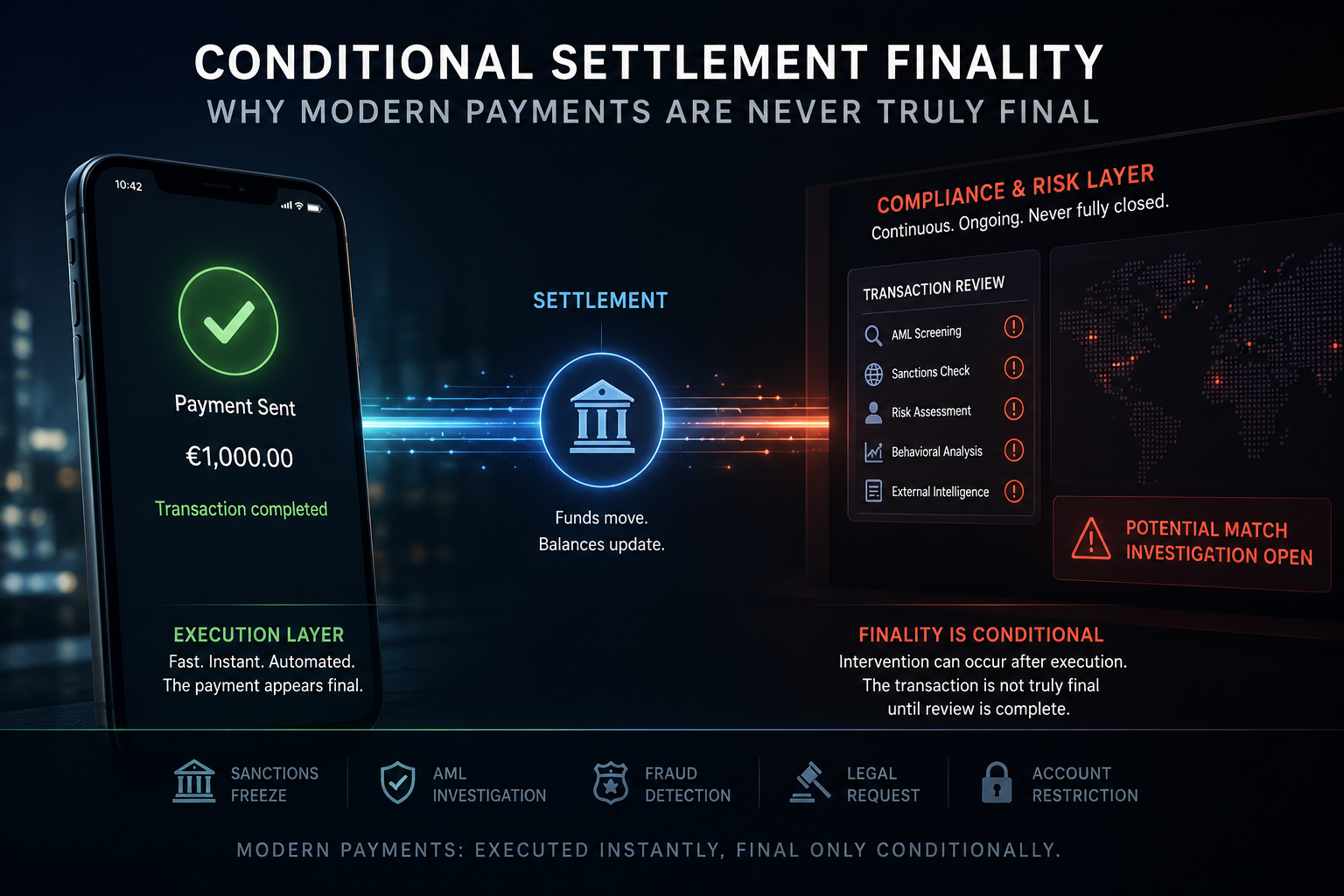
In reality, modern financial systems operate through multiple overlapping layers.
One layer executes the transfer itself:
- balances are updated,
- messages are transmitted,
- accounts reflect the new state.
Another layer evaluates the transaction from a regulatory perspective:
- anti-money laundering controls,
- sanctions screening,
- fraud detection,
- transaction monitoring,
- suspicious activity analysis.
Historically, these processes were more tightly connected. Slower systems gave institutions more time to evaluate transactions before completion.
Modern systems changed this relationship.
Execution became almost instantaneous, while compliance processes remained structurally open-ended.
As a result, the transaction may already be executed while the regulatory evaluation is still ongoing.
This creates a state that most users never see directly:
a transaction that appears final, but is not fully closed.
Why AML Changes the Meaning of Settlement
Anti-money laundering systems fundamentally altered the structure of financial finality.
AML frameworks are not designed as simple pre-transaction filters. They operate continuously:
- before execution,
- during execution,
- and after execution.
The post-execution phase is particularly important.
Modern compliance systems are built around incomplete information. Institutions often cannot fully determine the significance of a transaction at the moment it occurs. New information may appear later:
- new sanctions lists,
- external intelligence,
- behavioral patterns,
- linked transactions,
- suspicious networks,
- law enforcement requests.
Because of this, financial institutions retain the ability — and often the legal obligation — to intervene after execution.
Funds may be frozen.
Accounts may be restricted.
Transactions may be escalated for investigation.
None of this reverses the technical execution itself. But it changes the practical and economic meaning of the transaction.
The payment happened.
But the final status of the payment remained conditional.
The Illusion Created by Real-Time Payments
Modern interfaces create a very strong psychological impression of certainty.
A green confirmation appears.
The balance changes instantly.
The system says “completed.”
This creates what could be called an illusion of finality.
Most of the time, this illusion works because most transactions are never challenged after execution. But structurally, the possibility always remains.
The important point is not how often post-execution intervention occurs.
The important point is that the system allows it.
As soon as post-execution intervention becomes possible, unconditional finality disappears.
Why Faster Systems Did Not Solve the Problem
There is a common assumption in finance and fintech that increasing speed also increases finality.
This is incorrect.
Speed reduces the time required for execution.
It does not eliminate the uncertainty created by compliance systems.
In fact, faster systems often increase dependence on post-execution controls because institutions have less time to evaluate transactions before processing them.
The uncertainty did not disappear.
It moved.
Historically, uncertainty appeared before settlement as delay.
Now it appears after settlement as conditionality.
Stablecoins Did Not Escape the Same Structure
Stablecoins are often presented as an alternative to traditional banking systems:
- instant,
- immutable,
- decentralized.
But the same structural problem reappears there as well.
Many major stablecoin issuers maintain:
- blacklisting systems,
- freezing capabilities,
- centralized compliance controls.
Even if the blockchain itself is technically immutable, the economic usability of the assets can still be restricted.
The technology changed.
The structural logic did not.
Execution became decentralized.
Compliance remained centralized.
Conditional Settlement Finality
The result is a different understanding of what settlement actually means.
A transaction is no longer fully final at the moment of execution.
Instead, modern systems operate through what can be described as conditional settlement finality.
The transaction is:
- technically completed,
- but still conditionally open from a compliance perspective.
Finality exists only after:
- execution,
- compliance review,
- and the expiration of meaningful intervention capability.
This is not a flaw of the system.
It is a direct consequence of how modern regulated finance operates.
The Fundamental Trade-Off
Modern financial systems face a structural trade-off.
A system that allows:
- sanctions enforcement,
- AML intervention,
- fraud prevention,
- and post-execution investigations
cannot simultaneously guarantee absolute finality at execution.
The two goals are incompatible.
If intervention remains possible, finality remains conditional.
Modern systems clearly prioritize intervention capability over unconditional settlement finality.
What Actually Changed in Finance
The most important transformation in modern payments was not speed.
It was the separation of:
- execution,
- and regulatory closure.
This distinction remains largely invisible to ordinary users because the technical layer moves faster than the compliance layer.
But structurally, this separation now defines modern finance.
Payments are no longer delayed.
They are conditionally finalized.
Further Reading
Full paper available on:
https://doi.org/10.5281/zenodo.19868191