DeFi Doesn’t Remove Trust — It Engineers It
--
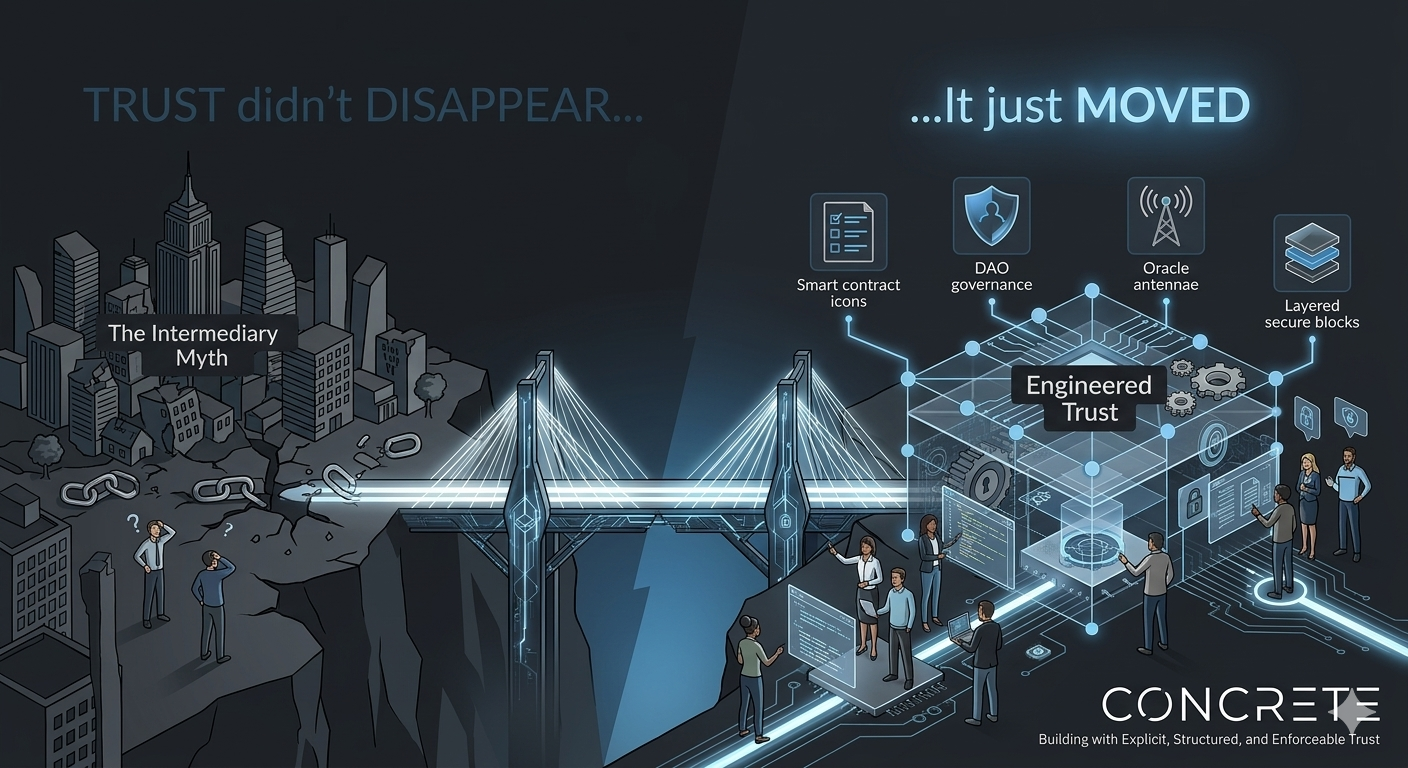
The Decentralized Finance (DeFi) revolution was built on a simple, powerful mantra: "Don’t trust people. Trust code." For a while, this narrative was enough to fuel a movement. We believed that by removing intermediaries like banks and brokers, we had eliminated the need for trust altogether. But as the ecosystem has matured and weathered countless exploits and market cycles, a deeper truth has emerged: Trust didn’t disappear. It just moved.
In today’s DeFi landscape, you aren’t trusting a banker, but you are implicitly trusting:
Smart Contracts: Assuming the logic is flawless and bug-free.
Governance Systems: Believing that token holders will act in the system’s best interest.
Oracles: Relying on external data feeds to be accurate and tamper-proof.
Bridges & Execution Layers: Betting on the security of the infrastructure moving your assets.
1. The Myth of the Trustless System
The core belief of DeFi is that "Code is Law" and that systems can function without human intervention. However, no system is truly trustless. Every protocol involves human-designed logic, human-managed upgrades, and human-fed data. The real question isn’t whether trust exists—it’s where it lives and how it is managed.
2. Where Trust Actually Lives
In many protocols, trust is often abstracted away rather than eliminated. We trade one form of trust (institutional) for another (technical). When you interact with a vault or a lending protocol, you are trusting the assumptions made by the developers. If those assumptions are hidden behind a complex UI, the user is taking on "blind trust" rather than enjoying "trustlessness."
3. The Problem with “Decentralization Theatre”
Some systems appear decentralized on the surface but lack true resilience. This is often referred to as Decentralization Theatre.
Multisigs as a Proxy: Using a small group of signers as the only line of defense.
DAOs with Low Participation: Where a tiny percentage of "whales" dictate the future of the protocol.
Static Systems: Protocols that can’t react during critical moments or black swan events.
True safety isn’t found in the appearance of decentralization, but in the robustness of the engineering.
4. Introducing Engineered Trust
We are moving toward a better model: Engineered Trust.
This means acknowledging that trust is a design element, not something to be ignored. Engineered trust involves:
Clear Roles: Defining exactly who is responsible for what.
Enforced Constraints: Using code to limit what participants can do, rather than just hoping they behave.
Response-Ready Systems: Designing infrastructure that can respond to failure in real-time.
This is how mature financial systems operate, and it is the philosophy behind Concrete.
5. Operational Security: Beyond the Code
Code alone cannot handle every edge case. For a system to be truly resilient, it needs a layer of Operational Security. This includes:
Continuous Monitoring: Tracking system health in real-time.
Rapid Response: Having mechanisms to pause or protect assets during an exploit.
Human Judgment: Utilizing expertise for complex edge cases that code cannot predict.
6. The Concrete Approach
Concrete prioritizes operational security over decentralization theatre. By making trust explicit rather than hiding it, Concrete builds a more resilient environment for capital.
Explicit Trust: We define exactly where the safeguards are.
Design for Response: Our systems are built to react to stress, not just try to prevent it.
On-Chain Enforcement + Off-Chain Intelligence: Combining the best of both worlds for maximum security.
7. The Bigger Shift
DeFi is moving beyond the "trustless" narrative. The industry’s next phase depends on making trust structured, explicit, and enforceable. Infrastructure will no longer be judged by how many "decentralized" buzzwords it uses, but by how it behaves under extreme stress.
The future of DeFi won’t be defined by those who claim to remove trust. It will be defined by those who engineer it best.