Buying XRP: My First Real Position in Crypto
--
A first trade isn’t about being right. It’s about learning to think.
Most people make their first crypto trade because a friend told them to, or because they saw a coin trending on Twitter. I wanted to be different.
Before I put a single dollar into the market, I spent weeks reading about geopolitics, stablecoin adoption, and the psychology that makes retail investors lose money.
My research
The first thing I learned is that Bitcoin leads the crypto market. If Bitcoin is trending upward or stable, altcoins often perform better afterward (CoinMarketCap). Before I looked at any specific coin, I checked Bitcoin. It was holding stable, there was no major panic selling, and market conditions looked safer for altcoins.
I also learned that crypto markets move in cycles of accumulation, bull market, distribution, and markdown (99Bitcoins). Looking at where we are now, sentiment felt cautious but fear had decreased from earlier volatility, which looked close to early optimism. That felt like a decent time to enter, not a time to panic.
But zooming out further, what really shifted my thinking was geopolitics.
The US and China are now going in completely opposite directions on crypto. In March 2025, Trump signed an executive order creating a Strategic Bitcoin Reserve. The US government holds around 328,372 BTC, making it the largest known state holder (Wikipedia). In July 2025, the GENIUS Act became the first proper US stablecoin law, letting banks and approved institutions issue their own. The DOJ even shut down its crypto enforcement team.
Meanwhile, China banned crypto even harder in February 2026, targeting anyone who talks about it, markets it, or facilitates it. And Russia is openly using crypto to get around Western sanctions, moving billions through stablecoins like A7A5 before it got shut down (Chainalysis).
During global conflict, there is a constant battle between Western sanctions systems and countries using crypto to work around them. This showed me that crypto has real use case in cross border payments, and inspired me to dive deeper into coins that are actually useful in the real world.
Why stablecoins changed everything for me
The thing that really opened my eyes was stablecoins.
I had heard of USDT and USDC but didn’t understand how big they had become. Some of my key findings were:
- Stablecoin transfers reached $18.4 trillion in 2025, more than Visa and Mastercard combined (EditorialGE)
- Over 99% of stablecoin market cap is USD pegged (Morgan Stanley)
- In countries with inflation or capital controls, many people hold USDT or USDC instead of their own currency
- Businesses are increasingly using stablecoins for cross border payments where traditional banking is slow or expensive
This taught me that people are adopting crypto over their own local traditional currency systems, this is because stablecoins are becoming stronger than local currency, and people are adapting fast.
Why XRP
I wanted to find a coin with a real use case in this kind of world. One that fits the geopolitical reality of sanctions, capital controls, and people trying to move money across borders without going through slow, expensive banks.
That search led me to XRP.
Ripple is a private technology company that uses the XRP Ledger, an independent, open source blockchain (Ripple). XRP has one of the largest market caps in the world and a real world use case focused heavily on cross border payments. Ripple also launched RLUSD in December 2024, a USD backed stablecoin that sits in the same ecosystem as XRP and could drive more utility for the XRP Ledger.
A coin that is already designed for the exact thing the world is moving toward, in an ecosystem that is building the dollar backed stablecoin side too.
Building the actual trade
Once I picked XRP, I had to figure out when and how to enter. I’m not trying to time the perfect bottom, but I also didn’t want to buy at the top of a spike. I used basic indicators and risk management to build an entry strategy.
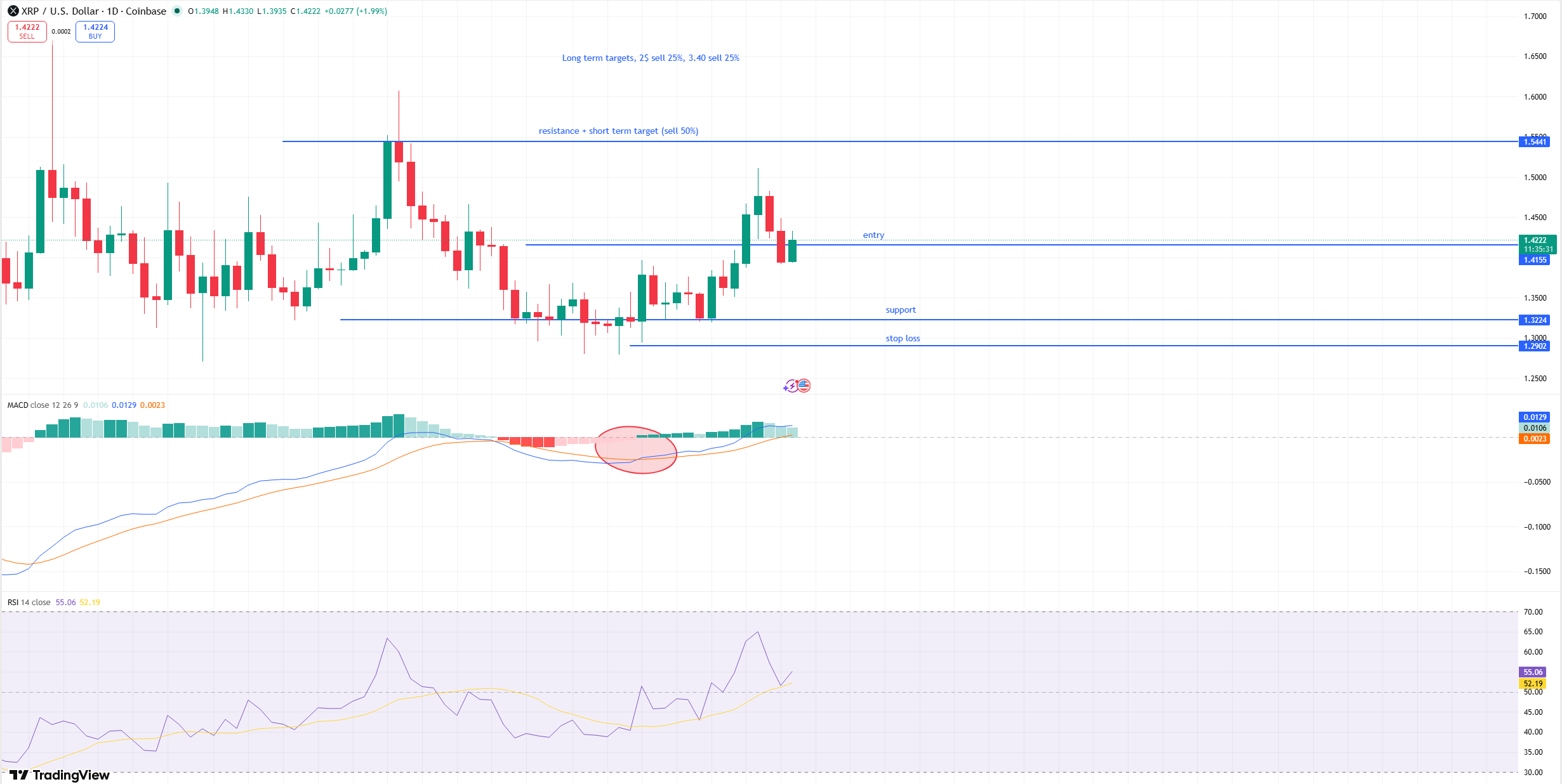
The RSI (Relative Strength Index) measures momentum on a 0 to 100 scale (Investopedia). I saw that XRP’s RSI was around 54, slightly above neutral, meaning the price wasn’t overextended and still had room to increase before hitting overbought territory at 70.
The MACD helps identify trend and momentum changes (Investopedia). I saw the MACD line had crossed above the signal line and the histogram remained positive after a short pullback, suggesting that while bullish momentum was cooling, the underlying trend was still intact. I felt there was enough conviction to enter a long position on the pullback, expecting the bullish trend to continue.
The last part of my decision making process was risk management. I used ATR (Average True Range) to understand XRP’s normal daily price swings so I wouldn’t oversize my position or place a stop too tight to survive normal volatility (Investopedia). Since XRP is one of the largest cryptocurrencies by market cap, I kept my position size moderate and avoided placing an unrealistically tight stop loss that could be triggered by routine market fluctuations.
My plan
I decided to take a laddering approach, which lets me trade short term using technical analysis while still betting on my longer term thesis that XRP benefits from cross border payment adoption and stable coin infrastructure growth in a fragmenting geopolitical environment. This also gives me exposure to different trading strategies rather than being locked into one timeframe.
My plan:
- Entry around $1.41
- Stop loss at $1.29
- Sell 50% at $1.54 (short term target, the recent resistance)
- Sell 25% at $2.00 (medium term, psychological level)
- Sell 25% at $3.40 (long term, prior cycle high)
The short term targets protect me if this is just another pullback in a fading trend. The long term targets give me upside if my thesis about cross border payments actually plays out.
What happens from here
I made a decision based on research, technical analysis, and a thesis I can actually defend, instead of buying because some guy on Twitter said XRP was going to $100.
If I’m wrong, I’ll write about that too. because that’s the whole point of this blog, showing the actual process, not just the wins.
If you’re also starting from zero, have been in the space since the start I’d love for you to follow along.
See you in the next one.