Bitcoin Financial Privacy: Why Owning BTC Doesn’t Make You Anonymous
--
The Problem Most Bitcoin Users Ignore
Bitcoin financial privacy is often assumed rather than understood. A typical user installs a wallet, receives BTC, and starts transacting under the belief that their identity is hidden. The logic feels intuitive: no name, no bank, no central authority.
But the reality is more complex and far less private.
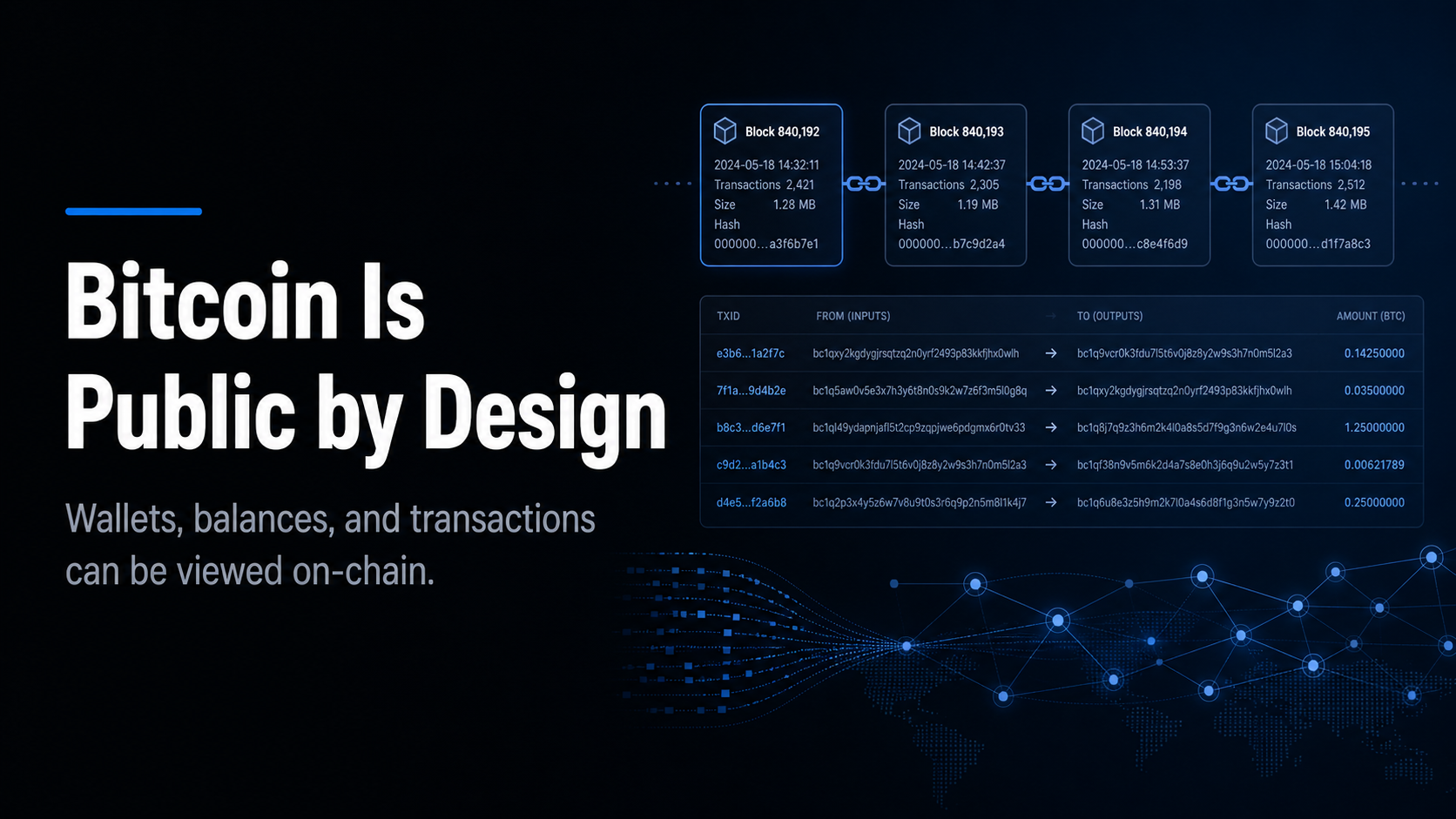
Every Bitcoin transaction is recorded on a blockchain public ledger. This ledger is permanent, transparent, and accessible to anyone with an internet connection. Wallet addresses, balances, and transaction flows are all visible. Over time, patterns emerge. These patterns can be analyzed, clustered, and linked.
This is where the misconception breaks.
Bitcoin is not anonymous. It is pseudonymous.
BTC Pseudonymous: What It Really Means
When people say BTC pseudonymous, they mean that transactions are linked to wallet addresses instead of real names. On the surface, this appears private. But in practice, it introduces a fragile layer of separation rather than true anonymity.
Consider a simple example:
A freelancer receives BTC for services. Later, they send a portion of that BTC to an exchange. That exchange requires KYC. At that point, the wallet becomes associated with a real identity. From there, every past and future transaction linked to that wallet can be analyzed.
The blockchain does not forget.
This creates what is often referred to as the crypto privacy gap — the difference between perceived anonymity and actual traceability.
Blockchain Public Ledger: Transparency vs Privacy
The blockchain public ledger is one of Bitcoin’s core strengths. It ensures trust, immutability, and verification without central authority.
However, this same transparency creates a privacy challenge.
Anyone can:
- View transaction histories
- Track wallet balances
- Follow fund movement across addresses
For individuals or businesses, this can expose sensitive financial behavior. Payment relationships, transaction volumes, and even operational patterns can become visible over time.
This is not theoretical. It is already happening across the ecosystem.
A Practical Example: Where Privacy Breaks
Imagine a small business accepting Bitcoin payments.
Customers pay into a public wallet address. Competitors can monitor that address. They can estimate revenue based on incoming transactions. Suppliers receiving payments can also be identified through outgoing transfers.
The business may never disclose this data, yet it becomes visible anyway.
Ownership of BTC, in this case, does not translate into financial privacy.
Bridging the Crypto Privacy Gap
This gap between ownership and privacy has led to the emergence of specialized solutions. Among them are Bitcoin mixing services designed to break the direct link between sender and receiver.
DreadPirate operates within this space as a Bitcoin mixer and anonymization service.
Instead of sending coins directly from one identifiable source to another, the process works differently. Coins are first combined with thousands of others. They are then split and distributed across exchanges. Finally, the user receives BTC that has no traceable link to the original transaction flow, with AML levels ranging from 0–25%.
This approach directly addresses the traceability issue inherent in the blockchain public ledger.
How the Process Fits Real Usage
Returning to the earlier business example:
Rather than sending funds directly from the business wallet to another destination, the funds can be processed through a mixing layer. The outgoing transaction no longer reflects the original wallet’s activity in a traceable way.
The result is separation.
This does not change Bitcoin itself. It changes how transaction paths are interpreted and linked.
Privacy Without Compromising Control
Another aspect of the privacy discussion is user control. Traditional financial privacy often comes at the cost of reliance on intermediaries. In contrast, Bitcoin maintains user ownership of assets.
Solutions like DreadPirate extend that control into the privacy layer.
There is no requirement for KYC, and no personal information is collected. The system operates without storing logs, meaning transaction data is not retained after completion. Each transaction is backed by a PGP-signed Letter of Guarantee, ensuring that the terms of the exchange are verifiable and cannot be forged.
The infrastructure itself is self-contained, using internal reserves and a proprietary mixing engine rather than third-party services.
Rethinking Bitcoin Financial Privacy
The key takeaway is simple but often overlooked:
Owning Bitcoin is not the same as having financial privacy.
The blockchain public ledger ensures transparency, but it does not provide anonymity. BTC pseudonymous structure offers a layer of separation, but not protection against analysis.
The crypto privacy gap exists because of this mismatch.
Where DreadPirate Fits
DreadPirate positions itself as a bridge between Bitcoin ownership and financial privacy. By restructuring transaction flow and removing direct links between inputs and outputs, it introduces a practical layer of anonymity within an otherwise transparent system.
For users who require separation between identity and financial activity, this becomes a functional necessity rather than an optional feature.
Final Thought
Bitcoin changed how value moves. Privacy tools are now shaping how that movement is interpreted.
Explore DreadPirate’s privacy layer: https://dreadpirate.io/