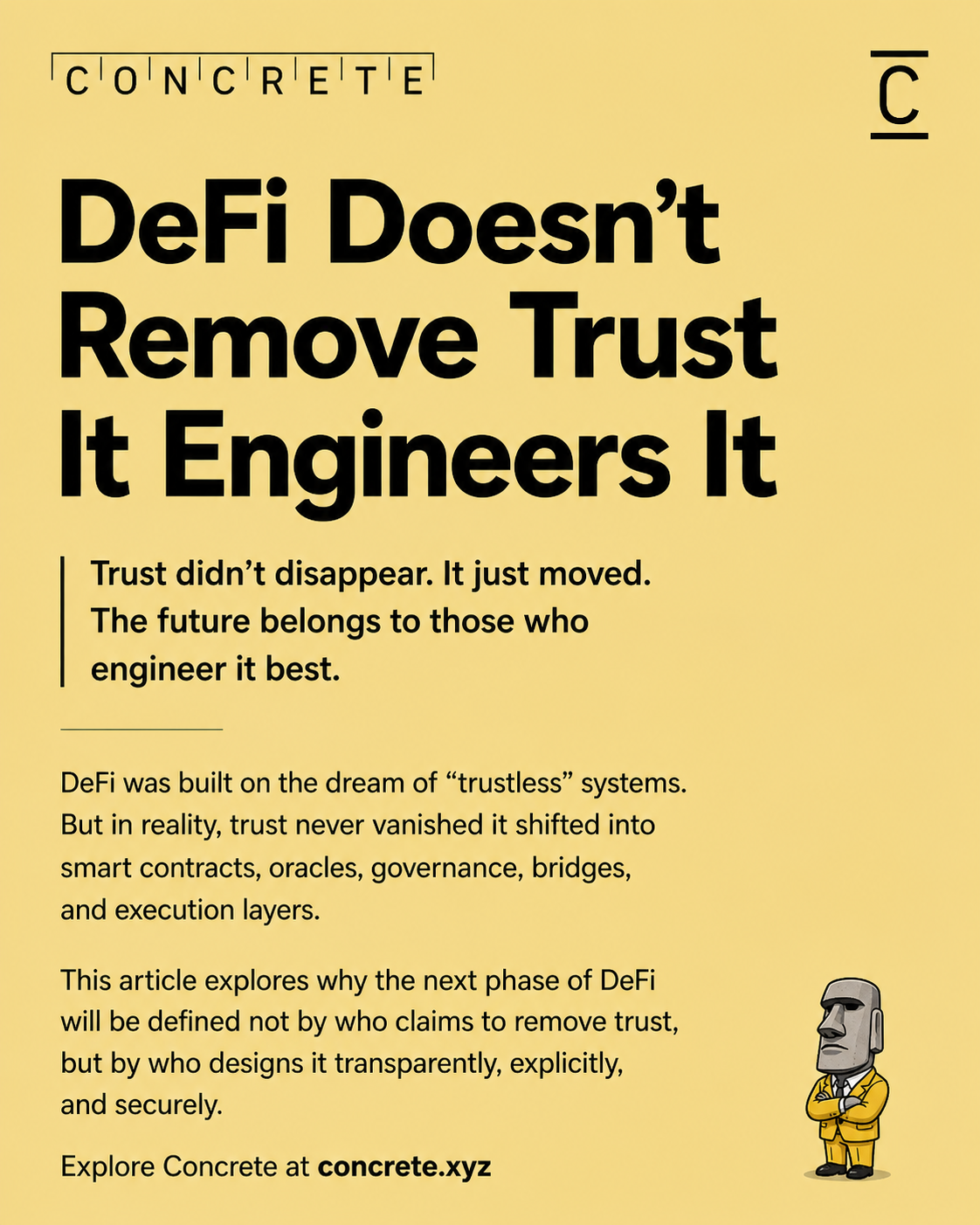
DeFi Doesn’t Remove Trust — It Engineers It
--
“Don’t trust. Verify.”
This mantra has been the rallying cry of DeFi since day one. The promise was radical: replace banks, brokers, and counterparties with immutable code. No human judgment. No middlemen. Just math, running exactly as written.
It’s a beautiful narrative.
It’s also incomplete.
Here’s the tension that the industry is finally confronting: no system is fully trustless. The question was never whether trust would disappear. The question is where it lives, how it’s structured, and who ultimately bears the risk.
Where Trust Actually Hides
Let’s be honest about what we actually trust when we use DeFi.
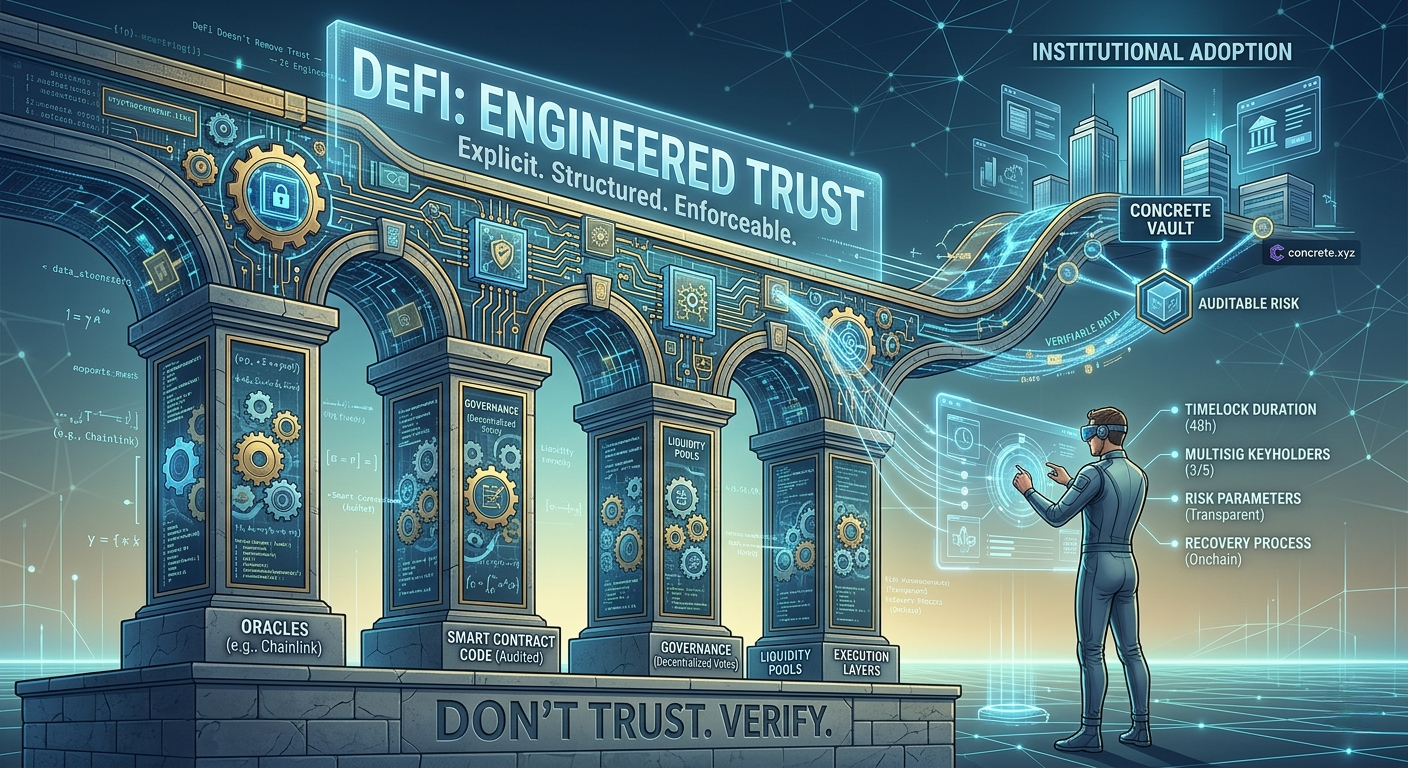
We trust that the smart contract has no critical bugs even after multiple audits. We trust that the governance system won’t be captured by a malicious proposal or a well-funded whale. We trust that oracles like Chainlink are reporting accurate prices, not manipulated data. We trust that bridges won’t be drained by an exploit (history suggests this is a risky bet). We trust that execution layers sequencers, validators, relayers will process transactions fairly.
None of this is “trustless.” It’s redistributed trust.
The difference between DeFi and TradFi isn’t the presence of trust. It’s whether that trust is hidden behind marketing or engineered deliberately into the DeFi infrastructure.
The Illusion of “Code Is Law”
The phrase “code is law” sounds definitive. But code is written by humans, deployed by humans, and critically upgraded by humans. Even non-upgradeable contracts exist within governance systems that can fork, vote, or socially coordinate around a different outcome.
When the DAO hack happened in 2016, the community didn’t say “code is law” and accept the loss. They hard forked. Trust in the community’s judgment overrode trust in the code’s finality.
That’s not a failure. That’s reality. And pretending otherwise is how we end up with systemic vulnerabilities.
Engineering Trust Explicitly
The next phase of DeFi security isn’t about eliminating trust it’s about making trust explicit, structured, and enforceable.
This means asking better questions:
- Who can pause this contract? Under what conditions?
- What happens if the oracle feeds bad data?
- How long does the timelock last? Who holds the multisig keys?
- If the bridge goes down, what’s the recovery process?
These are operational security questions. They’re boring. They’re not as exciting as “unstoppable finance.” But they’re the difference between a protocol that fails gracefully and one that fails catastrophically.
Explore Concrete at https://concrete.xyz/ 🚨 platforms like this are building exactly this kind of explicit trust layer, where risk parameters are transparent, collateralization is onchain, and enforcement doesn’t require guesswork.
What Engineered Trust Looks Like
Engineered trust isn’t a contradiction. It’s a design discipline.
Consider Concrete vaults as an example. These are structured products where every assumption about risk, yield, and liquidation is written into the system not hidden in a legal document or a Discord channel. The trust isn’t removed. It’s specified. You know what you’re trusting, down to the parameter level.
This is what institutional DeFi demands. Institutions don’t need trustlessness. They need auditable trust the ability to verify exactly who holds what risk, under what conditions, with what recourse.
“Show Where Trust Actually Lives”
Let’s stop pretending. Open any DeFi protocol, and you’ll find trust hiding in plain sight. It’s not malevolent — it’s just abstracted away behind interfaces, audits, and consensus mechanisms. But abstraction isn’t elimination.
Here’s where trust actually lives.
Smart Contract Assumptions
You trust that the contract does what the documentation says. More importantly, you trust that it doesn’t do anything the documentation doesn’t say. Every delegatecall, every unchecked block, every upgradeable proxy is a point where “code is law” becomes “code is interpreted law.” Audits reduce risk. They don’t remove it.
Governance Decisions
Someone can change the rules. Whether it’s a multisig or a token vote, you’re trusting that those with keys or quorum won’t act maliciously or incompetently. The number of governance attacks and last-minute proposals passing with low turnout proves this isn’t theoretical. Onchain enforcement doesn’t matter if governance can overwrite the enforcement logic.
Oracle Dependencies
Your position liquidates at Xprice.ButwheredoesXprice.ButwheredoesX come from? A set of nodes operated by people you’ve never met. If those nodes stall or report manipulated data, your collateral vanishes. DeFi security isn’t just about the core contract it’s about the data pipeline feeding it. That pipeline is held together by reputational trust, not math.
Bridge Security
Bridges are the single largest source of exploits in crypto. Why? Because they require trust across two domains. You lock asset A on chain 1, mint asset B on chain 2. The validator set watching that lock is… some committee. Maybe decentralized, maybe not. Every bridge hack is a reminder: cross-chain trustless systems are mostly an aspiration, not a reality.
Execution Layers
Even if the contract and oracle are perfect, you trust the sequencer (on rollups), the relayer, or the validator to include your transaction. MEV, censorship, reorgs these are trust failures at the base layer. Operational security at the node level matters as much as code audits.
Trust Abstracted Away
The clever trick of DeFi marketing was to relabel trust as “assumptions” and then hide those assumptions in technical documentation nobody reads. You trust the multisig signers but do you know their names? You trust the oracle but did you check its uptime history? You trust the governance timelock but do you know the escape hatch conditions?
Engineered trust flips this. Instead of hiding assumptions, it surfaces them. Instead of hoping the bridge committee does the right thing, it enacts onchain enforcement that triggers automatically when conditions are violated.
This is what Concrete vaults are designed for making every dependency explicit, every risk parameter visible, every enforcement mechanism onchain. Not because trust disappears, but because when you can see exactly what you’re trusting, you can decide whether that trust is worth taking.
Explain the Problem With “Decentralization Theatre”
Here’s an uncomfortable truth: a system can look decentralized and still fail exactly like a centralized one.
Worse — because everyone believes it’s decentralized, no one watches the single point of failure hiding in plain sight.
Call this what it is: decentralization theatre.
Multisigs as a Proxy for Security
A 3-of-5 multisig sounds decentralized. Five different entities hold keys. Democracy, right? But who are those five? Often: the founding team, two close investors, and a friendly advisor. They all share a Signal group. They all coordinate instantly. That’s not decentralization — that’s a board of directors with extra steps.
When a $100 million protocol has a 3-of-5 that meets once a week on Zoom, your DeFi security is exactly one social engineering attack away from collapse. The appearance of distributed control masks the reality of concentrated operational power.
DAOs With Low Participation
A governance token lets you vote. In theory, thousands of stakeholders guard the protocol. In practice? Turnout hovers around 5–10% for most proposals. A single whale with 4% of supply can pass anything if the rest don’t show up.
This is the illusion of trustless systems — the idea that code and voting replace human authority. But low-participation DAOs are just oligarchies with a UI. The trust hasn’t been removed. It’s been concentrated into the hands of the few who bother to show up.
Timelocks That Delay but Don’t Prevent
Timelocks are good. They give users a window to exit if a malicious upgrade passes. But here’s the catch: a timelock only delays the outcome. It doesn’t prevent it. If governance passes an exploit disguised as a “fee optimization,” you have 48 hours to sell everything. That’s not safety. That’s a two-day head start on a sprint.
Engineered trust would require something stronger: veto rights, circuit breakers, or an onchain enforcement mechanism that auto-rejects proposals failing specific risk checks. Timelocks alone are decentralization theatre.
Systems That Can’t React During Crisis
The ultimate test of any DeFi infrastructure isn’t during a bull run when everything works. It’s at 3 AM on a Sunday when an oracle reports a price of $0, liquidations cascade, and the multisig signers are asleep.
Decentralized systems often have no emergency response plan because “emergency response” sounds centralized. So they freeze. Or they crash. Or they rely on a backdoor that was never documented.
Resilience isn’t about looking decentralized. It’s about having clear, fast, accountable crisis operations — whether that’s an automated circuit breaker, a publicly audited recovery multi-sig, or a governance process that can execute in hours, not weeks.
Appearance vs. Actual Safety
Appearance.
10 signers on a multisig
50,000 governance token holders
72-hour timelock
Decentralized bridge
Reality
3 actively use their keys
5 whales decide every vote
No veto mechanism if vote was malicious
4 validators run the entire thing
“Introduce Engineered Trust”
We’ve spent three parts dismantling the myth of “trustless” DeFi. We’ve shown where trust hides, how decentralization theatre misleads, and why pretending trust doesn’t exist leads to catastrophe.
So what’s the alternative?
Not abandonment of DeFi. Not a return to banks. Something better: engineered trust.
What Engineered Trust Actually Means
Engineered trust flips the question. Instead of asking “How do we eliminate trust?” it asks “How do we design trust so that it’s visible, bounded, and enforceable?”
This isn’t a compromise. It’s an upgrade.
In an engineered trust system:
- Roles and responsibilities are clear. You know exactly who can pause, who can upgrade, who can propose, who can veto. No hidden admins. No “the community will figure it out.”
- Permissions are defined and limited. Every action has a scope. A multisig signer can’t drain treasury. A governance proposal can’t skip the timelock. Automation can’t override human escalation paths.
- Constraints are enforced onchain. You don’t rely on people “doing the right thing.” You write the boundaries into code. If a liquidation tries to happen outside parameters, the transaction reverts. If an oracle deviates too far, a fallback triggers.
- Systems can respond to failure. Not all failures are preventable. But they can be survivable. Circuit breakers, recovery modules, and transparent escalation processes mean a bug doesn’t have to become a bankruptcy.
This is how mature financial systems operate not because they’re centralized, but because they learned the hard way that unmanaged trust is just another name for unmanaged risk.
Why This Matters for DeFi Security
The reason we’ve seen billions lost in hacks, governance attacks, and bridge exploits isn’t because DeFi is young. It’s because too many protocols confused “no trusted third parties” with “no trust management at all.”
DeFi security isn’t just about audits and bug bounties. It’s about operational security the systems, processes, and redundancies that operate when code fails. And code will fail.
Engineered trust builds those redundancies in from day one. It treats failure as a design constraint, not an exception.
How Concrete Embeds Engineered Trust
This isn’t theoretical. Explore Concrete at https://concrete.xyz/ Concrete is built explicitly around engineered trust.
Concrete vaults don’t pretend to be trustless. They document every dependency: which oracles feed prices, which accounts hold execution rights, what the liquidation parameters are, and exactly how long withdrawal windows last. Every constraint is enforced onchain. Every role is permissioned with clear boundaries.
The result is DeFi infrastructure that institutions can actually use because they don’t need to trust blindly. They need to verify the trust design. Concrete makes that possible.
From Trustless to Trust-Aware
The next generation of trustless systems won’t actually be trustless. They’ll be trust-aware. They’ll acknowledge that trust exists, then engineer it into modular, auditable, enforceable layers.
That’s the shift:
Old Model
“Trust the code”
Governance by token vote
Multisig as black box
Oracle dependency hidden
Engineered Trust
“Trust the constraints on the code”
Governance with checks, delays, and vetoes
Multisig with logged keys, thresholds, and rotation
Oracle fallbacks and deviation bounds published
“Connect This to Operational Security”
We’ve established that engineered trust is the path forward. But design alone isn’t enough. Systems don’t run on blueprints they run on operations.
This is where operational security enters the conversation. And it’s where many DeFi protocols, even well-designed ones, fall short.
Code Alone Cannot Handle Every Scenario
Smart contracts are deterministic. The world is not.
An oracle deviation attack. A governance proposal that passes by one vote, clearly malicious. A bridge validator set that suddenly rotates to unknown entities. A vulnerability that isn’t a bug but a logic edge case no auditor considered.
Code can’t say, “That feels wrong, let’s pause and ask a human.”
But your operations should.
Monitoring: Seeing the System in Real Time
You can’t respond to what you don’t see. DeFi security starts with monitoring not just for price movements, but for behavioral anomalies:
- Is governance proposal volume spiking from a single address?
- Is an oracle reporting value changes outside historical volatility?
- Are withdrawal requests suddenly 10x normal volume?
These aren’t just data points. They’re signals that engineered trust needs human eyes to interpret. Real DeFi infrastructure includes dashboards, alerts, and 24/7 surveillance not as a nice-to-have, but as a core operational layer.
Rapid Response Mechanisms
Even with perfect monitoring, you need the ability to act. Fast.
This is where onchain enforcement meets operational process:
- Circuit breakers that can be triggered by a trusted monitor
- Emergency pause functions with transparent conditions for unpausing
- Fallback oracles that activate when primary feeds degrade
- Recovery multisigns with time-locked, auditable execution
The myth of trustless systems says these mechanisms are “centralization.” The reality of engineered trust says they’re risk management. The difference is transparency: who can trigger, under what conditions, and what’s the accountability if they trigger incorrectly?
Human Judgment in Edge Cases
Let’s be honest: some situations can’t be fully automated.
- “The oracle price is technically correct, but the market is being manipulated do we still liquidate?”
- “Governance passed an upgrade, but we just discovered it has a backdoor do we override?”
- “The bridge relayer is down, but users’ funds are safe do we wait or force a manual settlement?”
These are judgment calls. Code can’t make them. A well-designed engineered trust system doesn’t eliminate human judgment it constrains and audits it. Clear escalation paths, documented decision criteria, and onchain logs of every override.
This is what institutional DeFi demands: not automation for its own sake, but controllable automation.
Layered Security: Defense in Depth
The best operational security is layered. No single control is perfect, but depth creates resilience.
- Layer 1: Smart contract logic with invariant checks
- Layer 2: Monitoring and anomaly detection
- Layer 3: Automated circuit breakers for extreme conditions
- Layer 4: Human-operated emergency response with time locks
- Layer 5: Insurance and user restitution frameworks
Concrete vaults are designed with this layered philosophy. Every vault has defined operational parameters, real-time risk monitoring, and clear escalation paths. You’re not trusting that nothing goes wrong. You’re trusting that when something does, there’s a system to catch it.
“Connect This to Concrete”
We’ve walked through the problem: trust doesn’t disappear, it hides. We’ve exposed decentralization theatre. We’ve introduced engineered trust and operational security as the real solution.
Now let’s talk about who’s actually building this way.
Concrete was built on a simple recognition: pretending to be trustless is dangerous. Engineering trust explicitly is the only path to institutional DeFi that actually works.
Here’s how Concrete turns the theory into practice.
Trust Is Explicit, Not Hidden
Most protocols bury their trust assumptions in Discord channels and unaudited multisigs. Concrete surfaces everything.
Every Concrete vault comes with documented risk parameters: which oracles feed prices, what the liquidation thresholds are, who holds execution rights, and how long every delay lasts. Nothing is “just trust us.” Everything is verifiable onchain.
This is engineered trust in its purest form not the absence of trust, but trust you can see, audit, and decide whether to accept.
Systems Designed for Response, Not Just Prevention
Prevention fails. Every system has bugs, every oracle can be manipulated, every market can behave irrationally.
Concrete doesn’t pretend otherwise. Instead, it builds response into the DeFi infrastructure:
- Circuit breakers that activate on abnormal conditions
- Fallback oracles that kick in when primary feeds degrade
- Graceful liquidation paths that don’t panic-sell into illiquid markets
- Timelocked recovery modules that give users notice and choice
This is the difference between trustless systems that collapse at first failure and mature systems that survive.
Onchain Enforcement + Off-Chain Intelligence
Code alone is brittle. Humans alone are slow and fallible. Concrete combines both.
Onchain enforcement handles the rules: “If collateral falls below X, liquidate according to Y.” That’s automated, fast, and impartial.
Off-chain intelligence handles the context: monitoring for oracle anomalies, governance attacks, or unusual withdrawal patterns. When something looks wrong, the system can pause not based on a single human whim, but based on predefined, transparent conditions.
This hybrid model is what real operational security looks like. It’s not either-or. It’s both.
Role-Based Architecture
Not everyone needs the same permissions. Not every action should be possible by the same key.
Concrete uses a role-based architecture:
Role
Vault creators
Risk monitors
Executors
Guardians
Responsibility
Define risk parameters within bounds
Trigger circuit breakers under defined conditions
Process liquidations and rebalances automatically
Emergency pause with timelock and transparency
No single role can drain funds. No single key can override the system. Every permission is scoped, logged, and auditable.
This is the opposite of decentralization theatre. It’s controlled decentralization where power is distributed but also bounded.
Controlled Execution Environments
DeFi has a dirty secret: most “automated” strategies still rely on off-chain bots with private keys. Those keys get compromised. Funds get stolen.
Concrete vaults keep execution onchain wherever possible. When off-chain components are necessary, they’re secured with key rotation, hardware security modules, and transaction simulation before signing.
This is DeFi security at the infrastructure level not just securing contracts, but securing the entire operational stack.
Why This Matters for Institutional DeFi
Institutions don’t need promises. They need proof.
Concrete provides verifiable onchain enforcement of every rule. Every vault’s behavior can be simulated, audited, and monitored in real time. Risk parameters are transparent. Response mechanisms are documented and testable.
This is why Concrete vaults are becoming the standard for institutional-grade DeFi not because they’re “more centralized,” but because they’re more trustworthy in the real sense of the word.
The Concrete Difference
Traditional DeFi
“Trust the code”
Hidden multisig keys
No emergency response
Off-chain bots with private keys
Decentralization theatre
Concrete
“Trust the constraints and redundancies”
Role-based, transparent permissions
Circuit breakers + monitored escalation
Onchain execution + secured off-chain components
Engineered trust with operational security
“Close With the Bigger Shift”
We started this series by questioning a sacred myth: that DeFi removes trust entirely.
We’ve shown that trust doesn’t disappear it moves into smart contracts, governance, oracles, bridges, and execution layers. We’ve exposed decentralization theatre the gap between how systems look and how they actually behave under pressure. And we’ve introduced engineered trust and operational security as the mature alternatives.
Now let’s talk about where this all leads.
DeFi Is Moving Beyond “Trustless” Narratives
The “trustless” slogan served a purpose. It differentiated crypto from TradFi. It rallied a movement. But markets and builders are growing up.
The most sophisticated teams are no longer asking, “How do we eliminate every human?” They’re asking, “How do we design trust so it’s transparent, bounded, and survivable?” That’s a fundamentally different engineering question and it’s producing fundamentally better DeFi infrastructure.
Real Systems Acknowledge and Structure Trust
Real systems don’t pretend. They document every dependency, every permission, every fallback. They build onchain enforcement for the rules that must be absolute, and layered human judgment for the edge cases that code can’t anticipate.
This isn’t weakness. It’s resilience.
The question isn’t whether your protocol has trust. It’s whether that trust is abstracted away in a Discord server’s pinned message or structured into the protocol itself, auditable by anyone, enforceable by code.
Resilience Matters More Than Ideology
Ideology says: “No multisig. No pause. No human override.”
Reality says: “When the oracle breaks at 2 AM, what happens?”
The protocols that survive the next black swan won’t be the purest ideologically. They’ll be the ones with circuit breakers that work, recovery paths that are documented, and operational security that doesn’t rely on a single sleep-deprived developer with a private key.
Resilience is the only ideology that pays.
Infrastructure Will Be Judged by How It Behaves Under Stress
Anyone can build a vault that works in a bull market. The test comes when volatility spikes, when gas wars erupt, when an oracle reports a bogus price, when a governance proposal slips through with malicious intent.
Concrete vaults are built for that test. Every risk parameter is explicit. Every enforcement path is onchain. Every response mechanism is practiced and audited. This is engineered trust for the real world not the whitepaper fantasy.
The Future: Who Engineers Trust Best
The next phase of DeFi won’t be defined by who shouts “trustless” the loudest. It will be defined by who builds systems that survive.
That means:
- DeFi security that goes beyond audits to include operational monitoring and rapid response
- trustless systems evolving into trust-aware systems that expose every dependency
- engineered trust becoming a standard design discipline, not an afterthought
- DeFi infrastructure that institutions can rely on because risks are transparent, not hidden
- Concrete vaults and similar products setting the bar for explicit, enforceable safety
- onchain enforcement as the baseline, with human escalation for the unexpected
- operational security treated as seriously as smart contract correctness
- institutional DeFi finally scaling because trust is designed, not denied
Final Thought
The myth of the trustless machine was beautiful. But beauty doesn’t stop a liquidation cascade. Engineering does.
DeFi’s adult moment is here. It’s not about removing trust it’s about engineering it so well that you don’t have to hope.
That’s the bigger shift. That’s the future.
Explore Concrete at https://concrete.xyz/ 🚨 and build it.
End of series. Thank you for reading.