The narrative of “Real World Assets” (RWA) in DeFi has shifted rapidly from theoretical exploration to active execution. Just last week, we witnessed the first major domino fall when Ondo Finance’s tokenized equity markets curated by Sentora were successfully incorporated into Euler, allowing users to leverage tokenized stocks and indexes as collateral within a permissionless lending environment.
This week, the momentum continued as two of the world’s largest traditional asset managers — BlackRock and Apollo Global Management — moved to deep infrastructure integration. By natively plugging tokenized assets into Uniswap’s liquidity rails and Morpho’s lending markets, these giants are signaling that the era of “testing” is over. We are now witnessing a structural paradigm shift where Wall Street is not just tokenizing assets, but actively utilizing decentralized protocols to trade and lend them.
The Institutional Pivot: Wall Street’s On-Chain Evolution Accelerates
Before examining the qualitative implications of these institutional maneuvers, it is crucial to ground the narrative in the quantitative data driving these markets. The scale of capital and the immediate market reactions underscore the magnitude of this week’s developments.
- $2.4 Billion: The current approximate assets under management (AUM) of BlackRock’s USD Institutional Digital Liquidity Fund (BUIDL), which is now fully integrated for on-chain execution.
- $940 Billion: The total traditional assets overseen by Apollo Global Management, which is now actively building out its on-chain credit strategy.
- 90 Million: The maximum number of MORPHO tokens (representing 9% of the total 1 billion supply) that Apollo and its affiliates are authorized to acquire over the next 48 months.
- $5.8 Billion: The Total Value Locked (TVL) within the Morpho lending protocol, cementing its position as the sixth-largest DeFi application by deposited capital.
- +17.8%: The week price rally of the MORPHO token following the formal announcement of the Apollo cooperation agreement.
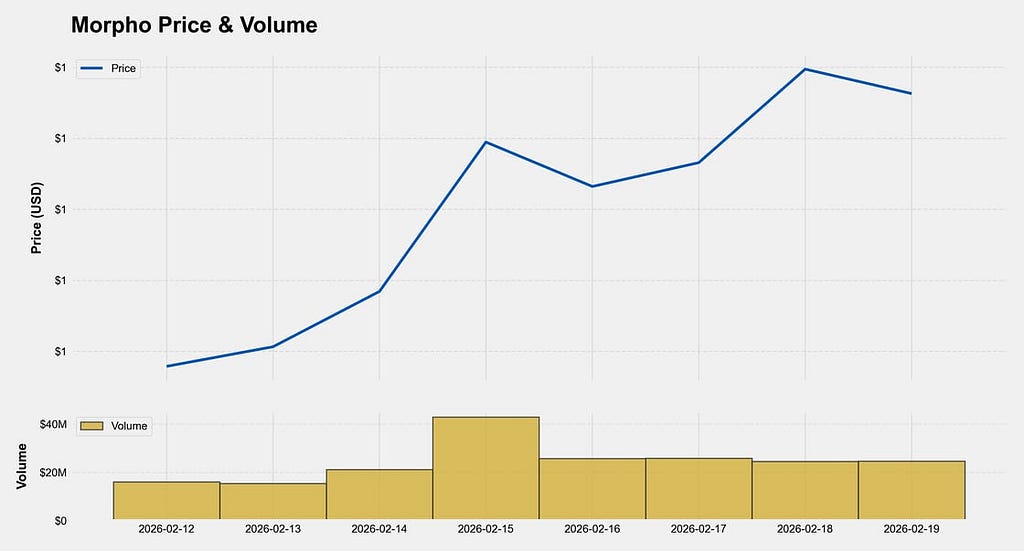
Source: Coingecko
TradFi Giants Bridge the Gap: BlackRock Integrates BUIDL with Uniswap
BlackRock has partnered with Securitize and Uniswap Labs to integrate its BUIDL fund into the UniswapX trading infrastructure. This development transitions institutional tokenization from a static issuance model into a dynamic, liquid on-chain environment. Eligible institutional investors can now trade BUIDL against USDC seamlessly, 24 hours a day, 7 days a week.
Crucially, this integration does not utilize Uniswap’s traditional Automated Market Maker (AMM) liquidity pools. Instead, it leverages UniswapX, an off-chain order routing system that settles on-chain. This structural choice is highly deliberate. By utilizing a Request-for-Quote (RFQ) framework, the system routes orders to whitelisted market makers (such as Wintermute and Flowdesk) acting as “solvers.” This allows institutions to source the best bilateral exchange rates without their capital ever co-mingling with non-KYC (Know Your Customer) retail funds in a permissionless AMM pool.
The operational mechanics of this integration highlight a sophisticated compromise between regulatory compliance and decentralized efficiency. Securitize acts as the compliance layer, pre-qualifying and whitelisting all participating wallets to ensure strict adherence to securities regulations. Meanwhile, UniswapX acts as the execution layer, providing the rapid settlement, transparency, and continuous uptime inherent to decentralized architecture.
Beyond the technical integration, BlackRock made a profound strategic statement by purchasing an undisclosed amount of UNI governance tokens. This represents BlackRock’s first direct financial engagement with a DeFi protocol’s native governance structure. It indicates a shift from merely utilizing decentralized software as a passive service provider to actively acquiring a vested interest in the underlying network’s future development and value accrual mechanisms.
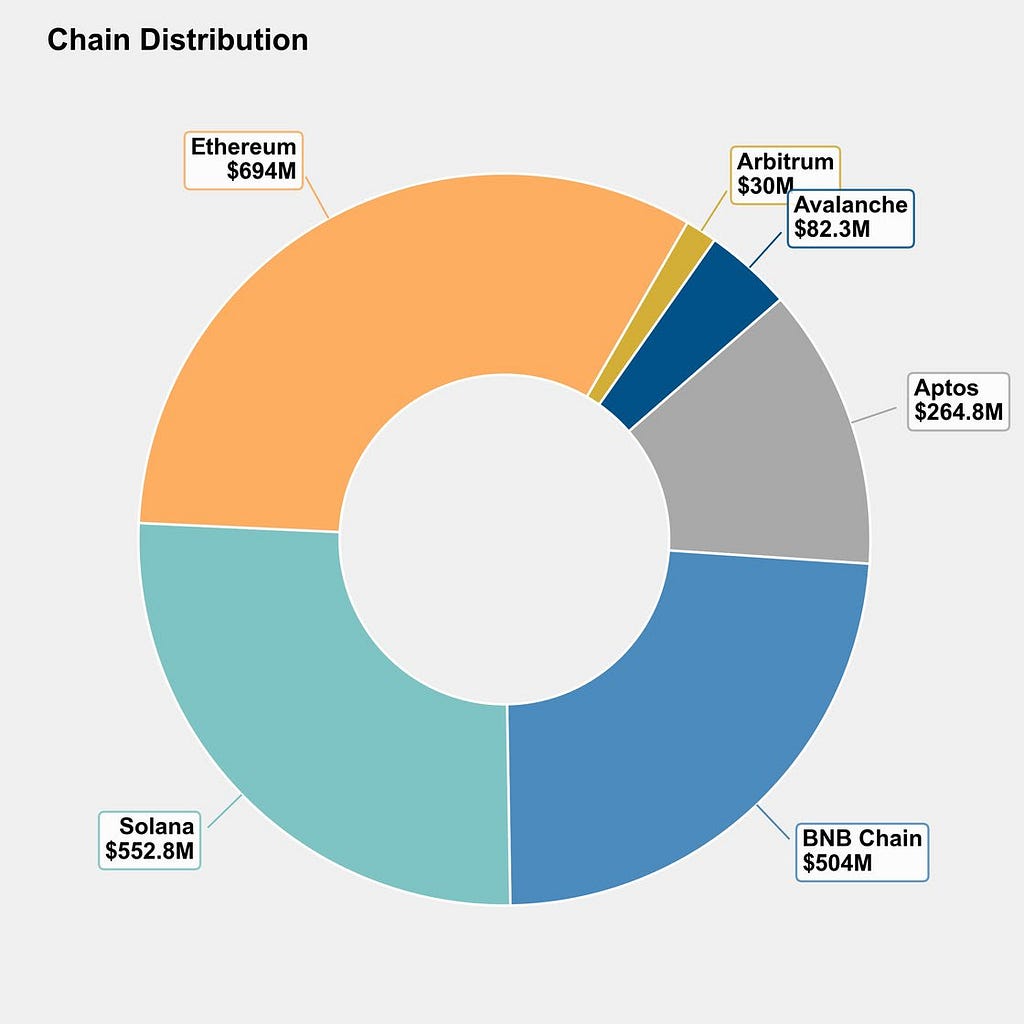
BUIDL chain distribution. Source: RWA.xyz
Apollo Taps Morpho for On-Chain Lending Markets
Parallel to BlackRock’s advancements in decentralized exchange infrastructure, Apollo Global Management has made a decisive entry into decentralized credit. The $940 billion asset manager signed a formal cooperation agreement with Morpho, a premier decentralized lending platform, to support and scale on-chain lending markets. This partnership represents a massive evolution from TradFi firms merely exploring blockchain to actively deploying capital programmatically within DeFi credit protocols.
The centerpiece of this agreement is Apollo’s commitment to acquiring a massive stake in the protocol’s governance. Over the next 48 months, Apollo and its affiliates can acquire up to 90 million MORPHO tokens through a combination of open-market purchases and Over-The-Counter (OTC) transactions. By structuring the acquisition with strict ownership caps and transfer restrictions, Apollo is signaling a long-term strategic alignment with the Morpho ecosystem rather than a short-term speculative trade.
The selection of Morpho as the lending protocol is rooted at its underlying architecture. Traditional DeFi lending platforms utilize a pooled-risk model, where adding a new collateral asset requires a decentralized governance vote. Morpho, conversely, features permissionless market creation. This allows anyone, including an institutional giant like Apollo, to instantly spin up isolated, custom lending pairs and curator-managed vaults without waiting for DAO approval.
This isolated risk architecture is fundamentally better suited for traditional asset managers. It allows Apollo to integrate its own tokenized private credit funds or specialized RWAs into bespoke lending pools. Institutional lenders can precisely control their risk parameters, tailoring collateral ratios and interest rate curves to their specific compliance and risk frameworks, all while utilizing Morpho’s highly efficient, immutable smart contract infrastructure.
The Strategic Overlap: Wall Street is Buying Governance
When synthesizing BlackRock’s Uniswap integration and Apollo’s Morpho agreement, a clear and highly consequential trend emerges: Wall Street is no longer afraid of governance tokens. Historically, traditional financial institutions have strictly avoided direct interaction with DeFi utility and governance tokens due to acute regulatory anxieties regarding unregistered securities.
The fact that the world’s largest asset manager (BlackRock) and a premier private equity powerhouse (Apollo) are now openly acquiring UNI and MORPHO tokens suggests a radical shift in institutional legal confidence. These firms possess the most conservative, highly resourced compliance departments on the planet. Their willingness to buy into DeFi governance implies that they view these assets as essential infrastructure stakes — analogous to holding equity in a clearinghouse or a traditional exchange network.
Furthermore, these moves validate the core thesis of the DeFi power-user: capital efficiency rules all. Traditional markets are burdened by T+1 or T+2 settlement times, fragmented liquidity, and siloed credit facilities. By plugging tokenized Treasuries (BUIDL) into decentralized routing (UniswapX) and building structured credit on permissionless rails (Morpho), institutions are actively upgrading their operational efficiency. They are successfully bridging the gap between the predictable yield generation of traditional finance and the liquid, composable nature of crypto.
Disclaimer: The information provided in this newsletter is for educational and informational purposes only and does not constitute financial, investment, or legal advice.
Beyond Tokenization: How BlackRock and Apollo are Utilizing DeFi Rails was originally published in Sentora on Medium, where people are continuing the conversation by highlighting and responding to this story.