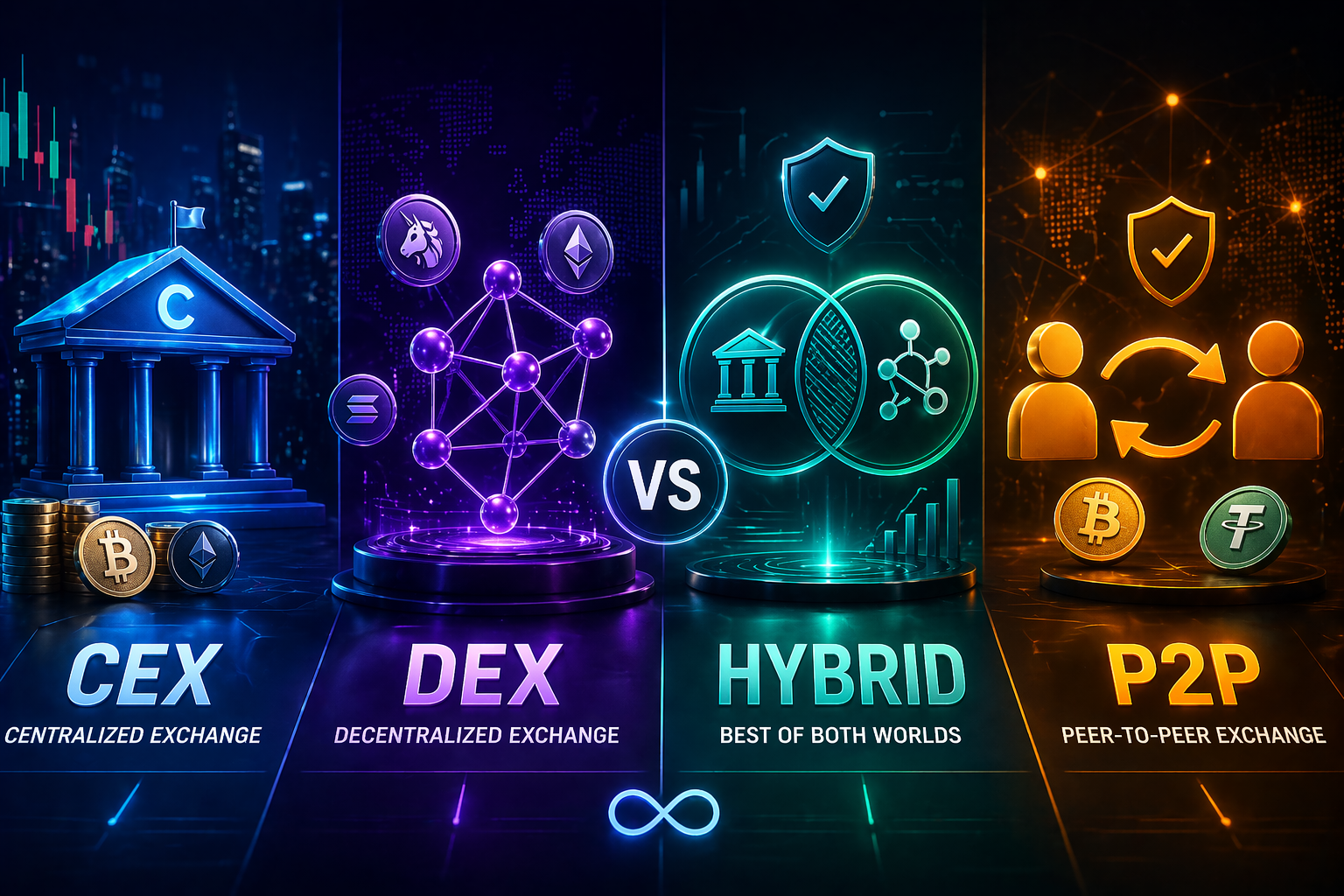
Crypto Exchange Business Models in 2026: CEX, DEX, Hybrid & P2P Compared
 Cryptiecraft8 min read·Just now
--
Majority of crypto exchanges designed prior to 2024 are now scrambling to restructure compliance stacks, reconsider revenue models and come to realize they did not design their architecture to go where the market actually went.
The later built ones? They began on a totally different basis. By 2026, crypto was no longer a playground of early adopters trying to become moonshot hunters. It was made a regulated, institutionally supported financial ecosystem with a global market capital that exceeded $3 trillion and institutional capital considering it as a valid asset class.
And right in the middle of all that? Crypto exchange business models are evolving faster than most builders expected.
If you’re thinking about launching an exchange platform, the old “just pick CEX or DEX” logic no longer cuts it. Your business model determines your revenue, your legal exposure, your audience, and honestly — your survival.
This guide breaks down every major exchange model (CEX, DEX, Hybrid and P2P) operating profitably in 2026, what each one earns, and how to think about the right fit for your goals.
What is Crypto Exchange Development?
Cryptocurrency exchange development involves creating secure platforms for users to Buy, sell and exchange cryptocurrency.
This includes building fundamental components such as trading engines, wallets, liquidity and order matching. Security measures like encryption, multi-factor authentication and smart contract verification are also built in.
In short, it’s about blending technology, regulation and business aspects to provide a scalable and secure trading platform.
The Smart Way to Choose a Crypto Exchange Model in 2026
Majority of them consider an exchange type as a technical option. That’s the wrong framing.
Going centralized, decentralized, hybrid, or peer-to-peer is only indicative of your target user, your regulatory strategy, and your revenue blueprint, and says less about your tech stack.
Industry estimates indicate that the global crypto exchange market is projected to have a value of around $85.75 billion in 2026, and will increase to 314 billion in 2033 with the CAGR of more than 20.
Such growth implies that competition is intense, and only those exchanges that are developed based on a well-articulated business model early in the day will be able to endure. There are three questions that you should answer before choosing a model:
Three questions you need to answer before picking a model:
1. Who is your core user? Retail traders want speed and simplicity. Institutions need deep liquidity and compliance documentation. Peer communities prioritize trust and local payment support. Each archetype pulls you toward a different model.
2. What regulatory environment are you building in? Operating under MiCA in the EU looks nothing like launching under MAS in Singapore or VARA in the UAE. Your model choice directly determines your licensing path and compliance cost.
3. Which revenue streams align with your liquidity strategy? A DEX running on swap fees needs different liquidity mechanics than a CEX monetizing through spot trading, margin products, and institutional tiers simultaneously.
Once you’ve answered those three, the model selection becomes far more obvious. Let’s walk through each one.
The Core Exchange Models in 2026
1. Centralized Exchange (CEX)
CEX’s still dominate volume. Platforms like Binance and Coinbase prove that the centralized model when built right, then it scales to billions in daily trading activity.
In this model, a central authority manages the order book, holds user funds, and handles trade matching through a high-speed engine. Users trade quickly, liquidity is deep, and the experience feels close to a traditional financial platform.
Why businesses still choose CEX:
- Highest liquidity concentration of any model
- Institutional trading desk compatibility
- Full KYC and AML control which is increasingly a regulatory advantage, not just overhead
- A proven revenue model built on trading fees, listing fees, margin products, and staking yield
The real challenge in 2026 is compliance cost. Operating a centralized exchange now requires VASP licensing in most major jurisdictions and the EU’s MiCA framework, UAE’s VARA, Singapore’s MAS and capital requirements have increased substantially across all of them.
Centralized exchange development demands serious infrastructure investment upfront: matching engine architecture, custody solutions, proof-of-reserves systems, and a compliance layer that can handle multi-jurisdictional reporting. The reward? The highest revenue ceiling of any exchange model in the market.
If you’re building for institutional clients or targeting retail mass adoption at scale, this is your model provided you have the capital and the compliance team to do it properly.
2. Decentralized Exchange (DEX)
DEX flipped the model entirely. No custody. No order book controlled by a company. Smart contracts handle everything.
In 2026, DEX platforms have matured well past the clunky early DeFi era. Multi-chain interoperability using protocols like LayerZero and Chainlink CCIP means users can trade across Ethereum, Solana, Arbitrum, and dozens of other chains without bridges that break or get exploited.
What makes the DEX model attractive now:
- Non-custodial structure significantly reduces regulatory burden
- AMM (Automated Market Maker) liquidity is dramatically more efficient than early versions
- A growing user base that prioritizes self-custody and privacy
- Global DeFi TVL has reportedly surpassed $200 billion, signaling serious capital commitment to the space
The primary source of revenue of a decentralized trading platform is the swap fees and liquidity pool incentives, but not the conventional listing fees or withdrawal fees. It is a lower-margin-per-trade business model which relies on high volume and sticky liquidity providers.
A competitive decentralized trading platform to be built in 2026 requires a solution to the multi-chain liquidity, front-running protection and optimization of gas at the same time. Technically challenging, but the regulatory benefit is actual to teams that desire to travel rapidly without the excessive licensing baggage.
3. Hybrid Exchange
The hybrid model is arguably the most strategically intelligent choice for new builders entering the market right now.
It combines the order book matching speed of a CEX with the non-custodial security of a DEX. Users control their private keys while still benefiting from a fast, intuitive interface. The matching engine runs off-chain for speed; settlement happens on-chain for transparency.
This model directly addresses the two biggest objections users have to either extreme:
“I don’t trust centralized custody” — the concern of every DeFi-native user (DEX).
“Decentralized platforms are too complicated” — the (CEX users)
Hybrid crypto exchange development has emerged as a leading architecture for projects that need to serve both retail and DeFi-native users without compromising on either experience.
It also positions exchanges well for compliance, since operators can apply KYC at the interface layer while keeping settlement decentralized.
If you’re building for the long term and want a model that can flex with regulatory changes without requiring a full architecture rebuild, the hybrid model deserves serious consideration.
4. Peer-to-Peer (P2P) Exchange
P2P exchanges bring the buyer and the seller together. None of these third-party order books. No pooled liquidity. Trades backed by just escrows between two.
The model performs well in markets with less access to traditional banking, where users will want to make fiat-to-crypto transactions, or where community trust is more important than platform trust.
P2P platforms have a high level of engagement in emerging markets in Southeast Asia, Africa, and Latin America.
P2P revenue drivers:
- Escrow service fees on each completed trade
- Premium merchant subscription tiers
- Transaction-based commissions scaled to volume
To create a trusted P2P trading platform by 2026, it is necessary to invest in a big dispute resolution system, identity verification, and fraud detection. It is a low barrier to entry, high complexity to run model in case you wish to scale it.
Revenue Streams by each Model
Understanding how each model earns is just as important as understanding how each one operates.
Your exchange model is more than just how your business operates it’s how you make money, grow and survive. In a crowded market, long-term success comes from building with clarity, not just launching with features.
Which Model Fits Your Goal?
There’s no universally “best” exchange model. The right answer depends on your specific market, your resources, and your risk tolerance.
Choose CEX if:
- You’re targeting institutional clients or high-frequency traders
- You have the capital for licensing and compliance infrastructure
- Liquidity depth is your primary competitive advantage
Choose DEX if:
- Your user base is DeFi-native and values self-custody
- You’re building for a specific blockchain ecosystem
- Lower regulatory complexity is a deliberate part of your strategy
Choose Hybrid if:
- You want to serve both mainstream and crypto-native audiences
- You need speed and security without choosing one over the other
- You’re building for long-term market positioning with regulatory flexibility
Choose P2P if:
- You’re focused on specific geographic markets with limited banking infrastructure
- Fiat access and local payment method support are central to your user experience
- Community-based trust and merchant reputation are key UX features
How 2026 Crypto Regulations Are Reshaping Exchange Development
Regulatory clarity has arrived and it’s reshaping how exchange businesses are structured at the foundation level.
The EU’s MiCA regulation is now fully active. The UAE’s VARA framework continues to attract crypto businesses with clearly defined licensing tiers. Singapore and Hong Kong have established themselves as Asia-Pacific hubs for compliant exchange operations.
What this means practically:
- Operating without a VASP license is no longer viable in most target markets
- KYC and AML are table stakes, not optional layers you add after launch
- Proof-of-reserves has shifted from a trust-building PR move to a near-regulatory requirement in several jurisdictions
Here’s the part most builders miss: this regulatory shift actually benefits serious, well-capitalized builders. It raises the floor on what it takes to enter the market and naturally filters out low-quality platforms.
If you are at the planning stage, connecting with experienced crypto exchange development company who understand multi-jurisdictional compliance requirements is not optional anymore it is the first step.
Things to Avoid When Building a Crypto Exchange
Most exchange projects fail not because of bad code, they fail because of bad business model decisions made early. Three patterns keep coming up.
Copying a competitor’s model without understanding the context. Binance’s model works because of Binance’s liquidity, brand, and regulatory relationships. A new exchange copying that structure without those assets is just adding to a crowded market without a reason to exist.
Underestimating the operational complexity of P2P at scale. P2P looks simple from the outside. Once dispute volume grows, fraud patterns evolve, and local payment systems multiply across markets, the operational layer becomes the real product and most teams aren’t prepared for it.
Building for today’s regulatory environment instead of the next one. Compliance isn’t static. Exchanges built on light-touch regulatory assumptions in 2024 are now scrambling to retrofit licensing requirements they ignored. Build with the next two years in mind, not just today.
Final Words
The crypto exchange space has grown up. The days of launching a white-label platform with a light compliance layer and waiting for organic growth are behind us.
What works in 2026 is a clearly defined model, a diversified revenue structure, and a regulatory foundation that can hold as the rules get tighter. CEX, DEX, hybrid, and P2P each carry real merit and real trade-offs. The key is matching the model to your market, your resources, and your long-term vision.
The market is growing. The opportunity is real. The question is whether your business model is built to capture it.