One phrase has appeared in every article I’ve written this year. It’s time to unpack what it actually means — and where the industry is heading if we don’t get it right.
Over the past several weeks I’ve written about GitHub Copilot from four different angles — the tooling layer, a production incident, our ROI data, and what it’s like to use Copilot to build AI infrastructure. One sentence has appeared in every piece:
The future of development is AI-Assisted. Not AI-Unsupervised.
I’ve used it as a conclusion, a caption, a LinkedIn hook. Readers have responded to it more than anything else I’ve written. And I’ve realized I’ve never actually unpacked what it means — precisely, with a framework you can use on your own team.
If you’ve read the previous articles, you’ve already seen the evidence. This article is about the pattern underneath all of it.
Two Words. One Critical Distinction.
AI-Assisted means a human developer remains the decision-maker. AI accelerates, suggests, scaffolds, and drafts. The human reviews, evaluates, accepts, rejects, and takes responsibility. The AI is a force multiplier on human judgement.
AI-Unsupervised means the output of an AI system is treated as correct until proven otherwise. The human’s role shifts from decision-maker to exception handler — they intervene when something breaks, not before.
Most teams think they are doing AI-Assisted development. Many are quietly sliding toward AI-Unsupervised without realising it. The slide is gradual, it feels like efficiency, and it doesn’t announce itself until something breaks in a way that’s hard to trace.
The Gradient Nobody Talks About
AI-Assisted and AI-Unsupervised are not two camps. They are ends of a spectrum, and almost every team sits somewhere in the middle — moving along it without a map.
Here’s the map.
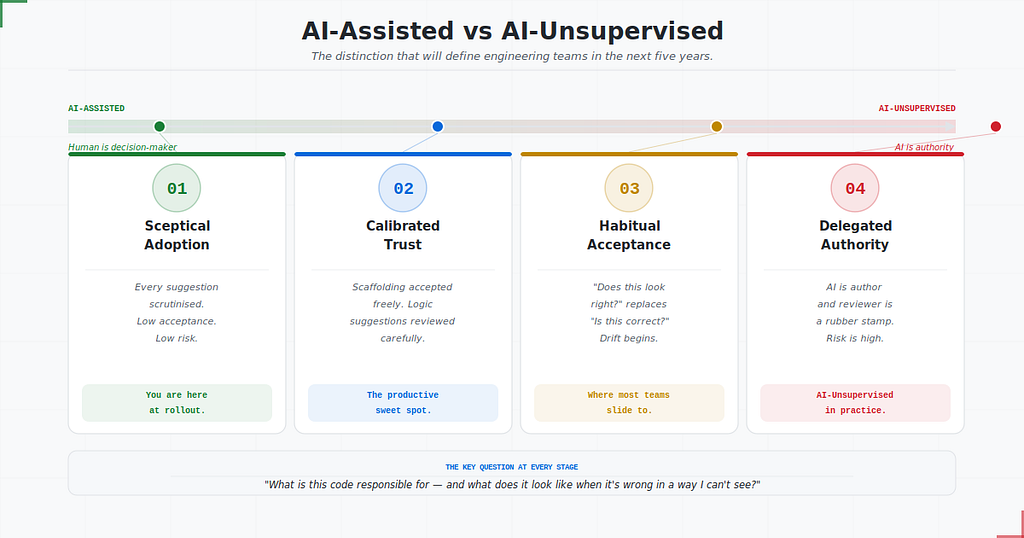
Stage 1 — Skeptical Adoption The team is new to the tool. Every suggestion gets scrutinized. Acceptance rates are low. The team is probably leaving productivity gains on the table, but the quality risk is minimal. This is where every team starts.
Stage 2 — Calibrated Trust Developers have learned where the tool is reliable and where it isn’t. Scaffolding suggestions get accepted freely. Logic suggestions get scrutinized carefully. This is the productive sweet spot — genuinely AI-Assisted development. The goal is to stay here.
Stage 3 — Habitual Acceptance The tool has been reliable often enough that scrutiny drops. Suggestions get accepted on pattern recognition rather than evaluation. The developer’s internal question shifts from “is this correct?” to “does this look right?” Those are different questions — and the gap between them is where production bugs are born.
Stage 4 — Delegated Authority The human’s role is primarily to trigger the AI and ship what comes back. Review is cursory. Test coverage is whatever Copilot wrote. The AI is the author and the reviewer is a rubber stamp.
Most teams start at Stage 1 and drift naturally toward Stage 3 over time. The drift feels like confidence. It looks like efficiency. It is neither — it’s the erosion of the critical layer that makes AI-Assisted development safe.
The incidents I’ve documented across this series — the AsNoTracking race condition, the early bug escape rate uptick, the audit trail gaps in our AI microservice — weren't random. They were the measurable signature of that drift. If you want the specifics, they're in the previous articles. The point here is the pattern: every failure I've written about happened at Stage 3, not Stage 4. The team wasn't reckless. They were experienced developers who had learned to trust a tool that was reliable 90% of the time — and got caught in the 10%.
What Pulls Teams Toward Stage 3
Understanding the drift matters more than condemning it. There are real forces at work.
Speed pressure adjusts expectations. When AI tools make you faster, stakeholders notice. The pressure to maintain that speed creates incentive to reduce friction — and critical review feels like friction.
Cognitive load is finite. When Copilot generates more code faster, the total review load increases even as per-suggestion review time decreases. Something gives. Usually it’s depth of scrutiny.
Pattern recognition is seductive. Experienced developers are good at recognizing correct-looking code. Copilot produces a lot of correct-looking code. The danger is that “looks correct” and “is correct in all cases” are genuinely different things — and the gap between them is exactly where AI hallucinations live.
Failures are asymmetric. Happy path code almost always works. Edge case failures are rare, intermittent, and hard to attribute. A developer who has accepted hundreds of Copilot suggestions without incident develops a reasonable prior that the suggestions are reliable. That prior is correct in aggregate and dangerous in specific cases.
None of this is a character flaw. It is a predictable response to how these tools work and how engineering teams operate under pressure. The counterpressure's have to be intentional — because the drift is automatic.
The Agentic Horizon
The stakes of this distinction are about to get significantly higher. And this is the part of the conversation that almost nobody is having yet.
The industry is moving rapidly from AI that suggests code to AI that writes, tests, commits, and deploys code. Agentic coding — where an AI system takes a task description and executes it end-to-end with minimal human checkpoints — is arriving faster than most teams have thought through the implications.
In that world, AI-Unsupervised isn’t a gradual drift. It’s the default mode.
The human’s role becomes reviewing pull requests generated entirely by an AI agent — often at a volume and speed that makes deep review impractical. The same questions that matter at the suggestion level become harder to ask at the PR level, because the surface area is larger, the output is more polished, and the pressure to merge and move on is greater.
A developer at Stage 2 — who has built the habit of asking “what is this code responsible for when it’s wrong in a way I can’t see?” — will carry that question into agentic PR review. It will feel natural because it’s already ingrained.
A developer at Stage 3 will apply the same habitual acceptance to agentic PRs that they apply to suggestions. The volume will be higher. The output will look more complete. The gaps will be the same ones that were always there — in the failure paths, the edge cases, the concurrent behaviour — just harder to find in a 500-line AI-generated PR than in a 10-line inline suggestion.
The mental journey from simple prompting to agentic coding that teams are navigating now isn’t just about learning new tools. It’s about whether the habits of AI-Assisted development are deeply enough ingrained to survive the step change in AI autonomy. The teams that form those habits now, at the suggestion level, will be far better positioned when agentic tools become the norm.
The habits form now. The agentic wave arrives regardless.
Staying at Stage 2
If Stage 3 is the drift, Stage 2 is the discipline. It doesn’t require elaborate process. It requires three things applied consistently.
Map your codebase by consequence. Not all code deserves the same level of AI scrutiny. Identify the areas where being wrong is expensive and invisible — billing logic, audit writes, concurrency, core abstractions. Apply a higher standard in those areas. Not because AI is untrustworthy there, but because the specific failure modes are harder to see and more costly when they manifest.
Own the failure paths explicitly. Copilot writes happy paths. Someone on your team must be responsible for the unhappy ones. For every AI-suggested implementation with external dependencies, someone asks: what does this code do when the dependency fails? That question will not be asked by the AI. It has to come from a human who understands the system.
Make invisible constraints visible. Anywhere the code does something that a future AI suggestion might “optimize” away, leave a comment explaining the intent — not what the code does, but why it does it that way. These comments protect against future drift. They are written for the next developer, and for the next AI suggestion that will look at the code without knowing what it is protecting.
None of this is bureaucracy. It is the minimum viable discipline for staying at Stage 2 while still getting the productivity benefits of Stage 3.
The Sentence, Unpacked
The future of development is AI-Assisted. Not AI-Unsupervised.
What it means, precisely:
AI tools are not going away. They will get more capable, more integrated, and more autonomous. The productivity gains are real and the industry will capture them regardless of whether individual teams are thoughtful about it.
But the teams that build trustworthy software with these tools — reliably, over time, in domains where being wrong is expensive — will be the ones that stayed at Stage 2. Not by slowing down. Not by distrusting the tools. By maintaining the one thing that makes fast, AI-assisted development safe: the human judgement layer that asks the questions the AI cannot.
The AI is the accelerator. The human is the driver.
Both matter. Only one of them is responsible for where you end up.
This article is the fifth in a series on AI-Assisted development:
- Beyond the Prompt — Why Static Analysis is the Digital Immune System of AI-Augmented Development
- From Hallucination to Production Bug: A Post-Mortem on AI-Generated Code
- I Expected GitHub Copilot to Make Us Better Engineers. It Didn’t — But It Did Something Else.
- Using AI to Build AI: Lessons from Building an AI Orchestration Layer with GitHub Copilot
AI-Assisted vs AI-Unsupervised: The Distinction That Will Define Engineering Teams was originally published in Level Up Coding on Medium, where people are continuing the conversation by highlighting and responding to this story.