A few years ago, “being good at DeFi” meant finding high APY before everyone else.
--
Today?
Being good at DeFi means surviving your own strategy management.
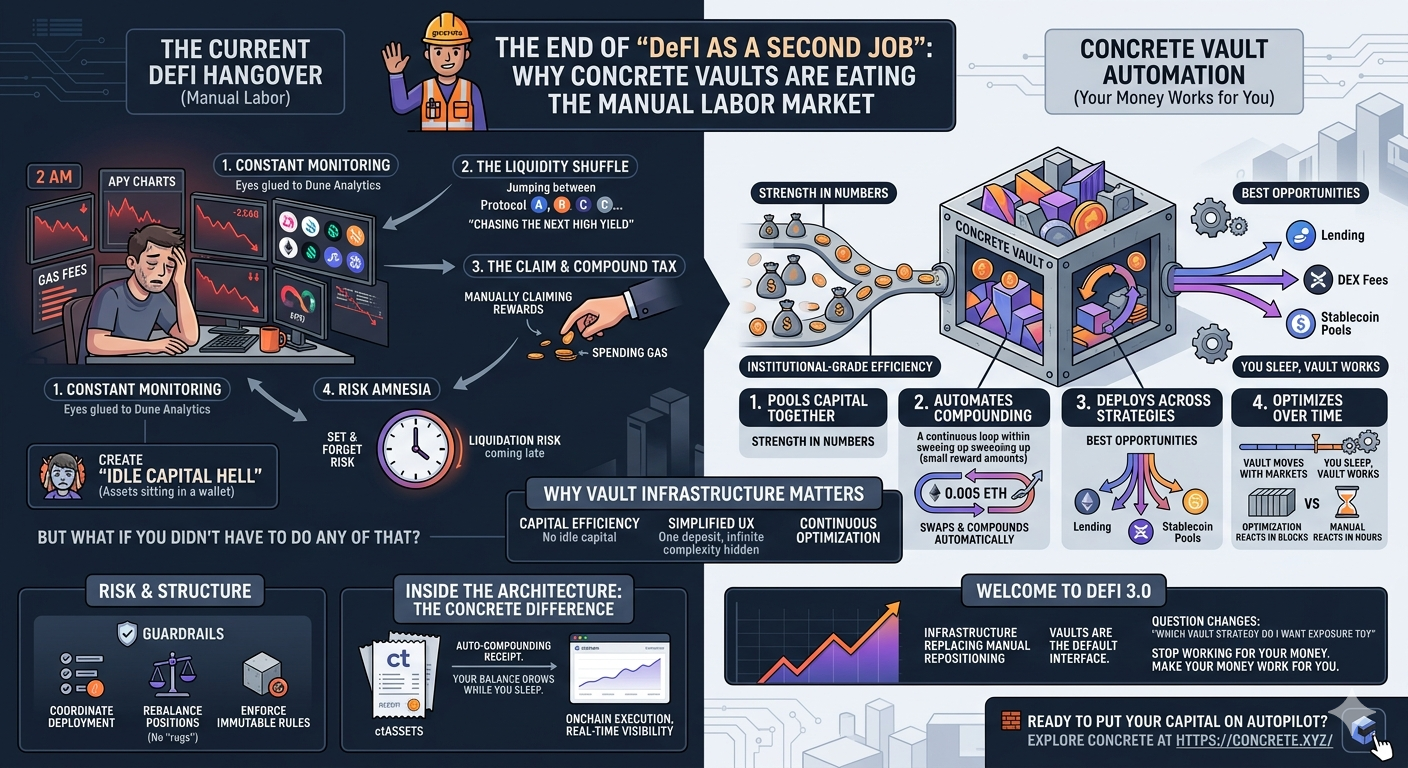
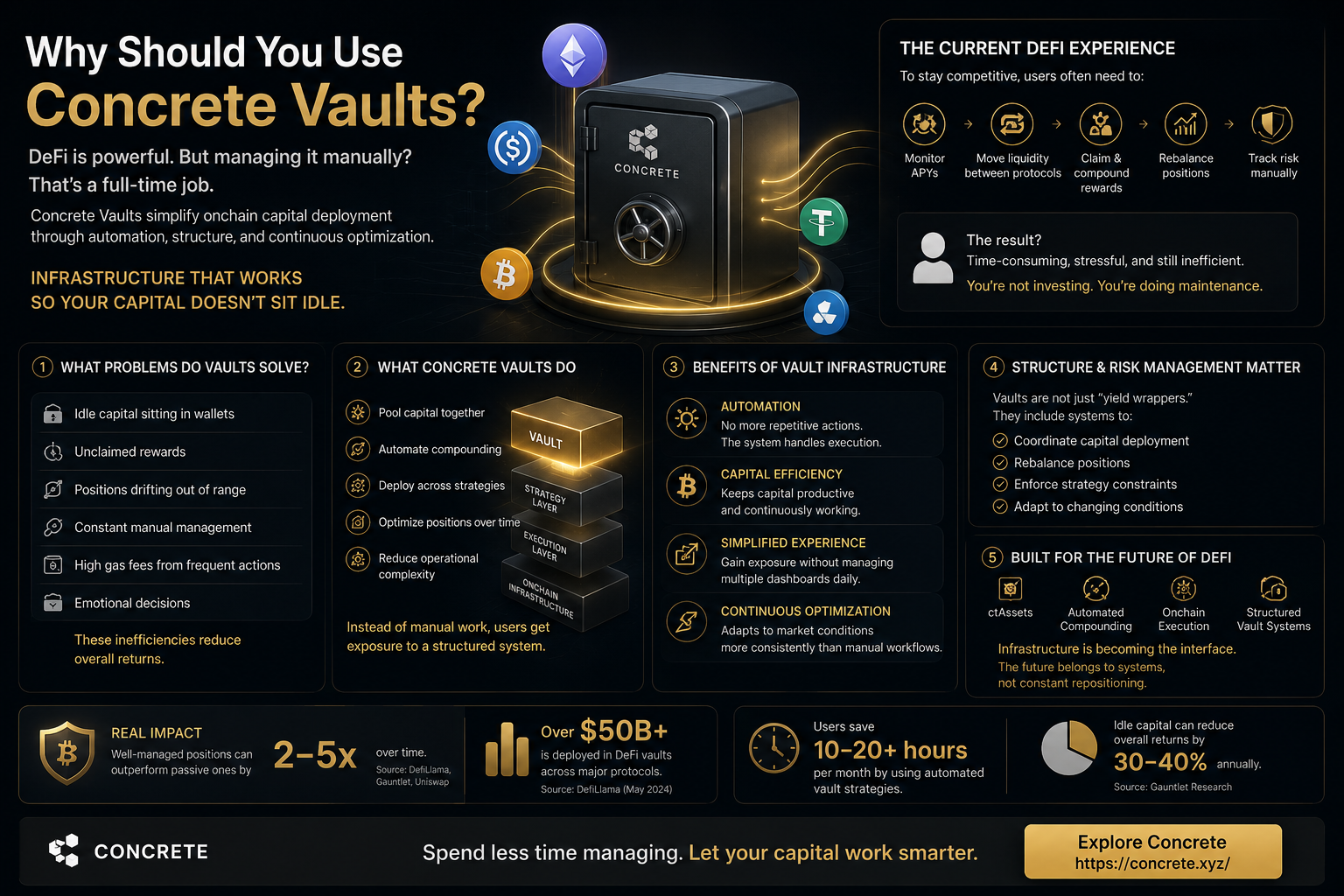
Because modern DeFi users are doing all of this manually:
— checking APYs across protocols
— moving liquidity between chains
— claiming rewards
— compounding yield
— rebalancing LP positions
— monitoring risk exposure
Every.
Single.
Week.
At this point some portfolios need more maintenance than old motorcycles.
And the funny part?
Even after all this work, a huge amount of capital still sits inefficiently onchain.
Rewards stay unclaimed.
Liquidity drifts out of range.
Capital sits idle in wallets doing absolutely nothing.
This is the hidden problem DeFi vaults are trying to solve.
🧱 The current DeFi experience is inefficient by design
The deeper DeFi evolves, the harder manual management becomes.
Take concentrated liquidity as a real example.
When Uniswap V3 launched, it massively improved capital efficiency compared to older AMM models.
But there was a catch.
Users suddenly had to actively manage liquidity ranges.
If ETH moved outside your range:
your capital stopped earning fees efficiently.
So users either:
— constantly rebalanced manually
— or watched performance slowly decay
The result?
Many people realized DeFi was becoming less “passive income”
and more:
“part-time liquidity operations manager.”
That shift changed everything.
Because once DeFi becomes operationally complex, infrastructure becomes more valuable than raw APY.
🧱 What Concrete Vaults actually do
Concrete Vaults are designed to reduce that complexity through structured DeFi systems.
Instead of manually repositioning funds every time markets shift, users can deposit into vault infrastructure built to coordinate capital more efficiently.
Concrete Vaults help users:
— pool capital together
— automate compounding
— deploy across strategies
— optimize positions continuously
— reduce operational overhead
The important idea here is not just automation.
It’s coordination.
Rather than thousands of users independently trying to optimize positions manually…
Vault systems centralize strategy execution into a structured framework.
That changes the user experience completely.
Instead of managing every action yourself, the vault architecture handles ongoing optimization behind the scenes.
🧱 Why vault infrastructure matters
A lot of people still think vaults are just:
“yield wrappers.”
But modern DeFi vaults are becoming infrastructure layers for onchain capital deployment.
That infrastructure matters because DeFi itself has become extremely fragmented.
Today capital moves across:
— lending markets
— DEX liquidity
— derivatives platforms
— cross-chain ecosystems
— yield aggregators
Managing this manually does not scale forever.
Vault systems solve several major problems.
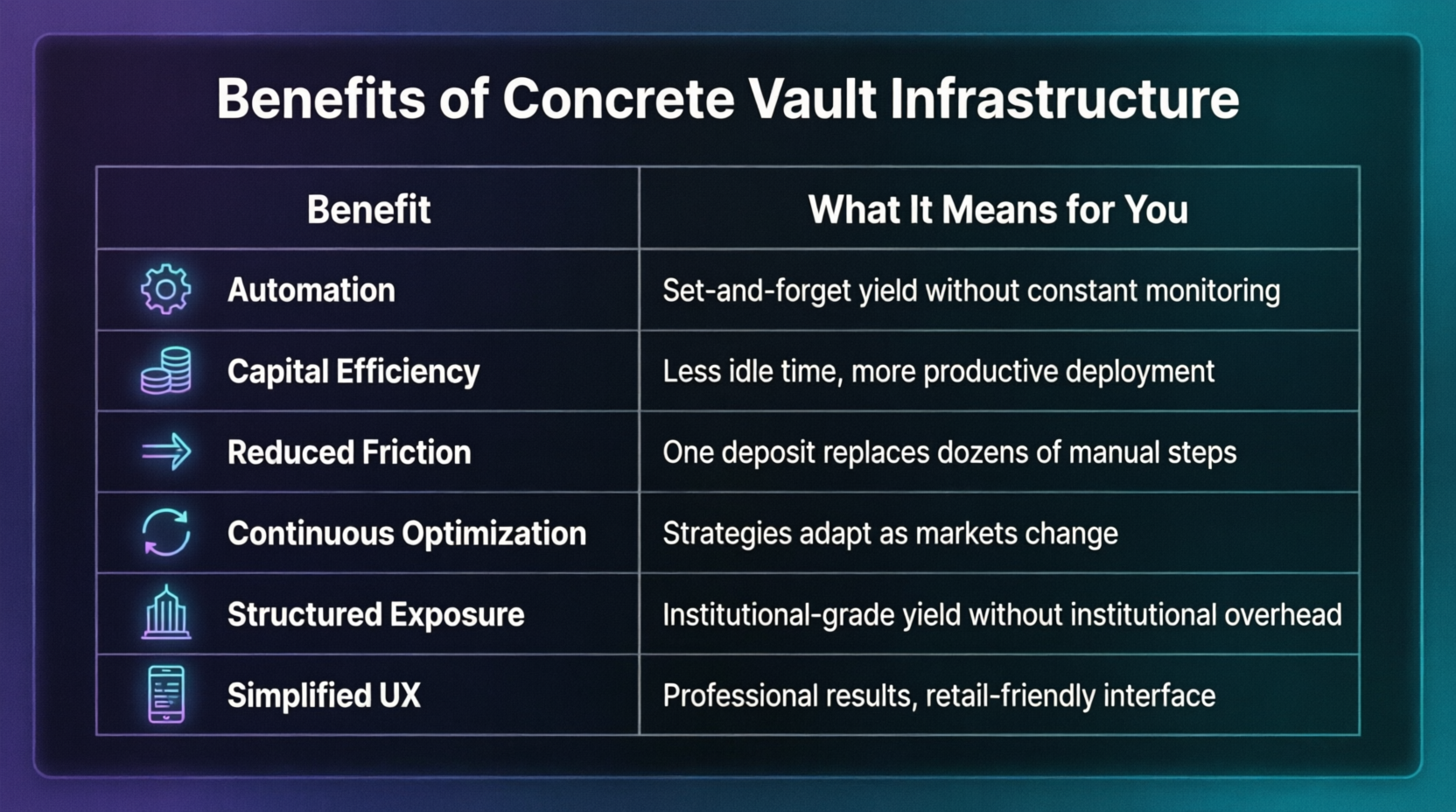
⚙️ Automation
Users no longer need to manually compound rewards or reposition constantly.
The vault structure handles repetitive execution automatically.
💰 Capital efficiency
Idle capital is one of the largest inefficiencies in DeFi.
Vault systems reduce inactive assets by continuously deploying and optimizing capital.
🧩 Simplified participation
Most users don’t want to monitor six dashboards daily just to maintain yield exposure.
Vault infrastructure simplifies the experience.
📈 Continuous optimization
Markets move continuously.
Structured vault systems can respond more consistently than manual workflows.
Especially because humans are emotional.
One bad market candle and suddenly people are tweeting:
“DeFi is dead”
for the 48th time.
🧱 Why structure and risk management matter
Concrete Vaults are not designed as simple “deposit and pray” products.
The underlying structure matters.
Vault systems need mechanisms to:
— coordinate capital deployment
— rebalance positions
— enforce strategy constraints
— adapt to changing conditions
This becomes increasingly important as institutional DeFi grows.
Because institutions don’t deploy capital based on vibes and motivational tweets.
They care about:
— execution efficiency
— structured exposure
— operational consistency
— scalable systems
And honestly, DeFi is slowly moving in that direction too.
We already saw what happens when systems lack structure during the yield farming mania of 2021.
Protocols offered massive emissions.
Capital rushed in.
Liquidity disappeared weeks later.
The issue wasn’t just unsustainable APY.
The issue was unstable coordination.
Vault infrastructure attempts to solve this by introducing systems that manage capital more systematically over time.
🧱 How Concrete Vault architecture fits into this evolution
Concrete Vaults use systems like ctAssets, automated compounding, and onchain execution to coordinate structured capital deployment across opportunities.
Instead of users manually chasing every yield opportunity themselves…
Vault infrastructure becomes the operational layer.
That means:
— positions can be optimized continuously
— rewards can be compounded automatically
— capital can remain productive longer
— strategy execution becomes more scalable
This is especially important as DeFi complexity continues increasing.
Because eventually, the biggest edge in DeFi may not be:
“who finds the next protocol first.”
It may be:
“who coordinates capital most efficiently.”
🧱 The bigger shift happening now
DeFi is evolving away from constant manual repositioning.
That model simply becomes too inefficient at scale.
The future increasingly points toward:
— structured DeFi
— automated systems
— coordinated vault infrastructure
— efficient onchain capital deployment
In other words:
Infrastructure is becoming the interface.
The same way cloud infrastructure replaced manually managing physical servers…
Vault systems may eventually replace much of today’s manual DeFi workflow.
And the users who adapt earliest may spend less time babysitting positions…
while their capital continues working efficiently onchain.
Explore Concrete at https://concrete.xyz/