62.68% Return in 30 Days Beats the S&P 500 With 5-Minute Semiconductor Signals
--
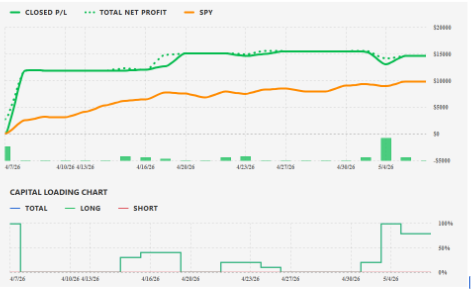
Market volatility in 2026 has reached levels not seen since the pandemic-era trading boom, with semiconductor stocks swinging 3–7% intraday as geopolitical tensions, AI infrastructure spending, and interest-rate uncertainty reshape global capital flows. In this environment, speed and adaptability matter more than ever — and that is exactly where Tickeron’s AI-powered trading robots are gaining attention. One standout performer is the Semiconductors (ENTG) — Trading Results AI Trading Agent, 5min, which delivered an impressive +62.68% return, a 65.50% win rate, and a 2.49 profit factor while outperforming the S&P 500 both last month and this quarter. The robot combines ultra-fast Financial Learning Models (FLMs), real-time signal adaptation, and short-duration execution windows to react to fast-moving semiconductor momentum. Traders searching for high-frequency AI-assisted strategies are increasingly turning to tools like Tickeron’s Trending Robots as volatility creates both risk and opportunity across global markets.
Key Takeaways
- Point 1: 62.68% Monthly Performance — The ENTG-focused AI Trading Agent significantly outperformed broad market benchmarks during a volatile quarter.
- Point 2: 5-Minute AI Signals — Rapid machine-learning execution allows the robot to react faster than traditional swing-trading systems.
- Point 3: Semiconductor Momentum Focus — The strategy targets one of the strongest sectors benefiting from AI infrastructure expansion and global chip demand.
- Point 4: Advanced Risk Controls — Built-in stop-loss corridors, dynamic position sizing, and signal confirmation systems help reduce emotional trading decisions.
- Point 5: Multi-Agent Expansion — Tickeron’s upgraded FLM infrastructure enabled new 15-minute and 5-minute AI agents with faster learning cycles and improved market responsiveness.
The semiconductor sector remains one of the most important battlegrounds in today’s financial markets. Massive AI datacenter spending from hyperscalers, continued supply-chain reshoring in the United States, and geopolitical competition over advanced chips continue driving institutional capital into semiconductor equities. Stocks like ENTG, AVGO, SOXS, and INTC have become central to AI trading strategies because of their liquidity, volatility, and strong correlation with AI infrastructure growth. ENTG benefits from semiconductor materials demand tied to advanced chip fabrication. AVGO continues gaining momentum from AI networking and custom chip demand. SOXS, the inverse semiconductor ETF, allows traders to capitalize on sharp downside volatility during geopolitical shocks or sector pullbacks. Intel remains highly relevant due to U.S. government support for domestic chip manufacturing and restructuring efforts. Recent market headlines surrounding AI datacenter expansion, export restrictions on advanced chips, and renewed Middle East tensions have amplified trading activity in these names, creating ideal conditions for high-frequency AI-driven systems.
At its core, the robot operates using a short-duration momentum and volatility-capture strategy. The system continuously scans intraday price movement, volume spikes, sector rotation signals, and technical pattern probabilities before initiating trades. The 5-minute architecture allows the AI to identify rapid momentum shifts that many traditional systems miss. Signal generation incorporates trend strength, relative volatility, and liquidity analysis, while execution layers apply strict stop-loss management and adaptive take-profit targets. For example, Tickeron’s corridor-based systems, such as the INTC AI Trading Agent with TP 3% / SL 2%, use predefined exit ranges to lock in gains while limiting downside exposure. Position sizing dynamically adjusts according to confidence levels generated by the model. Traders using these robots should understand that shorter timeframes increase trading frequency and require disciplined capital allocation, but they also create opportunities to exploit intraday inefficiencies that human traders often cannot process quickly enough.
Tickeron’s competitive edge comes from its proprietary Financial Learning Models (FLMs), a next-generation AI framework designed specifically for financial markets. Unlike traditional algorithms that rely heavily on static indicators or fixed historical rules, FLMs continuously adapt by learning from evolving market conditions, price-action structures, and behavioral shifts. These models integrate technical analysis with machine-learning feedback loops, enabling the system to identify probability-driven setups with greater speed and precision. Recent infrastructure upgrades significantly increased Tickeron’s computational capacity, allowing FLMs to react faster to market changes and accelerating the development of new 15-minute and 5-minute AI trading agents. According to Sergey Savastiouk, Ph.D., CEO of Tickeron, the mission is to democratize institutional-grade AI trading technology for retail investors while reducing emotional decision-making. By combining transparency, real-time analytics, and automated execution logic, Tickeron aims to give independent traders access to tools once reserved primarily for hedge funds and quantitative trading firms. Traders can explore additional AI systems through Tickeron’s AI Robots and Virtual Agents platform.
Looking ahead, the outlook for semiconductor-focused AI robots remains constructive, particularly if volatility stays elevated and AI infrastructure spending continues accelerating globally. Market conditions favoring this robot include strong sector momentum, elevated intraday trading ranges, and sustained institutional participation in semiconductor names. Continued growth in AI servers, cloud infrastructure, and defense-related semiconductor demand could create additional opportunities in tickers like AVGO, ENTG, and INTC. However, traders should remain realistic: AI systems perform best when disciplined risk management is paired with favorable market liquidity and trend persistence. For investors seeking a structured, data-driven approach instead of emotional trading, Tickeron’s robots offer a compelling combination of automation, analytics, and adaptive learning. Current promotional offers, including up to 75% discounts celebrating Tickeron’s 10-year anniversary, are available through the Tickeron Sale Page.
Risks & Important Disclaimer
- Semiconductor stocks can experience extreme volatility due to geopolitical developments, earnings surprises, or regulatory changes.
- Short-term AI trading systems may generate frequent trades, increasing exposure to slippage and transaction costs.
- Leveraged or inverse products such as SOXS carry amplified risk and may not be suitable for all investors.
- AI models depend on historical and real-time data patterns, which may fail during unprecedented market events.
- Past performance metrics, including win rates and annualized returns, do not guarantee future profitability.
Disclaimer: The information on this webpage is provided for general informational and educational purposes only and is not intended as investment advice, a recommendation to purchase or sell any security, or an offer or solicitation related to investments. It does not consider your personal financial situation, goals, or risk profile, and all investing carries inherent risks, including the possibility of losing your entire investment. For more details, please review Tickeron’s full disclaimer: Disclaimers and Limitations
This is for educational and informational purposes only. It is not financial advice. Past performance does not guarantee future results. Always do your own research or consult a licensed advisor. Prices can go down as well as up.