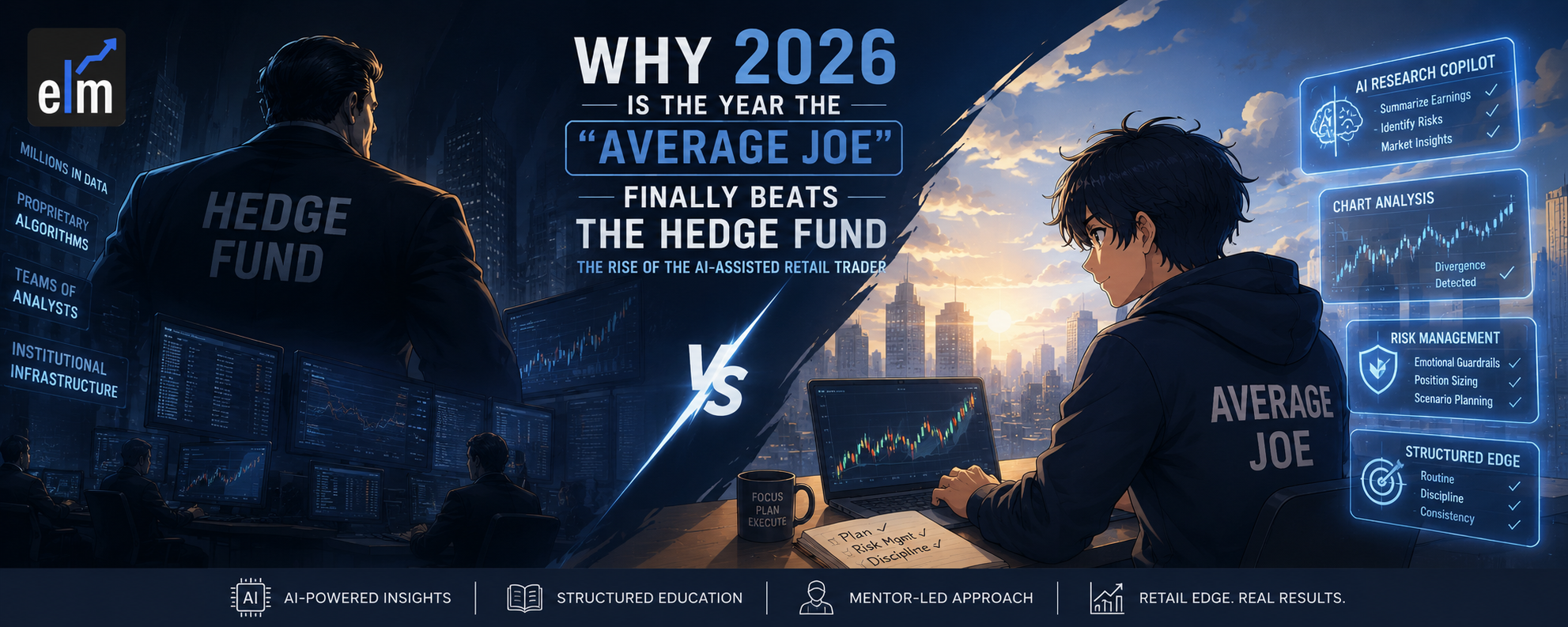
Why 2026 is the Year the “Average Joe” Finally Beats the Hedge Fund: The Rise of the AI-Assisted Retail Trader
 Elearnmarkets4 min read·Just now
--
For decades, the “David vs. Goliath” narrative in the stock market was mostly a myth. While retail traders were squinting at lagging indicators on free charting software, hedge funds were spending millions on Bloomberg terminals, high-frequency algorithms, and a small army of analysts to scrape through 200-page earnings reports.
The playing field wasn’t just uneven, it was a different sport entirely.
But as we move through 2026, the script has flipped. The “Average Joe” is no longer bringing a knife to a gunfight, they’re bringing a Co-pilot. Through the integration of Large Language Models (LLMs) like ChatGPT, Gemini, and Claude, the retail trader has finally gained the one thing that used to be exclusive to the 1%: The power of a dedicated research department.
The End of Information Asymmetry
In the past, the biggest hurdle for a beginner was “The Fog.” You’d hear about a stock, try to read an SEC filing, get lost in the jargon of a 10-K, and eventually give up or follow a “tip” from a random YouTuber.
In 2026, AI-assisted traders are doing things differently:
- Instant Synthesis: Instead of spending six hours reading an earnings transcript, traders now feed the document into an AI to identify specific sentiment shifts. A prompt as simple as “Highlight the three biggest risks mentioned by the CEO that weren’t in the previous quarter’s report” can save hours of manual labor.
- Multimodal Chart Analysis: With the ability of AI to “see” images, beginners are using tools to double-check their own technical analysis. By uploading a screenshot of a chart, a trader can ask, “Do you see a divergence between the RSI and price action here?” It’s like having a NISM-certified mentor looking over your shoulder.
From “Vibes-Based” Trading to Structured Routines
The reason 90% of retail traders lose money isn’t a lack of intelligence; it’s a lack of structure. Most people trade based on “vibes” or news headlines. Institutional traders, conversely, follow a rigid, repeatable process.
This is where AI is truly leveling the field. Retail traders are now using AI to build and maintain a Structured Daily Routine.
Imagine it’s 8 PM. In the old days, you’d be scrolling Twitter for ideas. Today, a modern mentor-led approach teaches you to use AI as your Chief Operating Officer:
- The Post-Market Review: Feed your daily trade log into an AI to spot emotional patterns (e.g., “I notice I tend to exit winning trades too early on Tuesdays”).
- The Pre-Market Checklist: Use AI to aggregate global macro data — bond yields, oil prices, and currency shifts — into a 2-minute briefing tailored to your specific portfolio.
- Scenario Planning: Before the market opens, you can ask an AI to simulate “What if” scenarios: “If the RBI raises rates by 25 bps tomorrow, which of my current holdings are most at risk based on their debt-to-equity ratio?”
The Strategic Edge: Agility and Personal Risk Management
Why the Human Still Matters
With all this talk of AI, it’s easy to think the “Human” part of the equation is obsolete. It’s actually the opposite. In 2026, AI has commoditized data, leaving only judgment and psychology as the remaining edge.
Hedge funds still struggle with “crowded trades” and institutional inertia. A retail trader, armed with AI for analysis and a solid foundational education, can move faster, stay more objective, and manage their own risk without the pressure of quarterly redemptions.
The “Average Joe” is beating the hedge fund not by being a better “calculator,” but by using AI to handle the math so they can focus on being a better “strategist.”
The Verdict: Don’t Trade Alone
The rise of the AI-assisted trader doesn’t mean you should jump into the deep end without a life jacket. The most successful traders this year are those who combined AI efficiency with structured human mentorship.
The goal isn’t to let the AI trade for you — that’s a recipe for disaster. The goal is to use AI to simplify the market until it becomes a language you can speak fluently.
If you’ve been sitting on the sidelines because the market felt “too complicated,” 2026 is officially your year to stop making excuses. The tools are free, the data is open, and the playing field has never been flatter.
At Elearnmarkets, we explain how options are priced, why theta works against short-dated buyers, and which trade structures give retail traders a real advantage. We believe that understanding the instrument before trading it is a necessity, not a luxury. By combining institutional-grade technology with Elearnmarkets’ professional mentorship, the “average Joe” now has more than a fighting chance. They have the Edge.
This document is for informational and educational purposes only and does not constitute financial, investment, or legal advice. Always consult with a certified financial advisor before making any investment decisions.