Your Bitcoin Is Worth 23,762 Loaves of Bread. Here’s Why That Matters More Than the Dollar Price.
 Crypto Stuff Converter6 min read·Just now
--
Every crypto app on your phone does the same thing. You open it, you see a number, and that number is in dollars. Bitcoin: $71,000. Ethereum: $2,200. Dogecoin: $0.09.
But what does $71,000 actually mean?
Not in theory. Not in “store of value” arguments on Twitter. In real life — what does your Bitcoin actually buy?
I spent the last few months building a tool to answer that question. And the answers are more interesting — and more disturbing — than I expected.
The dollar price is a distraction
When Bitcoin hit $69,000 in November 2021, crypto Twitter celebrated. When it hit $71,000 this month, the reaction was quieter. Same price range, right?
Wrong. In November 2021, a loaf of bread cost $2.50. Today it costs $2.99. A gallon of gas was $3.40. Today it’s $3.80. Rent was $1,550. Today it’s $1,750.
So your Bitcoin is nominally worth more dollars — but those dollars buy less stuff. The number on your screen went up. Your actual purchasing power may not have.
This is the gap that nobody in crypto is tracking. Until now.
What your crypto actually buys today
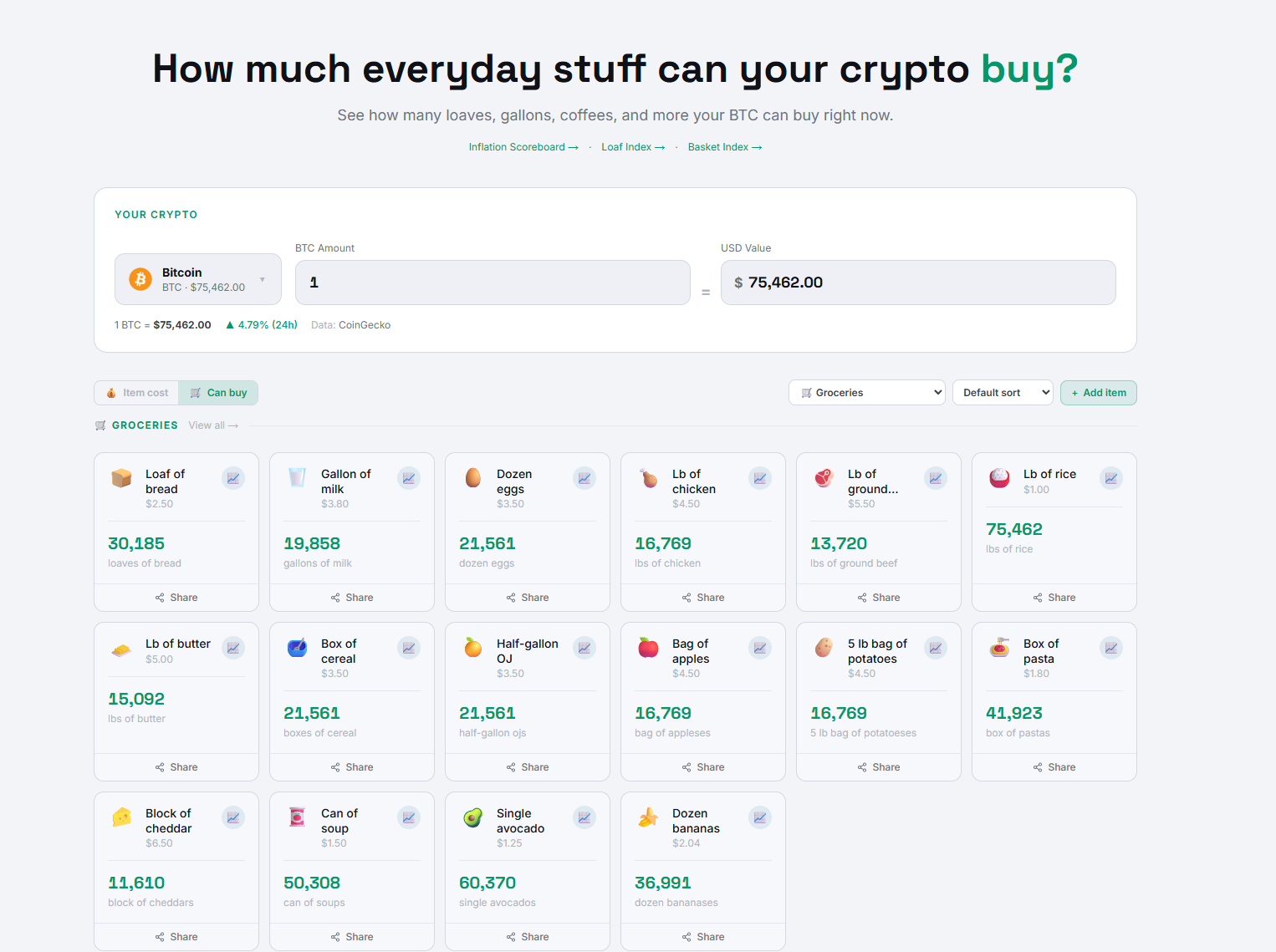
I built CryptoStuffConverter to translate crypto holdings into things people actually buy. Not dollars — stuff. Here’s what the data shows right now:
1 Bitcoin ($71,000) buys:
- 23,762 loaves of bread
- 18,684 gallons of gas
- 40 months of rent (that’s 3.3 years)
- 1.69 Tesla Model 3s
- 8.8 Super Bowl tickets
- 0.17 average US homes (you need about 6 BTC for a house)
1 Ethereum ($2,200) buys:
- 736 loaves of bread
- 579 gallons of gas
- 1.26 months of rent
- 4.4 AirPods Pro
1 Dogecoin ($0.09) buys:
- 0.03 loaves of bread (you need 33 DOGE for one loaf)
- 0.02 gallons of gas (you need 42 DOGE to fill one gallon)
- 0.00005 months of rent (you need about 19,400 DOGE for one month)
That last one stings. But it puts things in perspective in a way that “$0.09” never does.
The numbers that will make you uncomfortable
When you start pricing everyday life in crypto, some results are genuinely alarming:
Healthcare in crypto is dystopian. An ambulance ride costs 0.017 BTC. Giving birth in the United States costs 0.266 BTC. A single Tylenol at a hospital — one pill — costs 0.00035 BTC. That same pill costs 0.0000017 BTC at CVS. The hospital charges 200x more, and it looks even more absurd when you see it in satoshis instead of dollars.
The cost of existing is enormous. Raising a child to age 18 costs 4.37 BTC. A wedding costs 0.49 BTC. A divorce costs 0.21 BTC. A funeral costs 0.11 BTC. From birth to death, life’s major milestones add up to roughly 6 BTC — about the same as one average US home.
Some items reveal how broken pricing is. A gallon of printer ink costs $4,500 — making it one of the most expensive liquids on Earth. That’s 0.063 BTC per gallon. For context, a gallon of gasoline costs 0.0000535 BTC. Printer ink costs 1,180x more than gasoline per gallon.
The nostalgia hits different. A Blockbuster late fee was $1 — or 0.000014 BTC. If you’d skipped that late fee in 2010 and bought Bitcoin instead, those 14 satoshis would be… well, still basically nothing. But the 10,000 BTC someone spent on two pizzas in 2010 would buy $710 million worth of stuff today. At current bread prices, that’s 237 million loaves. Enough to give every person in the United States seven loaves each.
Crypto purchasing power is falling — even when prices rise
Here’s the finding that surprised me most.
I built a Crypto Basket Index that tracks how many everyday items a fixed amount of crypto can buy over time. Think of it as the Consumer Price Index, but for crypto.
Bitcoin’s price is roughly flat over the last 90 days. But its purchasing power — measured in actual goods — is down. Gas prices spiked 21.2% in March alone. Grocery prices are up 2.7% year over year. The dollar price of Bitcoin didn’t move much, but the stuff it buys got more expensive.
This is the metric nobody talks about. Every crypto influencer tweets about price. Nobody tweets about purchasing power. But purchasing power is the only thing that matters if you ever plan to actually spend your crypto on anything — or convert it to dollars and spend those dollars.
When Bitcoin goes up 10% and inflation eats 4%, your real gain is 6%. When Bitcoin goes sideways and inflation runs at 3.3%, you’re losing purchasing power every day you hold. That’s not a bear case for crypto — it’s just math that nobody is doing.
The $0.02 conversion that changes how you think about money
The most searched conversion on the site so far isn’t Bitcoin to houses or Ethereum to rent. It’s the cheap stuff. People want to know what a single Dogecoin buys. What a single Shiba Inu token is worth in real terms.
And the answer is humbling.
1 DOGE buys 0.03 loaves of bread. Not three loaves. Not a third of a loaf. Three hundredths of a loaf. A slice, maybe, if you’re being generous.
1 SHIB buys approximately one crumb.
But zoom out. If you bought $100 of Dogecoin at its 2021 peak of $0.74, you got 135 DOGE. Today that’s worth $12.15 — enough for exactly one avocado toast in Brooklyn. If you bought $100 of Dogecoin in January 2020 at $0.002, you got 50,000 DOGE. Today that’s worth $4,500 — enough for one gallon of printer ink, or a year of daycare, or a down payment on a used Honda Civic.
Same coin. Same holder. Radically different bread-buying power depending on when you got in.
Why this matters for your portfolio
I’m not here to tell you to buy or sell anything. But I am going to suggest that you start thinking about your crypto differently.
Instead of asking “what’s my portfolio worth in dollars?” — ask “what does my portfolio buy?”
If the answer last month was “a used car” and this month it’s “most of a used car,” you lost purchasing power. Even if the dollar number looks the same. Inflation is invisible when you only look at prices in dollars. It becomes extremely visible when you look at prices in bread.
The Crypto Basket Index tracks this every day. It measures what your crypto can actually purchase across a basket of 20 everyday items — bread, gas, coffee, rent, eggs, and more. When the index is above 100, your crypto buys more stuff than on the baseline date. Below 100, it buys less.
It’s the simplest, most honest measure of whether holding crypto is making you richer or poorer in real terms.
Try it yourself
The full converter is free at CryptoStuffConverter.com. Pick any crypto, see what it buys across 200+ items, from a single french fry ($0.02) to the International Space Station ($150 billion).
Some starting points:
- How much Bitcoin for a loaf of bread?
- How much Dogecoin for a pack of cigarettes?
- How much Ethereum for a month of rent?
- How much Shiba Inu for a Lamborghini?
- The Crypto Basket Index — real purchasing power over time
The full April 2026 Crypto Purchasing Power Index report is also published with methodology, data sources, and more findings.
Your crypto has a dollar price. But it also has a bread price, a gas price, a rent price, and a cigarettes price. Once you see all of them, the dollar price stops being the only number that matters.
Data sourced from CoinGecko (crypto prices) and U.S. Bureau of Labor Statistics (item prices). Updated hourly. Not financial advice — just bread math.