Why You Should Stop Managing DeFi Manually (and Let a Vault Do It)
 Dizcorvus3 min read·Just now
--
Most people who’ve been in DeFi long enough know the routine. You find a good yield. You move liquidity there. A week later, a better APY shows up somewhere else. You chase it. Rewards pile up unclaimed. Positions drift out of balance. Before long, you’re spending more time managing positions than actually earning from them.
That’s not a personal failure. That’s just what manual DeFi looks like at scale.
The Real Cost of Manual Strategy
The problem isn’t that users are lazy. The problem is that DeFi protocols move fast, and the gap between “checking occasionally” and “actively optimizing” is where a lot of yield gets left on the table.
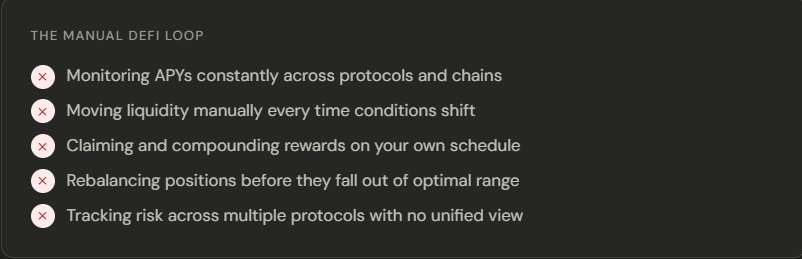
To stay competitive, a typical DeFi user needs to:
- Monitor APYs across multiple protocols
- Move liquidity when better opportunities appear
- Claim and compound rewards regularly
- Rebalance positions as market conditions shift
- Track risk exposure manually across chains
Do all of that right, and you’re basically running a small asset management operation. Miss any of it, and capital sits idle or underperforms. The infrastructure was never built for this kind of constant attention.
This is exactly the problem Concrete Vaults are built to solve.
What a Concrete Vault Actually Does
A Concrete Vault pools capital from users and deploys it through a structured, automated system. Instead of each user managing their own positions, the vault coordinates capital across strategies automatically.
In practical terms, this means:
- Capital gets pooled rather than fragmented across individual wallets
- Compounding happens automatically, not when you remember to claim
- The vault deploys across yield opportunities without manual input
- Positions get rebalanced based on changing conditions
- Operational complexity moves off the user entirely
The result is structured DeFi exposure without the operational overhead. Users deposit, and the vault handles the rest.
The Mechanics Behind the Efficiency
This is where it gets more interesting than just “yield aggregator.”
Concrete Vaults aren’t simply routing capital to the highest APY at a given moment. The architecture includes coordination logic that enforces strategy constraints, responds to changing market conditions, and manages capital deployment in a more disciplined way.
A key part of this is ctAssets — tokenized representations of vault positions. When you deposit into a Concrete Vault, you receive ctAssets that represent your share of the pooled capital. These assets track your position while the vault does the work underneath: automated compounding, onchain execution, rebalancing.
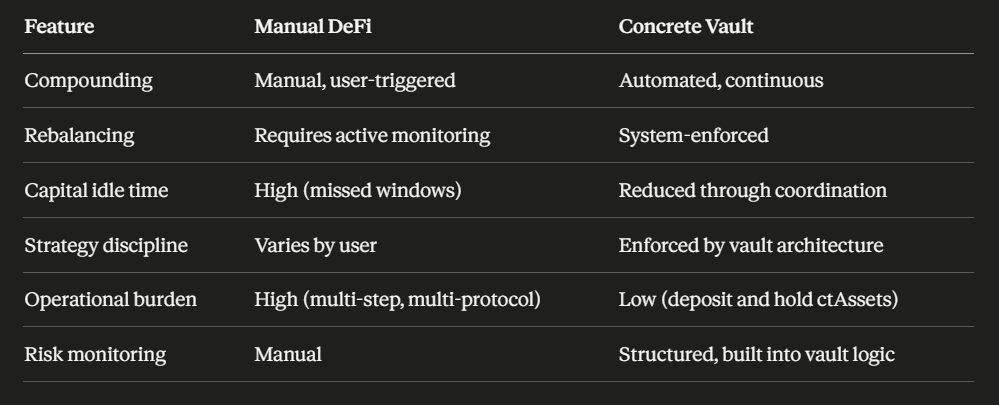
FeatureManual DeFiConcrete VaultCompoundingManual, user-triggeredAutomated, continuousRebalancingRequires active monitoringSystem-enforcedCapital idle timeHigh (missed windows)Reduced through coordinationStrategy disciplineVaries by userEnforced by vault architectureOperational burdenHigh (multi-step, multi-protocol)Low (deposit and hold ctAssets)Risk monitoringManualStructured, built into vault logic
Why Capital Efficiency Matters More Than APY
There’s a tendency in DeFi to optimize for the headline number. But idle capital — capital sitting between moves, waiting to be compounded, or parked in a position you haven’t gotten around to rebalancing — is a real drag on returns.
Concrete Vaults reduce idle capital by design. The vault is always deployed, always compounding, always responding. No waiting for a user to log in and click buttons.
This matters more as DeFi becomes more complex. Chains multiply. Protocols layer on top of each other. The surface area a manual trader needs to cover keeps expanding. Infrastructure that handles onchain capital deployment automatically doesn’t just save time — it becomes the more rational approach.
The Bigger Shift Happening in DeFi
DeFi is maturing. The early years rewarded users who were fast, attentive, and willing to manually chase yield across protocols. That model still works if you have the time and technical depth. But it doesn’t scale.
What’s replacing it is infrastructure — systems designed to coordinate capital more efficiently than any individual can. Concrete Vaults represent that direction. Not a simpler interface on top of the same manual process, but actual institutional DeFi-grade logic running underneath.
The users who are still clicking between protocols all day aren’t wrong. They’re just doing a job that’s increasingly being automated.
The future of DeFi probably belongs to the infrastructure, not the individual.
Explore Concrete at https://concrete.xyz/