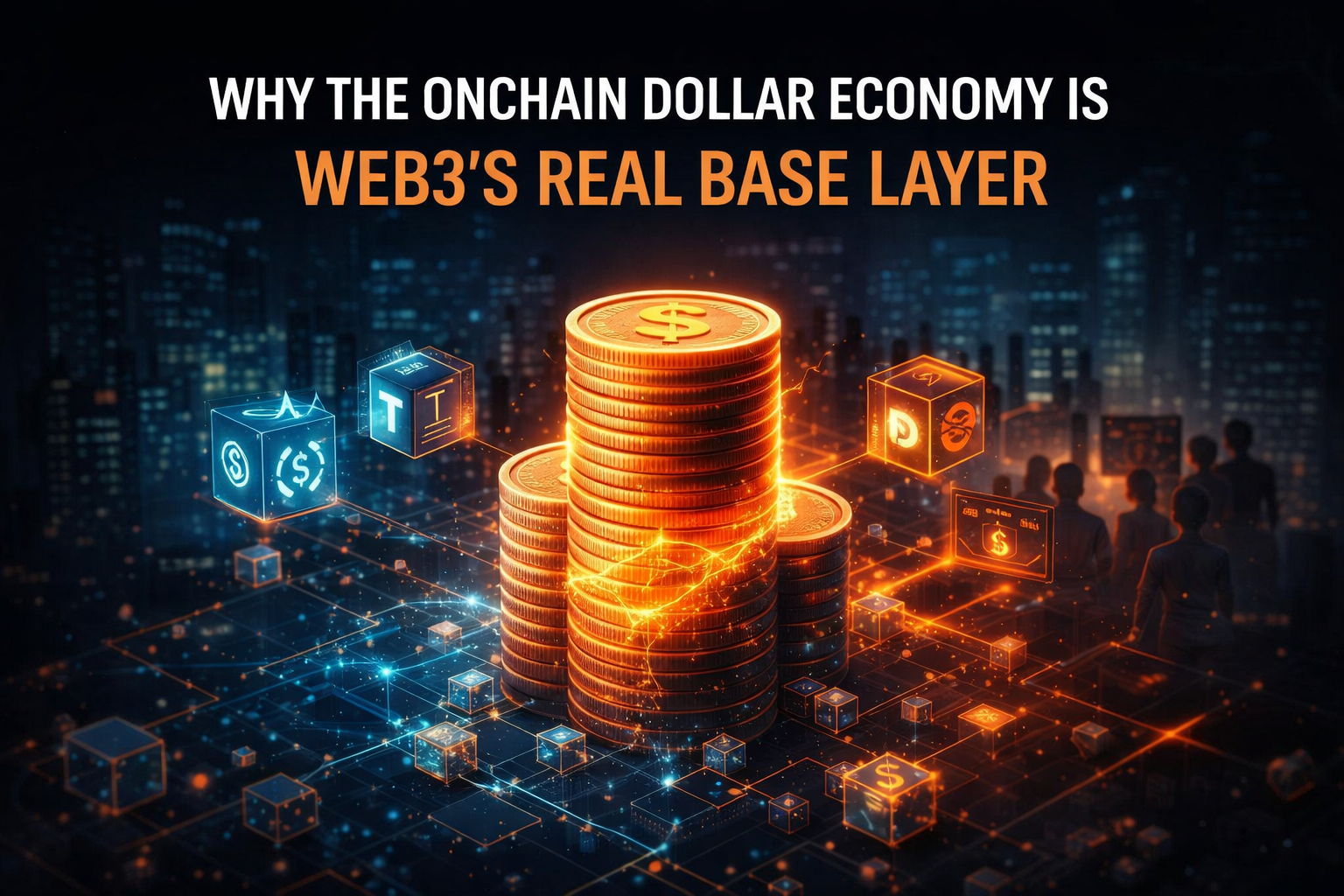
Why the On-chain Dollar Economy Is Becoming Web3’s Real Base Layer
 Mytier Universe Official Blog7 min read·Just now
--
Web3 may still speak in the language of tokens. But its real economic center of gravity is increasingly moving toward dollar liquidity, settlement, and yield distribution.
TL;DR
The Web3 economy is shifting from a structure centered on token speculation to an infrastructure economy built on the onchain dollar (stablecoins). The defining question of this new era is no longer “Which token captures attention?” What matters now is who controls the dollar settlement layer and who captures the yield generated on top of it. For builders and projects like Mytier, long-term competitiveness will depend on how well they build around trusted settlement, deep liquidity, and credible value distribution.
For years, the Web3 economy was largely framed through speculation.
The conversation centered on token launches, governance assets, emissions, incentives, and price cycles. Value was often measured by market cap, narrative strength, or the speed at which capital rotated from one sector to another.
But that framework is no longer sufficient.
A different kind of foundation is forming beneath the visible surface of speculation. And increasingly, that foundation looks less like a new class of crypto-native money and more like an onchain version of the dollar.
Stablecoins are no longer just a convenient instrument for trading. They are becoming the monetary base layer of Web3.
That shift matters because base layers do more than support activity. They determine where liquidity sits, how settlement happens, who captures yield, and which institutions gain structural influence over the economy built on top of them.
The Question Has Changed
The key question in Web3 economy is no longer simply “Which token captures attention?”
Increasingly, it is this:
Who controls the dollar layer, and who keeps the yield generated on top of it?
That is why the recent regulatory debate matters.
The U.S. Treasury’s first proposed rule under the GENIUS Act, announced in April 2026, addresses how payment stablecoin issuers may be regulated and under what conditions certain issuers may operate under state-level regulatory regimes. One week later, an additional proposal followed, focused on anti-money laundering and sanctions compliance.
This is not a marginal policy detail.
It shows that stablecoins are no longer being treated like peripheral crypto products. They are being treated more like core financial infrastructure.
At the same time, the White House Council of Economic Advisers published a paper that directly addresses the heart of the economic debate. Its conclusion was clear. Even if yield on stablecoin holdings were prohibited, bank lending would increase by only $2.1 billion, or 0.02%, while net welfare costs would reach $800 million. Even under stacked worst-case assumptions, the report found that the case for a yield ban remained weak.
That matters because it reframes the policy fight.
The issue is no longer whether stablecoins matter.
They clearly do.
The issue is whether the yield generated by the assets backing stablecoins should remain within the banking system, be captured by issuers, or be passed through to users in some form.
This is not just a regulatory question.
It is an economic question about who gets to own the most important margin in the emerging onchain dollar economy.
Stablecoins Are Becoming Infrastructure
A market becomes infrastructure when it begins to provide a standard for settlement, liquidity, and trust across other forms of activity.
That is exactly what is happening with stablecoins.
Stablecoins are increasingly being used not only for trading, but also for payments, collateral movement, treasury operations, and cross-platform settlement. Recent CoinDesk research suggests that stablecoins remain above $300 billion even in a weaker market environment, while tokenized assets, payments, and onchain transaction volume continue to grow.
This is why stablecoins should no longer be analyzed as a niche crypto category.
They are becoming closer to an operating layer.
And once that becomes clear, the rest of the Web3 economy starts to look different.
Governance tokens may still matter.
Protocol fees still matter.
Application-layer incentives still matter.
But all of these are increasingly sitting on top of a more fundamental reality: the system needs a trusted settlement asset, deep dollar liquidity, and a credible mechanism for moving value across platforms, protocols, and institutions.
Put differently, speculation may have accelerated Web3’s growth.
But dollar liquidity is what is beginning to sustain it.
Yield Is the Real Fault Line
The most important economic conflict inside the onchain dollar economy is not simply about payments.
It is about yield.
Stablecoin reserves are typically backed by cash equivalents and short-duration Treasury-related assets. As stablecoins scale, the question of who benefits from that reserve structure becomes impossible to ignore.
There are only a few possible answers.
Yield can remain embedded within the issuer model.
It can be suppressed by regulation.
It can be competed away through product design.
Or it can, at least partly, flow back to users.
Each of these paths implies a different Web3 economy.
If yield remains trapped at the issuer layer, scale will tend to concentrate power in the hands of the largest stablecoin operators and their closest institutional partners.
If regulation blocks yield distribution entirely, the economics of participation become more centralized and less competitive.
If yield begins to flow outward, stablecoins stop being passive instruments and start to resemble programmable savings infrastructure.
That is why the fight over stablecoin yield matters.
It is not a side debate.
It is a struggle over who captures the economic surplus of the next financial base layer.
Tokenization Makes the Stakes Bigger
Once tokenization enters the picture, the issue becomes even more important.
According to the IMF, tokenization is not simply an efficiency upgrade. It is a structural shift in financial architecture that changes the nature of settlement, liquidity management, and systemic risk. The long-term success of tokenized finance depends on public trust, safe settlement assets, and robust governance.
Tokenization does not remove trust from finance.
It reorganizes it.
And in most cases, that trust still needs an anchor asset.
Right now, the strongest candidate for that role is neither a governance token nor a volatile crypto-native asset.
It is the onchain dollar.
That is why stablecoins and tokenized finance should not be discussed separately.
They are converging into the same economic architecture.
One provides the settlement anchor.
The other expands the range of assets, liabilities, and workflows that can move across that anchor.
What This Means for Web3 Builders
The lesson for builders is straightforward.
The next stage of Web3 economy will not be won simply by launching more tokens or designing better narratives.
It will be shaped by who can build around three things:
trusted settlement, deep liquidity, and credible value distribution.
That means the core economic design questions are changing.
It is no longer enough to ask:
- How do we attract users?
- How do we incentivize participation?
- How do we create token demand?
The harder and more durable questions are now:
- What asset does the system settle in?
- Who controls the reserve economics?
- Who captures the yield?
- And how much trust is concentrated in the institutions operating that layer?
These may look like economic questions.
But in reality, they are infrastructure questions.
What This Means for Mytier
This shift is especially important for Mytier.
If Web3 is moving toward an economy organized around onchain dollars, settlement assets, and programmable trust, then the real opportunity is not in chasing short-term token narratives. It lies in understanding the infrastructure logic beneath them and becoming clear about what role can be played on top of that layer.
This is where Mytier can begin to matter.
As the onchain dollar economy starts to handle hundreds of billions of dollars in foundational liquidity, the risks associated with AI-driven cyberattacks and the arrival of quantum computing are likely to become more serious. In response to these emerging vulnerabilities, Mytier is positioning itself around a decentralized security infrastructure that combines AI-based active defense with Post-Quantum Cryptography (PQC). That direction matters because it is aimed at strengthening the resilience of trust across the core financial layers and protocols that support the onchain dollar economy.
In other words, Web3 economy should no longer be understood merely as a sequence of speculative cycles. It increasingly needs to be understood as a system defined by base layers of liquidity, authority, and secure settlement.
In that world, the most important assets are not always the loudest ones.
Sometimes the most important layer is the one that quietly makes every other layer possible, and quietly protects it.
That is what the onchain dollar economy is becoming.
Not just a tool for transactions,
but a real base layer on which much of Web3’s next economic structure may be built.
And Mytier is a project trying to stand in the direction of making that layer more secure.
Author: Jackie Skyla — Mytier Senior Analyst
Mytier is building the foundational Web3 infrastructure for the post-quantum era.
🌐 Website: [Link]
🐦 X (Twitter): [Link]
💬 Telegram: [Link]
— — — — — — — — — — —
References
[1] U.S. Department of the Treasury — Treasury Seeks Public Comment on GENIUS Act Notice of Proposed Rulemaking Concerning State-Level Regulatory Regimes (April 1, 2026)
[2] U.S. Department of the Treasury — Treasury Proposes Rule to Implement the GENIUS Act’s Requirements to Counter Illicit Finance (April 8, 2026)
[3] The White House Council of Economic Advisers — Effects of Stablecoin Yield Prohibition on Bank Lending (April 2026)
[4] IMF Notes — Tokenized Finance (April 2026)
[5] CoinDesk Research — Digital Assets 2026: Above the Noise (March 2026)