Why the CLARITY Act Quietly Makes Ethereum the Biggest Winner in Crypto
--
May 12, 2026
The Senate Banking Committee released its 309-page substitute text of the Digital Asset Market Clarity Act this morning. Most of the coverage will focus on which tokens fail the new decentralization test, which issuers face new disclosure burdens, and which projects need to restructure within the four-year graduation window. That coverage is correct but incomplete.
The more important story is what the bill does to the one asset that clears every prong of the test and happens to be the only programmable smart contract platform that does. Once this framework becomes law, Ethereum will occupy a regulatory category in U.S. law that has exactly one member. Two of the dominant bear theses against ETH for the last five years die simultaneously, and the market hasn’t caught up yet.
Context: Two Bills, One Framework
Before getting into the substance, the broader regulatory architecture deserves a brief recap, because public discussion has been conflating two distinct pieces of legislation.
The GENIUS Act (Guiding and Establishing National Innovation for U.S. Stablecoins Act) was signed into law by President Trump on July 18, 2025. It established the first federal regulatory framework for payment stablecoins: 1:1 reserve requirements with liquid assets, monthly reserve disclosures, federal or state licensing for issuers, prohibitions on algorithmic stablecoins, and a key restriction that stablecoin issuers cannot pay interest or yield directly to holders. GENIUS covers USDC, USDT, and bank-issued stablecoins. It does not cover anything else.
The CLARITY Act is everything else. It handles the SEC and CFTC jurisdictional split, the decentralization test for non-stablecoin tokens, exchange registration, DeFi treatment, custody rules, and the ancillary asset framework. The two bills are complementary pieces of the broader regulatory architecture.
Most general financial media coverage of CLARITY has focused on stablecoin yield, because the bill’s Title IV section on “Preserving Rewards for Stablecoin Holders” was the political flashpoint that nearly killed it. Banks pushed to prohibit indirect yield through exchanges and DeFi protocols, since yielding stablecoins compete with deposits. Crypto exchanges pushed to preserve it. The bipartisan compromise reached on May 1, 2026 unblocked the bill but kept it on a knife’s edge through several markup delays.
That fight matters, but it is one section of a nine-title bill. For anyone who actually holds and trades non-stablecoin tokens, the more consequential provision is buried in Section 104, and almost no one is talking about its second-order effects on asset valuation.
The Test
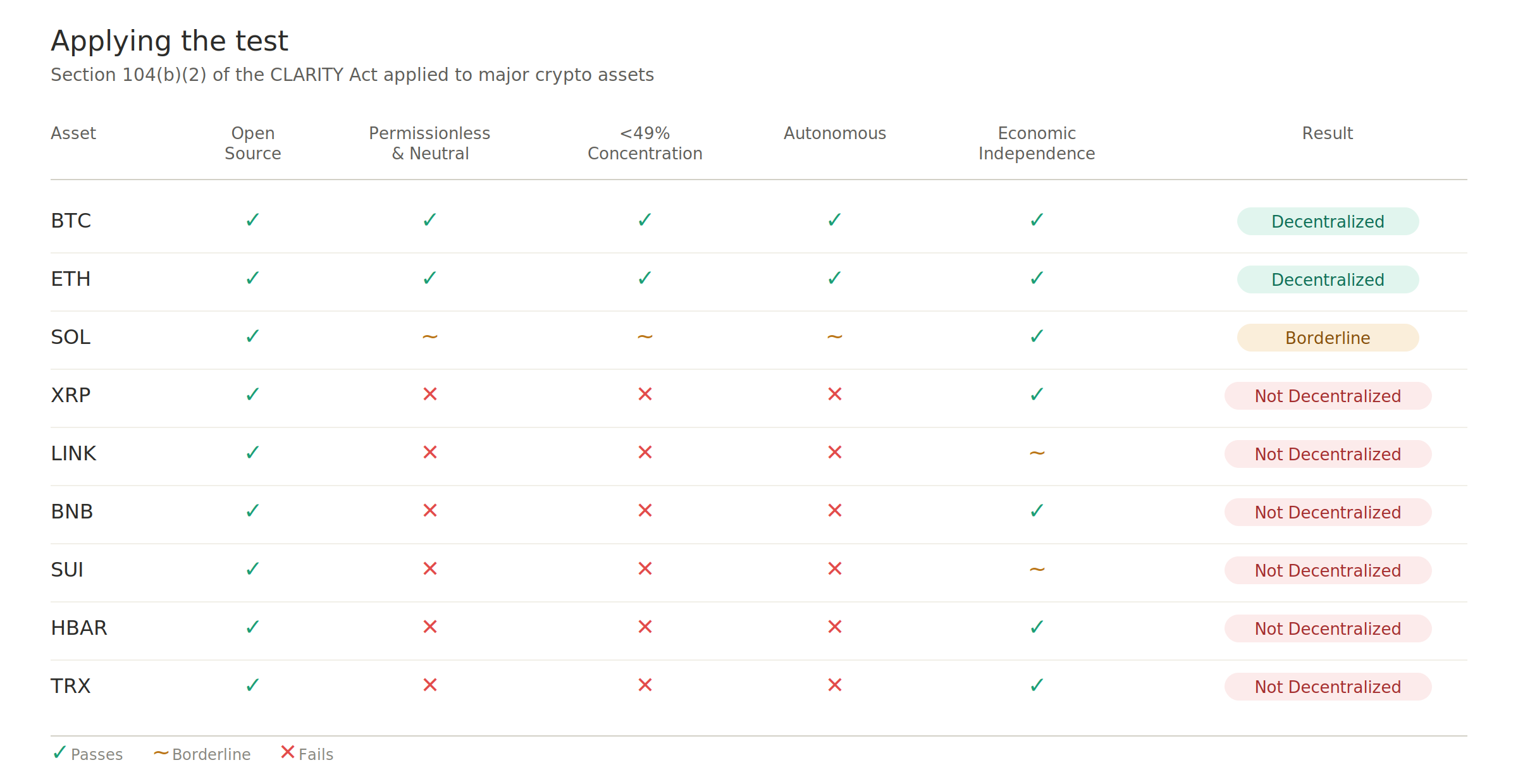
Section 104(b)(2) of the bill directs the SEC to weigh five criteria when determining whether a network and its token are under coordinated control:
- Open Digital System. Is the protocol publicly available open-source code?
- Permissionless and Credibly Neutral. Can any coordinated group censor users or grant themselves hardcoded preferential access?
- Distributed Digital Network. Does any coordinated group beneficially own 49% or more of outstanding tokens or voting power?
- Autonomous Distributed Ledger System. Has the network reached an autonomous state, or does someone retain unilateral upgrade authority?
- Economic Independence. Are the primary value-accrual mechanisms actually functional?
A network that fails this test produces a “network token” that is presumed to be an “ancillary asset,” meaning a token whose value depends on the entrepreneurial or managerial efforts of an identified originator. That classification triggers semiannual disclosure obligations, insider resale restrictions modeled on Rule 144, and primary offering registration requirements. Secondary trading on exchanges continues uninterrupted.
The 49% threshold is the headline number, and it is substantially more permissive than the House CLARITY Act’s 20% line. Networks that fail at 49% fail for genuine structural reasons rather than technicalities.
Bitcoin and Ethereum clear every prong without controversy. Solana sits on the line, with foundation influence over upgrades, heavy early insider allocations, and a history of coordinated network halts cutting against the autonomous and credibly neutral prongs. Every other major smart contract platform fails for structural reasons that are not easily remedied. That list includes XRP, BNB Chain, Sui, Hedera, and Tron, and by extension most of the L1 competitive set.
Among assets that clear the test, exactly one has a functioning native smart contract economy.
The Valuation Regime Shift
Tokens trade on two fundamentally different valuation frameworks. The first is the commodity / monetary premium regime, where value derives from scarcity, network effects, store-of-value properties, and reflexive demand, with no fundamentals-anchored ceiling. The second is the cash flow / equity regime, where value derives from revenue capitalized through standard multiples, with hard ceilings imposed by realistic revenue projections.
Most non-Bitcoin tokens have lived in strategic ambiguity between these regimes, marketing themselves on whichever framing produced the higher valuation. The CLARITY Act ends that ambiguity through three mechanisms.
First, disclosure imposes the cognitive frame. Section 4B(d) requires semiannual disclosures including audited financial statements (above $25M), going-concern statements from the CFO, related-party transaction summaries, and forward-looking development costs. Once a token has SEC filings that look like 10-Qs, institutional analysts will value it like they value entities that file 10-Qs. The document format determines the valuation framework.
Second, the statutory definition is itself an admission. An ancillary asset is defined as a token “the value of which is dependent upon the entrepreneurial or managerial efforts of an ancillary asset originator.” That definition is conceptually incompatible with monetary premium, which requires value independent of any issuer’s efforts. A token cannot simultaneously meet the legal definition of an ancillary asset and credibly claim monetary premium pricing.
Third, legible scarcity is fragile scarcity. Monetary premium is reflexive, and reflexivity requires a credible scarcity narrative that the market can collectively believe. The moment a token has SEC-filed treasury disclosures, named insider unlock schedules, and quarterly reports on related-party transactions, the scarcity story becomes legible, and once it is legible, it is no longer reflexive. Investors can see exactly how much supply sits with insiders and exactly when it gets sold. That visibility kills the bid.
The result is a two-tier market. Tier 1 assets trade on monetary premium with no fundamentals-derived ceiling. Tier 2 assets trade on revenue multiples with defensible ceilings. Tokens currently priced on Tier 1 logic that get classified into Tier 2 face structural re-rating. For tokens with weak fundamentals and strong narrative-driven valuations, with LINK and SUI being the clearest examples, the re-rating could be severe.
The Death of the Two ETH Bear Theses
For five years, the case against ETH has rested on two pillars.
The first held that ETH would eventually fail commodity classification and be treated as a security. The pre-mine, the foundation’s continued influence, Vitalik’s public role, and the validator economics post-Merge all gave the SEC plausible grounds to push back if it chose to. Every ETH bull case carried a tail-risk discount for the possibility that institutional access gets restricted.
The second held that ETH would be displaced by faster, cheaper smart contract platforms. Every cycle produced new “ETH killers” such as Solana, Sui, Aptos, Avalanche, Sei, and BNB Chain, each pitched on better UX and lower fees. The argument was that ETH’s technical limitations would force economic activity to migrate, diluting value capture.
The CLARITY Act does not just weaken these theses. It structurally inverts them.
The first thesis dies because ETH clears all five Section 104 criteria cleanly. No coordinated control, no ownership concentration approaching 49%, no unilateral upgrade authority post-Merge, fully open-source, value accrual functional. The regulatory tail risk that justified the persistent discount evaporates.
The second thesis dies in a more interesting way. The “ETH killers” only compete with ETH when they are valued on the same regime. If SOL gets certified as decentralized, the competition continues. If it does not, and every other major smart contract competitor will not, they get forced into Tier 2 valuation while ETH remains in Tier 1. The competitive set changes. A Tier 2 asset cannot compete with a Tier 1 asset on monetary premium because the entire point of Tier 1 is that no fundamentals-based ceiling applies. The faster, cheaper chains can still win on transaction throughput and developer mindshare in specific verticals. They cannot win on the asset valuation framework that matters most for L1 market cap.
The Category of One
Among assets that clear the Section 104 test, Ethereum is the only one with a functioning native smart contract economy. Bitcoin clears the test but does not host programmable finance at the base layer. Every smart contract platform with meaningful TVL fails the test in one or more material ways. That includes Solana, BNB Chain, Sui, Tron, Avalanche, Near, Aptos, and Cardano.
The bill therefore creates a regulatory category, decentralized digital commodity with native smart contract economy, that currently has exactly one member.
Every traditional financial institution exploring tokenization, settlement, custody, or onchain finance needs two things: programmability and regulatory clarity. Before CLARITY, those properties were strictly disjoint. Bitcoin was clean but not programmable. Smart contract platforms were programmable but legally ambiguous. After CLARITY, Ethereum is the only asset that delivers both within a single statutory category.
Anyone building tokenized treasuries, tokenized funds, onchain settlement infrastructure, or institutional DeFi access has a clearly preferred substrate once this framework takes effect. The preference is not aesthetic or technical. It is compliance-driven. Asset managers, custodians, and bank-affiliated funds operate within legal frameworks that favor commodity-classified assets and disfavor securities-adjacent ones. The institutional flow follows the classification, and the classification has narrowed to one programmable asset.
The Sound Money Question
Once both BTC and ETH share Tier 1 classification, the comparison between them on monetary properties becomes worth examining carefully, because the conventional framing gets it backwards.
Bitcoin’s appeal has always rested on a tentatively fixed supply schedule of 21 million coins with predictable halvings every four years. This is genuinely valuable as a scarcity narrative, and the simplicity of the story is part of why BTC achieved monetary premium first. But the BTC supply model carries three structural burdens that are rarely discussed alongside the scarcity argument.
First, mining produces persistent structural selling. Network security depends on miners covering real-world operational costs: electricity, hardware, hosting, financing. Those costs are denominated in fiat, which means miners must sell a meaningful portion of newly issued BTC into the market continuously, regardless of price. That selling is permanent, price-insensitive, and baked into the consensus mechanism itself. It is the cost of having a proof-of-work security model.
Second, BTC offers no native yield. Holders who want yield must either lend BTC to a counterparty (introducing credit risk) or move it onto a non-BTC platform (introducing custody and bridge risk). The opportunity cost of holding non-yielding BTC compounds over time relative to assets that generate native yield. For institutional holders who measure performance against benchmarks that include yield, this is a real and persistent drag.
Third, the mining subsidy cliff is a long-tail risk to the very decentralization that makes BTC eligible for Tier 1 classification. Block rewards halve every four years and approach zero by 2140, but the practical pressure starts much earlier. By the 2030s, subsidy revenue will be a small fraction of what it is today, and fee revenue has to make up the difference to maintain security. If fee markets do not develop sufficiently, the lowest-cost mining operators consolidate, miner concentration increases, and the credibly neutral decentralization that Section 104 rewards starts to erode. This is not an imminent risk, but it is a structural one that the BTC model has not solved.
Ethereum inverts each of these properties.
ETH has variable issuance with no fixed cap, which is the headline argument used against it by sound-money purists. The framing is superficial. What actually matters for holders is the rate at which their share of total supply changes, not whether the supply schedule has a fixed terminal value. Under Ethereum’s post-Merge design, all issuance is distributed to validators as staking rewards. Validators earn yields that have historically run above the issuance rate, meaning anyone who stakes maintains or grows their share of total supply over time. The “infinite supply” argument is rhetorically punchy but mathematically moot for any holder who participates in the validator set or holds liquid staking tokens.
The structural selling that burdens BTC does not exist on ETH at the same scale. Validators have minimal operational costs relative to their yield. Solo staking requires a one-time hardware purchase and trivial ongoing electricity. Liquid staking and pooled staking abstract even that away. Issuance accrues to the validator set and is largely retained, not dumped into the market to cover costs. The same security model that distributes yield to holders also avoids the price-insensitive selling that proof-of-work requires.
The subsidy cliff problem does not exist either. Ethereum’s security budget scales with the value of staked ETH and is funded through ongoing issuance plus fee revenue. There is no predetermined date at which security funding falls off. The model is self-sustaining in a way that BTC’s becomes increasingly dependent on fee market development that may or may not materialize.
None of this is an argument that ETH replaces BTC. They serve different roles in an institutional portfolio. BTC is the simpler, more legible, more politically defensible scarcity asset. ETH is the productive monetary collateral that pays holders to participate in its security. The point is that the conventional framing that BTC is “harder money” than ETH because of the fixed supply cap collapses on close inspection. ETH’s variable issuance combined with native yield delivers better real economic properties for holders than BTC’s fixed supply combined with zero yield, and it does so without the structural selling pressure or long-term security funding risk.
For institutional allocators building Tier 1 crypto exposure, this matters. The case for ETH alongside BTC is not just “the programmable one” anymore. It is also “the one that pays you to hold it without forcing structural sales to fund its security.”
The Treasury Companies Tell the Same Story
The structural differences between BTC and ETH are not abstract. They manifest concretely on the balance sheets of the two largest corporate treasury vehicles built around each asset. Strategy (MSTR), formerly MicroStrategy, holds the largest corporate Bitcoin position. BitMine Immersion Technologies (BMNR) holds the largest corporate Ethereum position. Looking at how each is funded and how each behaves reveals the underlying supply-side dynamics playing out in real corporate finance.
Strategy holds approximately 780,000 to 818,000 BTC as of May 2026, depending on the reporting week. It funds those purchases through a combination of $8.2 billion in convertible notes (maturing between 2027 and 2032) and approximately $10.3 billion in preferred stock across the STRF, STRK, STRD, and STRC series. The convertible notes must either be converted to equity at maturity (which dilutes existing shareholders) or refinanced (which requires market access at acceptable terms). The preferred stock carries ongoing dividend obligations, with STRC alone requiring approximately $80 to $90 million in quarterly payouts.
Strategy’s operational software business is dwarfed by its treasury position and generates minimal cash flow relative to its obligations. The company has reported three consecutive quarters of losses tied to Bitcoin price declines, including a $12.5 billion net loss in Q1 2026. On May 5, 2026, executive chairman Michael Saylor explicitly broke from his five-year “never sell Bitcoin” mantra during the Q1 earnings call, telling analysts that Strategy might sell some Bitcoin to fund dividends. He revised the framing within days to “never be a net seller” and “buy 10 to 20 Bitcoin for every one sold,” but the directional shift is real. Polymarket’s odds of Strategy selling any Bitcoin by year-end jumped from 13% before the call to 87% after.
The structural reality is straightforward. Strategy’s ability to continue accumulating Bitcoin depends on its ability to issue new debt or preferred stock at terms it can service. On the Q1 2026 earnings call, Saylor articulated the model’s breakeven explicitly: Bitcoin needs to appreciate at approximately 2.3% annually for Strategy’s existing holdings to cover STRC dividend obligations indefinitely without selling common stock. That figure has been reported widely and reflects Saylor’s own published math, but it is one of three conditions that must hold simultaneously. The mNAV premium must stay above approximately 1.22x to justify continued issuance, demand for STRC preferred stock must hold up, and Bitcoin must clear the 2.3% threshold. None of these are catastrophic risks individually, and the 2.3% rate is well below Bitcoin’s historical average. But the rate is also a moving target. STRC’s effective dividend yield has climbed from 9% at launch to 11.5% after seven monthly hikes, which raises the breakeven over time. There is no organic income stream from the underlying asset to fund operations. Strategy must successfully refinance, reissue, or convert to maintain its position.
BitMine Immersion Technologies operates from a fundamentally different posture. As of the most recent disclosures, BMNR holds approximately 3.6 to 5.2 million ETH, depending on the reporting period, with effectively zero debt. The company holds between $400 million and $1 billion in unencumbered cash. Roughly 69% of its ETH holdings are actively staked, generating an estimated $400 million in annual staking revenue through its dedicated MAVAN (Made-in-America Validator Network) infrastructure.
The structural difference is that BMNR generates native yield from its underlying asset. Staking rewards compound regardless of ETH’s spot price. The company does not need to roll debt, refinance preferred stock, or maintain an mNAV premium to fund operations. It can be a passive holder generating cash flow indefinitely, or it can deploy capital actively. The $200 million investment in MrBeast’s Beast Industries in January 2026, alongside the planned “MrBeast Financial” DeFi platform that will be built on Ethereum, represents the latter. BMNR is using its treasury position to participate in and accelerate Ethereum’s economic ecosystem rather than simply hold the asset.
That distinction matters for long-run trajectory. Chairman Tom Lee’s recent comments at Consensus Miami 2026, suggesting that BMNR may slow its ETH accumulation because there are “other things to be doing in crypto right now,” signal that the company sees expansion paths beyond simple accumulation. A Bitcoin treasury company has fewer such paths. There is no native yield to compound, no protocol-level ecosystem to participate in, no equivalent to the validator infrastructure or DeFi integration that ETH enables.
Neither company has been immune to this cycle’s downturn. BMNR is down approximately 80% from its July 2025 peak. MSTR has posted three consecutive quarters of losses. Both have seen their net asset value premiums compress as digital asset treasuries broadly come under pressure. The analysis here is not that one company is winning while the other is losing. It is that the structural mechanics differ in ways that map directly onto the underlying assets they hold.
Strategy’s flexibility comes from continued access to capital markets. BMNR’s flexibility comes from continued staking yield. Strategy must roll debt to maintain its position. BMNR must keep its validators online. Strategy has structural sell pressure baked into its operational requirements. BMNR has structural buy pressure from staking rewards that compound back into the holdings. These are not narrative preferences. They are mechanical consequences of the supply-side properties of the underlying assets.
Where the industry narrative moves from here likely depends on how the next twelve to twenty-four months unfold. If Bitcoin appreciates substantially, Strategy’s model continues to work spectacularly, and the leveraged-BTC thesis remains the dominant institutional crypto narrative. If Bitcoin trades flat or declines, Strategy’s rollover requirements become increasingly burdensome, and the absence of native yield becomes increasingly visible as a structural disadvantage. The Ethereum treasury model has a wider band of conditions under which it remains viable, because the staking yield provides a floor that pure BTC accumulation lacks.
For an industry that is about to receive its first comprehensive regulatory framework under CLARITY, and for an institutional audience that is about to start making decade-long capital allocation decisions based on that framework, the treasury company comparison provides a useful preview of how the abstract supply-side arguments translate into real corporate behavior. The treasuries are leading indicators of where the underlying assets are heading.
Network Philosophy and the Limits of Legal Classification
A subtle but important point that needs to be addressed directly. Even if Solana eventually achieves certification as decentralized under Section 104, that classification alone would not place SOL on the same valuation footing as ETH. Legal classification is necessary but not sufficient for Tier 1 monetary premium treatment. The deeper question is what each network is actually optimizing for, and what its own founders and ecosystem participants believe it should be valued as. On those questions, ETH and SOL have made consciously divergent choices.
Ethereum has, from the beginning, prioritized credible neutrality, reliability, and permanence above raw performance. The network has achieved a decade of 100% uptime, with no major outages since launch. Validator count exceeds one million active validators following the Pectra upgrade in May 2025, distributed globally with the largest concentrations in the US and Europe but with meaningful presence across multiple continents. Average validator uptime sits around 99.2%. The consensus mechanism prioritizes finality and safety over speed, with deliberate constraints designed to ensure that no single party, including the Ethereum Foundation, can unilaterally alter the protocol.
Solana has prioritized throughput and transactional speed. The architecture is optimized for processing as many transactions per second as possible at the lowest possible cost. These are real engineering achievements and they enable use cases that Ethereum’s base layer cannot serve. But they have come at a cost that the Solana ecosystem itself increasingly acknowledges.
The network has experienced at least seven major outages since 2021, including multi-hour halts in January 2022, May 2022, June 2022, September 2022 (18 hours), February 2023 (18+ hours), and February 2024 (5 hours). Each required coordinated validator restarts. The Solana Foundation reports a 16-month outage-free streak as of mid-2025, which is real progress, but the contrast with Ethereum’s never-halted record reflects a fundamental difference in design priority rather than a temporary engineering gap.
Validator metrics tell a similar story. Solana’s active validator count has dropped from approximately 2,560 in early 2023 to roughly 795 in early 2026, a 68% decline. The Nakamoto Coefficient, which measures the minimum number of entities required to control a critical share of the network, has fallen from 31 to 20. The Solana Foundation frames this as healthy pruning of subsidized Sybil nodes that never meaningfully contributed to decentralization, which is a defensible interpretation. The alternative interpretation, that the economic model of running a Solana validator has become uneconomic for smaller operators with annual costs exceeding $49,000 in voting fees alone, is also supported by the data. Both interpretations can be partially correct, but neither produces a network with the geographic and operator diversity that Ethereum maintains.
Client diversity is the cleanest comparison and the one most worth examining, because it directly addresses the structural resilience that monetary collateral requires.
On Ethereum, the consensus layer is healthily diversified. Lighthouse holds roughly 43% of validators, Prysm 31%, Teku 14%, with Nimbus, Grandine, and Lodestar sharing the remainder. No single client holds a supermajority. The execution layer is more concentrated but improving: Geth at around 50% (down from 85% historically), Nethermind at 25%, Besu at 10%, Reth at 8%, Erigon at 7%. This diversity is not theoretical. In September 2025, a critical bug in the Reth client stalled 5.4% of Ethereum nodes, but the network continued operating without disruption because the other clients implemented the protocol independently. Ethereum’s design philosophy explicitly contemplates that any single implementation may fail, and the network’s continued operation does not depend on any one team’s code being bug-free.
On Solana, client diversity has historically been close to nonexistent. For most of its mainnet history, every validator ran some variant of the original Agave codebase. The February 2024 outage halted the entire network because there was no independent implementation to keep operating while the bug was fixed. Today, Jito-Solana, which is a fork of Agave optimized for MEV, holds approximately 72 to 88% of stake. Vanilla Agave holds another 9%. Both share common code ancestry, meaning a bug in core Agave logic could affect roughly 80% of the network simultaneously. Firedancer, developed by Jump Crypto as Solana’s first genuinely independent client implementation, went live on mainnet in December 2025 and holds approximately 7 to 8% of stake. Frankendancer, a hybrid that pairs Firedancer’s networking with Agave’s execution, accounts for another 20 to 26%. The Solana ecosystem targets 50% Firedancer stake by Q2 to Q3 2026, which would represent meaningful progress toward genuine client diversity, but the network remains structurally vulnerable to single-implementation failures until that threshold is crossed.
These differences are not accidents of engineering capability. They reflect deliberate philosophical choices. Ethereum has consistently chosen slower, more conservative paths that prioritize the network’s ability to function regardless of any single team’s code or any single party’s intent. Solana has consistently chosen faster, more performant paths that accept higher coupling and operational dependencies in exchange for speed. Both are valid engineering approaches. They produce assets with different properties.
The asset implications follow directly. The Solana ecosystem itself, including major analyst frameworks from VanEck and 21Shares, increasingly values SOL as a capital asset on a cash flow basis. SOL holders earn returns from network revenue, fee burns, and staking yields, and the asset is priced on its ability to generate those flows. This is internally consistent with Solana’s positioning as financial infrastructure for high-throughput applications. It is also a Tier 2 valuation framework. Co-founder Anatoly Yakovenko has publicly framed Solana as a “global atomic state machine for finance” and emphasized execution-layer value capture rather than monetary premium. The Solana community largely embraces this framing.
Ethereum, by contrast, has consistently positioned ETH as productive monetary collateral. Staking yield, ultrasound money discourse, deflationary mechanics, and validator distribution all serve a Tier 1 framing where ETH is held as a monetary asset that pays its holders for participating in network security. The framing is more contested within the ETH community than it is within the SOL community, but the underlying network design supports it.
What this means in practice is that even if Solana achieves certification as a decentralized digital commodity under CLARITY, its own ecosystem positions it as a Tier 2 asset. The certification would unlock institutional access and remove regulatory tail risk, both of which are positive for the price, but it would not move SOL into the comparison set that drives monetary premium pricing. Markets do not assign monetary premium to assets whose own creators and ecosystems value them as capital assets generating cash flows.
This is the deeper reason why ETH’s category-of-one status is more durable than the legal framework alone would suggest. Legal classification, network design philosophy, ecosystem positioning, and revealed market preference all point in the same direction. The competitive set that would credibly contest ETH’s Tier 1 status would need to clear the legal test, maintain comparable reliability and decentralization, and have its own ecosystem position the asset as monetary premium rather than cash flow. Among existing networks, no candidate satisfies all three conditions, and the philosophical commitments required to satisfy them cannot be retrofitted quickly.
What the DeFi Dominance Was Actually Measuring
ETH’s persistent DeFi dominance has been treated as a legacy effect. The conventional view was that ETH won DeFi early through first-mover advantage but that dominance would erode as faster chains captured developer mindshare and user activity. Every TVL migration to Solana, every DeFi summer on a competitor chain, every “the market is rotating away from ETH” piece reinforced this framing.
The actual outcome does not fit the narrative. Despite years of well-funded competitors with technically superior execution layers, despite the L2 fragmentation problem, despite the high-fee L1 era, Ethereum and its rollup ecosystem still dominate stablecoin settlement, DeFi TVL, RWA tokenization, and institutional onchain activity. BlackRock’s BUIDL launched on Ethereum. Franklin Templeton’s tokenized money market fund launched on Ethereum. Stablecoin supply on Ethereum mainnet plus major L2s dwarfs every competing chain combined. Real-world asset tokenization is overwhelmingly happening on Ethereum.
This persistence in the face of technically superior alternatives was not legacy effect. The market was pricing in something that had not yet been legally articulated: builders and institutions valued credible neutrality and regulatory defensibility above performance. They were betting on the outcome that CLARITY now formalizes.
The qualities that made Ethereum slower, including rigorous decentralization, no unilateral upgrade authority, conservative consensus changes, and deliberate validator decentralization, are exactly the qualities Section 104 now rewards. Every “ETH is losing to faster chains” piece from the last three years was measuring the wrong variable. The right variable was always credible neutrality, and credible neutrality was always going to be the qualifying property once regulatory clarity arrived.
The market’s revealed preference was correct. It just did not have the legal framework to defend itself, and the framework now moving through the Senate is the one that codifies it.
The Comparison Set Shifts
ETH’s natural comparison set has historically been other smart contract platforms such as SOL, BNB, SUI, and AVAX. Under that framework, ETH is “the slow expensive one” and faces persistent narrative pressure as competitors ship faster execution. Valuation multiples get anchored to revenue, TVL share, and developer activity, all of which produce ceilings.
After CLARITY, that comparison set fragments. The Tier 2 chains compete with each other on cash flow multiples and revenue capture. ETH’s relevant comparison set becomes Tier 1 monetary-base assets with utility premium: BTC primarily, gold conceptually, sovereign reserve assets in extremis. None of those frameworks produce market caps anchored to revenue. All of them produce market caps anchored to monetary roles in larger economic systems.
This is a multi-trillion-dollar reframing. ETH spent the last cycle being pulled down toward Tier 2 valuation logic by competitive pressure. CLARITY pulls it up toward Tier 1 valuation logic by establishing that its competitors are no longer in the comparison set for that framework.
It also resolves a tension that has plagued ETH for years. The base-layer L1 has been undervalued relative to L2 activity because value capture from L2 rollups back to L1 ETH has been theoretical and contested. Under the new framework, that question matters less. ETH’s value is not anchored to L2 fee capture. It is anchored to its monetary role as the only programmable digital commodity. The L2 ecosystem extends ETH’s economic reach without diluting its monetary premium, because the monetary premium derives from the regulatory category, not the fee revenue.
Sizing the Monetary Premium Pool
The phrase “multi-trillion-dollar reframing” deserves to be unpacked, because the difference between Tier 1 and Tier 2 valuation regimes is not a matter of multiples. It is a matter of which addressable pool the asset is competing for. Cash flow valuation anchors to network fee revenue, which for ETH currently runs in the low single-digit billions annually. Apply any reasonable multiple, and the implied market cap lands in the tens of billions. Monetary premium valuation anchors to something categorically different and categorically larger.
Gold is the cleanest reference point. Above-ground gold supply totals roughly 244,000 metric tons, and at current prices the market cap sits at approximately $32.8 trillion. Industrial demand for gold accounts for a small fraction of this. The overwhelming majority is pure monetary premium: value that exists because gold preserves purchasing power across centuries in a way that fiat currencies, sovereign bonds, and most other financial instruments do not. Gold pays no yield. It generates no cash flow. None of these properties prevent it from sustaining a $32 trillion valuation, because the market assigns monetary premium to assets that credibly preserve wealth regardless of their utility.
Gold’s monetary premium function comes with operational friction that is often underappreciated. Physical gold requires authentication at every transaction boundary. Bars need assay testing for purity and weight. Coins need verification as genuine. LBMA Good Delivery standards exist precisely because counterparty trust in gold quality cannot be assumed without institutional infrastructure. Retail gold typically trades at 2 to 5 percent premiums to spot to compensate for authentication and distribution costs. Cross-border movement requires customs declarations, security, and transport insurance. Paper gold (ETFs, futures, allocated and unallocated accounts) solves authentication but reintroduces counterparty risk and breaks the bearer-asset properties that motivate much gold ownership in the first place. The gap between paper gold and physical possession is precisely the gap between trusting institutions and not, which becomes important in the next section.
Real estate is where the more interesting analysis lies. Global real estate is valued at approximately $393 trillion as of early 2026, the largest asset class in the world. Residential property accounts for $287 trillion of that, with agricultural land contributing another $48 trillion and commercial making up the balance. Real estate has three distinct value layers that need to be separated. Use value is what you pay for shelter or productive land. Cash flow value is what you pay for rental yield or agricultural output. Monetary premium is what you pay above those layers because the asset preserves wealth and cannot be inflated away.
The monetary premium component of real estate is what causes prime properties in Manhattan, London, Hong Kong, and Tokyo to trade at cap rates of 2 to 3 percent. The rental yields alone do not justify those prices. The implicit store-of-wealth function does. A reasonable estimate is that 30 to 50 percent of global real estate value, somewhere between $120 trillion and $200 trillion, represents monetary premium that has been absorbed into real estate by default rather than by suitability. This absorption happened because no alternative existed at scale. Wealth has to be parked somewhere, and for most of the modern era the only options that could absorb global flows were gold, equities, sovereign bonds, and real estate. Equities are cash flow assets. Bonds carry sovereign credit risk. Gold is too small to absorb the full overflow. Real estate took the residual by default.
The carrying cost asymmetry is what makes this absorption increasingly fragile. Property taxes typically run 1 to 2 percent annually in the US and considerably higher in some jurisdictions. Maintenance averages another 1 to 2 percent annually. Insurance costs have risen materially as climate-related repricing accelerates. Total carrying costs sit somewhere in the 2 to 4 percent annual range before accounting for vacancy, repair shocks, or management fees. Transaction friction compounds the carrying cost problem. US residential transactions typically incur 7 to 10 percent round-trip costs once realtor commissions, transfer taxes, title insurance, and closing fees are accounted for. International friction is often higher, with UK stamp duty reaching 12 to 17 percent on high-value or additional properties, and Singapore’s Additional Buyer’s Stamp Duty reaching 60 percent for foreign buyers. Time to liquidate ranges from 30 to 90 days under good conditions and considerably longer in distressed markets. Price discovery is opaque. Lot sizes are large and indivisible. Real estate’s monetary premium function has been subsidized for decades by tolerating these operational frictions. None of it matters when no alternative exists. All of it matters when one does.
The Migration Already in Motion
The monetary premium pool is not static. Wealth is actively moving between reservoirs in response to two related dynamics that have become measurably more salient over the past decade: declining trust in institutions and rising geopolitical tension.
Trust in institutions has been falling across multiple dimensions. Edelman’s Trust Barometer consistently shows institutional trust at or near historic lows across most developed economies. Geopolitical tension has accelerated this. The 2022 freezing of Russian central bank reserves was a watershed moment for sovereign asset managers. The recognition that dollar-denominated reserves held in Western financial infrastructure are conditional on political alignment changed the risk calculus for every non-aligned central bank. The response has been measurable in three distinct asset classes.
Central bank gold accumulation is the most visible response. Central banks added over 700 metric tons to reserves in 2025, the largest annual net addition since 1967. The People’s Bank of China has been a net buyer for 14 consecutive months as of late 2025, with reserves now at a reported 2,308 tonnes. India has been accumulating in parallel. Beyond accumulation, several central banks have moved to repatriate physical gold from foreign vaults. Germany famously brought half its gold home from New York and Paris between 2013 and 2020. Poland, Hungary, the Netherlands, and Austria have done similar moves. The pattern signals that the response to declining institutional trust is not just more gold but specifically gold held outside institutions that might fail or be weaponized.
The bond market dimension is larger and less commonly discussed. US Treasuries have functioned as a monetary premium asset for the better part of 80 years. The “risk-free rate” framing in global finance is really a statement that Treasuries serve as the ultimate store of dollar-denominated wealth. Sovereigns, corporations, and wealthy individuals have parked trillions in Treasuries not because of the yield but because Treasuries have been the deepest, most liquid, most institutionally trusted store of value available globally. The Treasury market is roughly $39 trillion outstanding, with foreign holders owning approximately $8.5 to $9.5 trillion depending on methodology.
Within that foreign pool, the rotation is empirically clear. China’s Treasury holdings peaked at $1.32 trillion in November 2013 and have declined to roughly $760 billion in early 2026, a 42 percent reduction. The PBOC and major Chinese state-owned banks have been described as engaged in an “orderly liquidation” of Treasury positions, with explicit policy guidance accelerating the trend in early 2026. The pattern is mirrored, with less explicit policy direction, in other major sovereign holders. The simultaneous PBOC pivot toward physical gold accumulation has been the cleanest single example of the cross-asset rotation: reduced Treasury holdings paired with 15 consecutive months of gold buying.
The dollar share of global FX reserves tells the same story at the macro level. The USD share of disclosed global reserves stood at 56.92 percent in Q3 2025, down from a peak of 72 percent in 2001. The decline is gradual but persistent. The Federal Reserve’s own 2025 analysis notes that the lost dollar share has been absorbed largely by smaller currencies (Australian dollar, Canadian dollar, Chinese renminbi) rather than by gold specifically, except for China, Russia, and Turkey. This is an important honesty: the de-dollarization narrative is real but often overstated. The trend is diversification more than abandonment, and the dollar remains by far the dominant reserve currency. But the directional pressure is consistent across two decades of data, and the underlying drivers (fiscal trajectory, weaponization risk, structural deficit expansion) are not improving.
The third response has been the gradual emergence of digital monetary premium assets as a fourth reservoir. Bitcoin has absorbed a portion of this overflow. The Bitcoin thesis from 2017 onward has explicitly been that BTC offers a digital alternative to gold for the monetary premium function, and the market has gradually rewarded that positioning. BTC now sits at approximately $2 trillion in market cap, having traveled from zero to that level in roughly fifteen years. The Bitcoin treasury company phenomenon, the spot ETF flows, and the recent corporate adoption stories all reflect the same underlying dynamic: monetary premium seeking a digital home that solves real estate’s carrying cost problem, gold’s authentication friction, and Treasury’s institutional dependency problem simultaneously.
The migration is therefore not a theoretical possibility. It is an ongoing, multi-decade, multi-asset reallocation that has been visible in central bank gold flows, Treasury rotation patterns, and reserve composition data for years. The relevant question is not whether the pool is moving but where the next destination becomes available.
ETH’s Position and the TAM Math
Ethereum has, until now, been excluded from this category by both regulatory ambiguity and competitive narrative pressure. The CLARITY Act removes the regulatory exclusion. The competitive narrative collapses on its own once classification narrows the field, as covered in earlier sections. What remains is the structural question of what ETH offers that prior monetary premium assets do not.
The answer is that ETH is the first monetary premium candidate in history with negative net carrying cost combined with institutional independence. Gold has positive carrying costs, zero yield, and authentication friction that institutional wrappers only partially solve. Real estate has modest gross yield largely offset by carrying costs, plus 7 to 17 percent transaction friction depending on jurisdiction, plus complete dependency on local property rights enforcement. Treasuries have positive yield but carry the institutional dependency that the 2022 reserve freeze made visible. ETH has near-zero custody costs, a staking yield of roughly 3 to 4 percent that exceeds protocol inflation, basis-point transaction costs, instant global liquidity, cryptographic authentication that requires no institutional infrastructure, and no jurisdictional dependency on any government’s property rights regime. Holding ETH and participating in network security generates a net positive return before any price appreciation, and the asset’s properties survive the failure of any single institution or country.
This combination has never existed before. Each prior monetary premium asset has solved some problems while accepting others. Gold solves institutional independence but has authentication friction and zero yield. Real estate solves yield but accepts jurisdictional capture and high friction. Treasuries solve liquidity and yield but accept institutional dependency. ETH is the first asset to solve all of these simultaneously, and the CLARITY Act is what makes this property recognized by the institutional infrastructure that controls capital allocation.
The TAM math that follows from this is not a prediction. It is a sizing exercise. If ETH captures 10 percent of gold’s current market cap, that implies roughly $3 trillion in market cap, or approximately 7 to 10 times the current level. If ETH captures 2 percent of the monetary premium component of real estate at the low end of the estimate, that implies roughly $2.4 trillion. If it captures 5 percent at the higher end, that implies $10 trillion. If ETH captures even 1 percent of foreign Treasury holdings as the rotation continues, that adds another $85 billion to the addressable flow. None of these scenarios require ETH to displace gold, real estate, or Treasuries. They only require some fraction of the global monetary premium pool, which has been absorbed by default into less-suitable vehicles and is already in measurable rotation, to migrate toward a more suitable destination over the coming decade.
The cash flow framework cannot reach these numbers. Annual ETH fee revenue would need to grow by orders of magnitude, and even then, equity-style multiples produce market caps well below the monetary premium implied range. This is the actual content of the Tier 1 versus Tier 2 distinction. The denominators are categorically different. The frameworks do not interpolate between each other. An asset is valued on one or the other.
Two cautions are worth stating directly. First, monetary premium is reflexive. Markets assign it to assets they believe will continue to hold it, and the status can be lost as well as gained. ETH’s newly legitimized monetary premium status is not guaranteed in perpetuity; it has to be defended through continued network reliability, decentralization, and credible neutrality. Second, migration timelines are slow. Even if a meaningful fraction of the existing monetary premium pool eventually shifts to digital alternatives, that process plays out over decades, not quarters. The implications for valuation are real but the path is not linear.
What this analysis establishes is the size of the addressable pool and the directionality of flows that are already in motion. ETH spent the last cycle being priced against fee revenue and TVL share, both of which produce ceilings in the low hundreds of billions. The framework that becomes available under CLARITY anchors ETH against a pool that is two orders of magnitude larger and currently engaged in a multi-decade reallocation that gold, BTC, and to a lesser extent other reserve currencies have so far been the primary beneficiaries of. That is the actual content of the reframing.
Risks to the Thesis
Three scenarios could weaken or invalidate this framework.
The bill might not pass. Polymarket has 2026 passage around 75%, the markup is Thursday, and political obstacles remain around missing ethics provisions. The decentralization framework has been broadly stable since mid-2025 across House and Senate versions, and the 49% threshold could move, but the basic five-factor structure is unlikely to change materially. If the bill dies entirely, the structural argument weakens substantially. If it passes in any recognizable form, the framework holds.
Solana could achieve certification. If Solana Foundation makes aggressive moves toward foundation restructuring, validator decentralization, and treasury redistribution within the four-year graduation window, ETH loses its formal monopoly on the “decentralized programmable” category. As argued above, certification alone would not move SOL into the Tier 1 valuation regime, because the Solana ecosystem itself positions the asset on a cash flow basis and the network’s design philosophy prioritizes throughput over the reliability properties that monetary premium requires. But certification would still narrow the gap meaningfully, particularly for institutional access and ETF flows. The next 24 months of Solana governance decisions are worth watching for both certification probability and any shift in how the ecosystem positions SOL’s valuation framework.
Markets might not assign monetary premium even where the category allows it. Regulation creates space for valuation frameworks; it does not force them. ETH could clear every prong of the test and still trade on cash flow logic if institutional analysts stick with familiar models. The precedent for monetary premium adoption is strong, with gold, BTC, and certain reserve currencies all qualifying, and the institutional infrastructure of ETFs, custody, and prime brokerage is already configured to facilitate Tier 1 treatment for assets that qualify. But the transition is not automatic.
ETH’s own structural challenges remain. The L2 fragmentation issue, the staking economics that some argue underweight L1 ETH, the conservative roadmap that frustrates builders, the deflationary dynamics that have underperformed expectations. None of these are resolved by CLARITY. The bill removes two of the largest structural overhangs and eliminates the competitive set that was pulling ETH’s valuation framework downward. It does not make Ethereum perfect.
What Happens Next
The immediate effects are modest. No automatic delisting, no overnight reclassification, no forced fund flows. The SEC has 360 days to complete rulemaking on what “common control” means in practice. The four-year graduation window gives projects time to restructure. The first wave of certifications and rejections will not begin until 2027.
The framing shift can happen much faster than the regulatory mechanics. Institutional asset managers, ETF issuers, custody providers, and bank-affiliated funds will start adjusting their internal classifications and allocation frameworks within months. The first “ETH is the only programmable digital commodity” research note from a major sell-side desk arrives within weeks. Narratives do not require completed regulatory processes. They just require a credible regulatory direction.
Crypto markets historically price regulatory clarity well before formal mechanisms complete. The BTC ETF traded for two years before approval. The ETH ETF priced its approval into spot months in advance. Major regulatory catalysts get discounted forward. The question for anyone holding or trading these assets is not whether the bill becomes law on July 4 or in 2027. It is whether the market starts pricing the structural implications before the law is finalized.
The structural framework underneath ETH’s valuation has quietly shifted from “competing smart contract platform with regulatory tail risk” to “category-of-one programmable digital commodity with monetary premium eligibility.” That shift has not been priced.
For five years, holding ETH meant accepting two structural discounts: regulatory ambiguity and competitive displacement risk. The bill being marked up Thursday removes both, while simultaneously narrowing the competitive set to zero peers. The market will figure this out. The only question is how long it takes.