
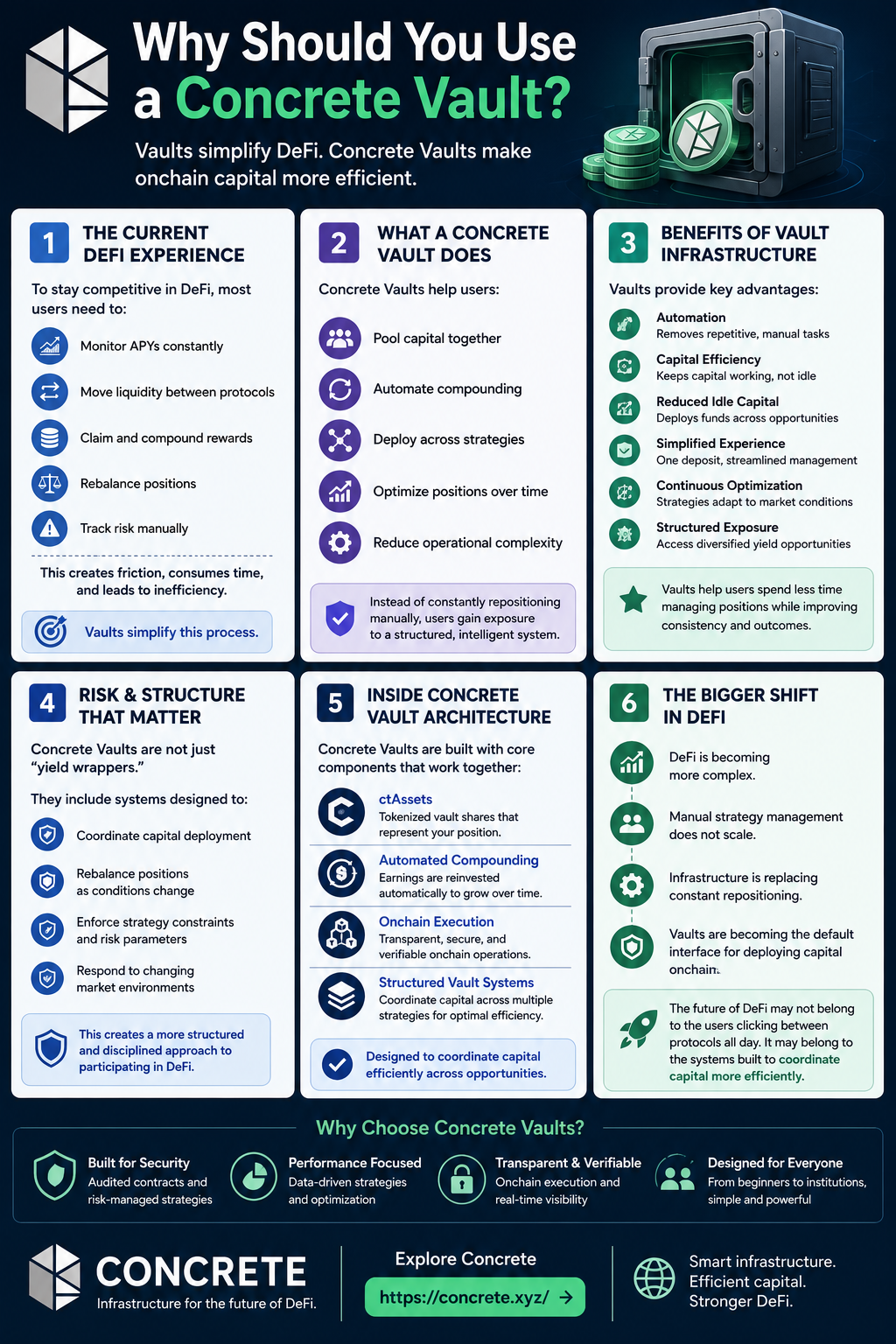
Why Should You Use a Concrete Vault?
 Rahulrj2 min read·Just now
--
Why Should You Use a Concrete Vault?
In today’s DeFi landscape, staying competitive is no longer simple.
Most users experience DeFi like this:
constantly monitoring APYs, moving liquidity between protocols, claiming and compounding rewards, rebalancing positions, and manually tracking risk. While this approach works, it comes at a cost — time, attention, and inefficiency.
The result is friction. Capital sits idle. Opportunities are missed. And strategy execution depends heavily on how active and disciplined the user is.
This is where vaults change the game.
What a Concrete Vault Does
A Concrete Vault transforms manual DeFi participation into a structured system.
Instead of managing every step yourself, Concrete Vaults allow users to:
- pool capital efficiently
- automate compounding
- deploy funds across curated strategies
- optimize positions over time
- reduce operational complexity
Rather than reacting to the market every day, users gain exposure to an intelligently managed framework designed to operate continuously.
Why Vault Infrastructure Matters
Vaults are not just convenience tools — they are infrastructure.
Strong vault systems provide:
- automation that removes repetitive tasks
- better capital efficiency with less idle liquidity
- continuous optimization instead of one-time positioning
- a simplified, professional user experience
The core benefit is consistency. Vaults allow users to participate in DeFi without constant micromanagement while maintaining disciplined execution.
Risk, Structure, and Control
Concrete Vaults are not simple “yield wrappers.”
They are built with systems that:
- coordinate capital deployment
- rebalance positions when conditions change
- enforce strategy-level constraints
- respond to shifting market environments
This structured approach reduces reliance on manual decisions and introduces a more resilient way to deploy onchain capital.
Inside Concrete Vault Architecture
At the center of this design are ctAssets, automated compounding mechanisms, and onchain execution.
Concrete Vaults are designed to:
- coordinate capital across multiple opportunities
- execute strategies transparently onchain
- maintain structured exposure rather than fragmented positions
This architecture allows capital to work continuously, instead of waiting for the next manual action.
The Bigger Shift in DeFi
DeFi is becoming more complex, not less.
Manual strategy management does not scale.
As the ecosystem matures, infrastructure is replacing constant repositioning. Vaults are becoming the default interface for deploying capital onchain.
The future of DeFi may not belong to users clicking between protocols all day.
It may belong to systems designed to coordinate capital efficiently.
Explore Concrete:
Explore Concrete