Why Should You Use a Concrete Vault?
--
DeFi unlocked global, permissionless finance.
But using it efficiently is still surprisingly difficult.
To stay competitive, users often need to:
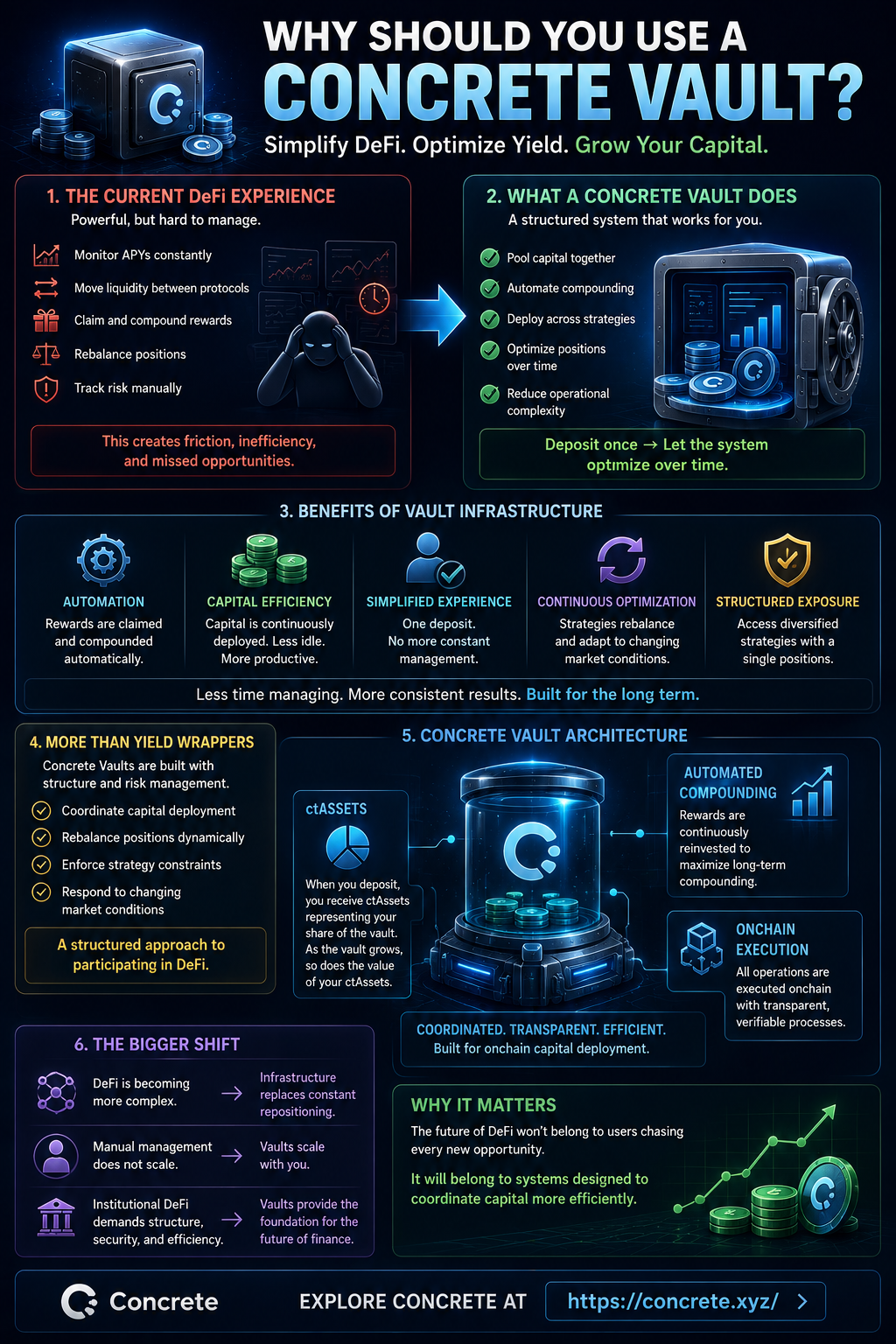
- Monitor APYs constantly
- Move liquidity between protocols
- Claim and compound rewards manually
- Rebalance positions as markets change
- Track risk across multiple strategies
What began as financial freedom quickly became operational work.
And as DeFi grows more complex, managing capital manually becomes harder to sustain.
This is where Concrete Vaults come in.
The Problem With Manual DeFi
Most DeFi users spend a significant amount of time managing positions.
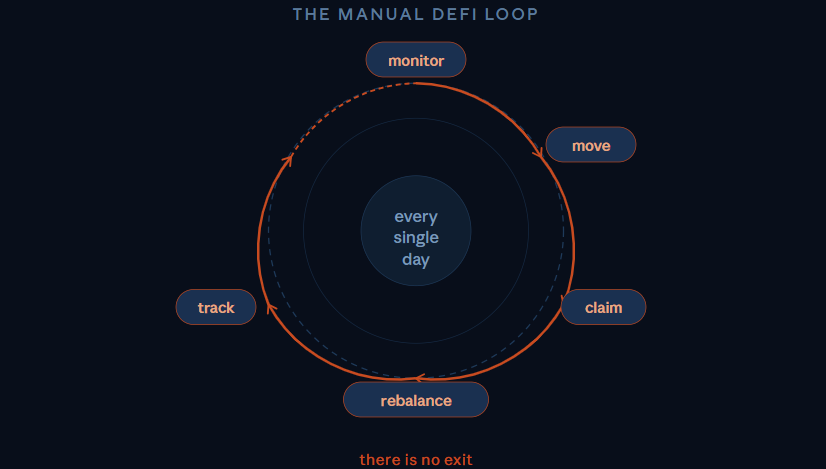
A typical workflow might look like this:
- Deposit into one protocol
- Monitor returns daily
- Move capital when incentives decline
- Reinvest rewards manually
- Adjust exposure during volatility
Every action introduces:
- Friction
- Gas costs
- Execution risk
- Time overhead
And because opportunities change constantly, users are forced into continuous repositioning just to keep capital productive.
The result?
A system where efficiency often depends on how active — and how experienced — the user is.
What a Concrete Vault Actually Does
A Concrete Vault is designed to simplify this process.
Instead of manually coordinating strategies yourself, the vault helps manage capital through a structured system.
Concrete Vaults allow users to:
- Pool capital together
- Automate compounding
- Deploy across strategies
- Optimize positions over time
- Reduce operational complexity
Rather than constantly moving between protocols, users gain exposure to a managed infrastructure layer.
The experience becomes:
Deposit once → let the system optimize over time
Why Vault Infrastructure Matters
Vault infrastructure changes how capital behaves in DeFi.
Instead of idle balances and reactive repositioning, vaults create systems where capital can remain continuously productive.
Key benefits include:
Automation
Rewards can be compounded automatically without requiring manual claiming or redeployment.
Capital Efficiency
Vaults reduce idle capital by continuously allocating assets across opportunities.
Simplified User Experience
Users no longer need to manage multiple positions across different protocols and chains.
Continuous Optimization
Vault systems can rebalance and adapt as market conditions change.
Structured Exposure
Instead of guessing between opportunities, users gain access to coordinated strategy management.
The key advantage isn’t just convenience.
It’s consistency.
Vaults help users spend less time managing positions while improving how capital is deployed over time.
Concrete Vaults Are More Than Yield Wrappers
Some vaults simply automate a single strategy.
Concrete Vaults are designed differently.
They include systems built to:
- Coordinate capital deployment
- Rebalance positions dynamically
- Enforce strategy constraints
- Respond to changing market conditions
This creates a more structured approach to participating in DeFi.
Instead of relying entirely on manual decision-making, the vault architecture helps manage complexity directly within the system itself.
How Concrete Vault Architecture Works
At the core of the system are several important components.
ctAssets
When users deposit into a Concrete Vault, they receive ctAssets.
These represent:
- Their share of the vault
- Their exposure to generated yield
- Their ownership within the system
As the vault grows and compounds, the value of the ctAsset can increase over time.
Automated Compounding
Concrete Vaults are designed to continuously reinvest rewards and optimize capital deployment automatically.
This allows users to benefit from:
- Long-term compounding
- Reduced idle capital
- More efficient capital growth
Without manually managing every step.
Onchain Execution
Vault operations occur onchain, enabling transparent execution and verifiable capital management.
This creates:
- Clear accounting
- Visible allocation logic
- Structured capital coordination
The vault behaves less like a passive container and more like a system for active onchain capital deployment.
Why This Matters for the Future of DeFi
DeFi is becoming more sophisticated every year.
More protocols.
More strategies.
More complexity.
But manual strategy management does not scale well in that environment.
Infrastructure does.
This is why vaults are becoming increasingly important.
They transform DeFi from:
- Constant repositioning
Into:
- Structured capital systems
The future of DeFi may not belong to users endlessly clicking between protocols searching for yield.
It may belong to systems designed to coordinate capital more efficiently, consistently, and intelligently.
That is the role Concrete Vaults are built to play.
🚨 Explore Concrete at:
👉 https://concrete.xyz/ 🚨
Because the next evolution of DeFi isn’t just more opportunities.
It’s better systems for managing them.