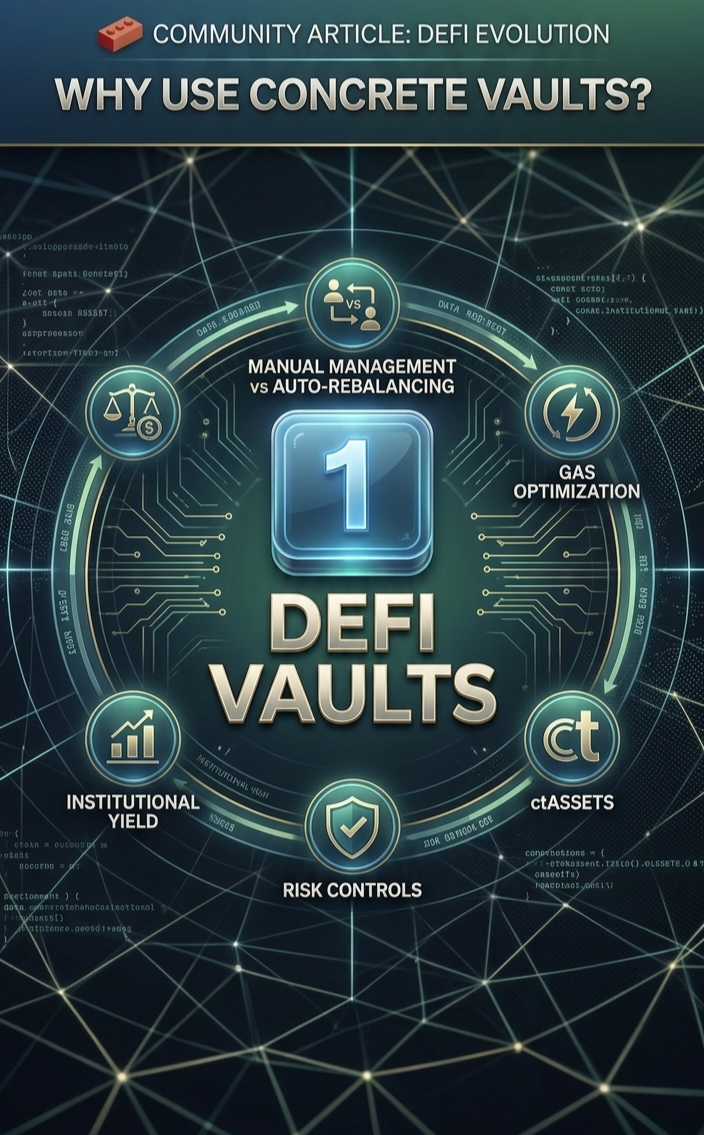
WHY SHOULD YOU USE A CONCRETE VAULT?
--
The Decentralized Finance (DeFi) space has evolved at a breakneck pace, shifting from a niche playground for crypto natives into a sophisticated ecosystem handling billions of dollars. Yet, for the average user or institution trying to maximize returns, the daily reality of managing capital remains a chaotic, hands-on struggle.
While manual liquidity management used to be the status quo, the market has outgrown it. To unlock true capital efficiency, the industry is transitioning away from manual execution toward institutional-grade infrastructure.
Here is why DeFi vaults—and specifically Concrete Vaults—are becoming the default interface for deploying onchain capital.
1. The Friction in the Current DeFi Experience
To remain competitive in DeFi today, users are forced to act like full-time asset managers. A typical day involves an endless loop of high-maintenance tasks:
Constant APY Monitoring: Yields fluctuate hourly across different protocols. What was a highly profitable pool yesterday might drop significantly by tomorrow.
Manual Liquidity Chasing: Moving capital between protocols to catch better yields burns gas fees, eats up time, and introduces execution risk.
Compounding Friction: Manually claiming rewards, swapping them for the underlying asset, and re-depositing them is highly inefficient.
Constant Position Rebalancing: Collateral ratios must be continuously watched to avoid sudden liquidations.
Manual Risk Tracking: Users have to independently assess the smart contract risk, economic design, and liquidity depth of every protocol they interact with.
This manual process creates massive friction. It turns DeFi participation into a repetitive job, resulting in sub-optimal yields, high gas overhead, and significant idle capital.
2. Enter Concrete Vaults: Simplifying Onchain Capital
Concrete Vaults fix this fragmented experience by pooling capital together and replacing manual, emotional human decision-making with automated, programmatically driven systems.
Instead of forcing you to log in daily and click through multiple protocol UIs, Concrete Vaults allow you to deposit your assets into a single, structured system that handles the heavy lifting behind the scenes:
Capital Pooling: By combining user funds, the vault achieves economies of scale, dramatically reducing the per-user gas cost of complex transactions.
Automated Compounding: The system automatically harvests rewards, converts them, and reinvests them back into the core strategy to maximize exponential growth.
Dynamic Strategy Deployment: Capital is programmatically routed across various institutional-grade yield opportunities based on real-time data.
Operational Simplicity: You gain diversified exposure to sophisticated onchain strategies through a single deposit, turning a complex multi-step process into a set-and-forget experience.
3. The Power of Vault Infrastructure
The true value of a vault doesn’t just lie in saving time; it lies in the underlying infrastructure that transforms how capital behaves onchain.
[ User Deposit ] ──> [ Concrete Vault Infrastructure ] ──> [ Automated Strategy Allocation ]
│ │
(RiskControls& ctAssets) <─────┘
Using a structured vault infrastructure delivers distinct advantages over manual farming:
Maximum Capital Efficiency: Capital rarely sits idle. If a market condition changes, the infrastructure is built to pivot liquidity swiftly into higher-performing environments.
Minimized Idle Assets: Manual investors often leave rewards unharvested for days or weeks due to high gas fees. Vaults run continuous optimization loops so that every dollar is working 24/7.
Consistent, Structured Exposure: Instead of guessing which protocol is safest or highest-yielding, users get predictable exposure to curated, risk-managed yield products.
4. Moving Beyond Simple "Yield Wrappers"
A common misconception is that all DeFi vaults are just simple "yield wrappers"—basic smart contracts that take a token and dump it into a single lending market.
Concrete Vaults are fundamentally different. They represent a layer of structured DeFi designed with baked-in risk mitigation and strict operational guardrails. They don’t just hold assets; they coordinate them.
Coordinated Capital Deployment: The system evaluates the entire landscape to place capital where it can safely capture the best risk-adjusted returns.
Proactive Rebalancing: If a specific pool becomes too risky or its yield dilutes, the vault automatically rebalances positions without requiring user intervention.
Enforcing Strategy Constraints: Every vault operates under strict risk parameters, ensuring capital never over-exposes itself to volatile or illiquid pools.
Real-Time Responsiveness: The system is built to react instantly to shifting market conditions, protecting downside risk in ways a human checking their phone a few times a day simply cannot.
5. A Look into Concrete Vault Architecture
At the heart of Concrete’s on-chain finance yield infrastructure is a highly sophisticated, secure framework built explicitly for institutional DeFi and scale.
The architecture relies on a few core pillars:
ctAssets: When you deploy capital into a Concrete Vault, you receive ctAssets in return. These tokens act as your liquid, yield-bearing receipt, representing your share of the pool while continuously accruing the underlying strategy’s returns.
Algorithmic Onchain Execution: Every single swap, rebalance, and compound event happens transparently onchain. Strategy execution is deterministic, auditable, and entirely free from human bias or backroom manipulation.
Structured Vault Systems: Concrete’s architecture is engineered to safely handle institutional-grade volume, combining transparent performance metrics with institutional-grade risk-management guardrails.
6. The Bigger Shift: The Future of Onchain Finance
The broader cryptocurrency landscape is undergoing a massive structural shift. As DeFi grows more complex, with thousands of layers, chains, and protocols, manual strategy management simply does not scale.
The future of decentralized finance doesn’t belong to individuals clicking buttons and manually chasing APYs between protocols all day. It belongs to robust, programmatic systems built to coordinate capital with absolute precision.
Automated infrastructure is rapidly replacing constant manual repositioning. Because of this, institutional-grade vaults are cementing themselves as the default interface for anyone serious about deploying capital onchain efficiently.
Take control of your onchain capital. > Explore the future of institutional-grade yield infrastructure and experience Concrete Vaults first-hand at concrete.xyz.