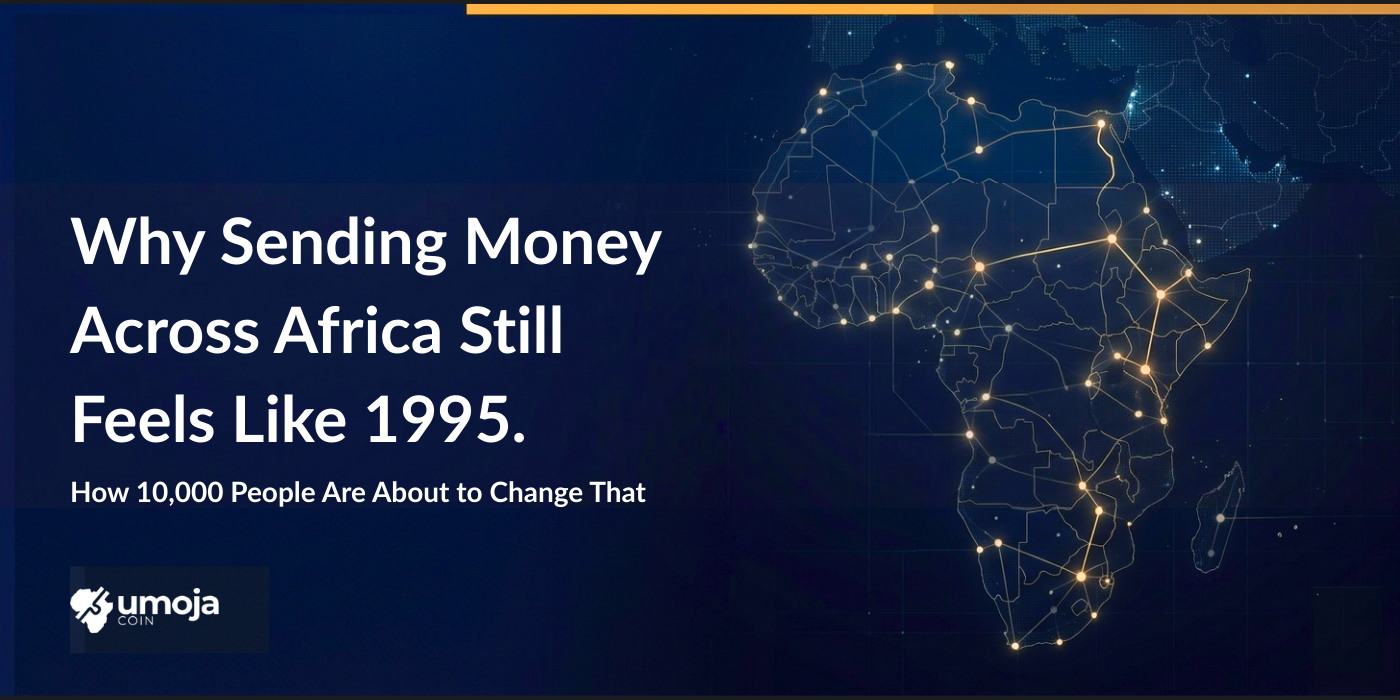
Why Sending Money Across Africa Still Feels Like 1995, And How 10,000 People Are About to Change That
 UmojaCoin4 min read·Just now
--
There is a scene that plays out every month across Africa, in a thousand different cities, and in a thousand different languages.
A woman in Lagos needs to send money to her sister in Nairobi. She goes to the bank, queues, and fills out forms. She's then required to pay a fee that eats 8 to 12 per cent of whatever she is sending. The money arrives within days sometimes. At other times, it arrives within a week, and by then the exchange rate has shifted, so her sister ends up receiving less than was sent.
Nobody is surprised because this is the norm. Everyone is instead frustrated—as they’ve been for a long time. Most people have simply accepted this as the cost of moving money across this continent, when they should not have to.
The Infrastructure Problem Nobody Is Talking About Loudly Enough
Sub-Saharan Africa has some of the highest remittance costs in the world. According to the World Bank, the average cost of sending $200 across the region hovers around 8%. That's nearly double the global average, and nearly four times the 3% target set by the United Nations Sustainable Development Group (UNSDG).
The fee is only part of the problem, though. The deeper issue here is the architecture. Most cross-border payments in Africa are still routed through correspondent banking systems that were designed decades ago. These are systems that were never built for the speed, volume, or geography of intra-African trade and personal transfers.
What you get is a patchwork. A payment from Ghana to Tanzania often travels through Europe first. A freelancer in Nairobi receiving payment from a client in Lagos may wait days, deal with failed transactions, and still lose money on the conversion. An importer in Abuja paying a supplier in Accra runs into friction that their counterparts in Europe simply do not face.
This is not a technology problem because the technology to fix this has existed for years. It is an adoption problem. And when it comes to adoption, that problem is solved by people, not systems.
Why Stablecoins Are the Closest Thing to a Real Fix
The idea behind a stablecoin is simple: take the programmability and borderlessness of crypto and remove the volatility that makes it impractical for everyday payments.
A stablecoin pegged to a stable asset moves instantly, crosses borders without a correspondent bank, and does not lose 8% along the way. For a freelancer, a market trader, or someone sending money home to family, that difference is not abstract. That difference is rent money, school fees, medical bills, emergency funds, etc. It is the gap between what was sent and what actually arrived.
UMC, the UmojaCoin stablecoin, was built specifically for this. Not as a speculative asset, or as a product for crypto enthusiasts, but as a payment tool for people who have been overcharged and underserved by the existing system for too long.
What 10,000 Early Users Actually Means
When a new payment network launches, the first users are not just customers. They are proof of concept. They are the signal that tells every developer, every merchant, every potential partner whether the product is real.
The first 10,000 verified users on Umoja Pay are not just getting 10 free UMC. They are establishing the initial network density that makes the product useful for everyone who comes after.
Payments work better when more people are on the same rail. Every early user makes the network more valuable for the next one, and this is why the 10,000 limit is not a marketing trick. It is a meaningful threshold. The people who sign up in this window are the founding cohort. The ones who will shape how the network grows, what features get built, and what becomes possible for the millions of users who will follow.
The Moment We Are In
Africa's digital payment space has had its moments. We've seen companies like M-Pesa, Flutterwave, Chipper Cash, etc, evolve and improve financial technology on the continent. Each one has pushed the frontier. But none of them has solved the cross-border problem at the infrastructure level, for ordinary people, without fees that erode the value of every transfer.
Umoja Pay is launching into that gap.
If you have ever sent or received money across an African border, you already know the problem. If you are a freelancer invoicing clients across the continent, you know this problem. If you are running a small business and paying suppliers in a different country, you know this problem.
This is not about crypto; this is about building payment infrastructure that actually works for Africa. Infrastructure that is fast, cheap, and built for the people who need it most. The first 10,000 spots are open. Be among the people who were there at the beginning.
Join the community: https://t.me/umojacoincommunity

![SCAMLAND CHRONICLES 20. Gen. William Garrett_V3 [Part 2].](https://cdn-images-1.medium.com/max/828/1*-jV6boP5xblUFP5170tXjQ@2x.jpeg)