Bitcoin Is Under Real Pressure
Bitcoin is below $63,000.
Miners are liquidating at the longest capitulation stretch of the year.
Spot ETFs have recorded six straight weeks of outflows.
And yet one of the largest corporate holders in the world continues to buy.
The move signals a broader stress phase unfolding beneath the surface.

TL;DR
- Bitcoin has fallen below $63,000 and faces heavy structural pressure.
- Miners are selling at the longest capitulation stretch of the year.
- Spot ETFs have recorded six consecutive weeks of outflows.
- $60,000 is the key technical and psychological support level.
- Realized price sits near $54,700, forming a deeper structural floor.
- Michael Saylor continues to accumulate through his company, Strategy.
- He dismisses quantum computing as an immediate threat.
- His conviction is rooted in time horizon, capital structure, and monetary thesis, not short-term price action.
This article examines whether that conviction is rational.
Technical charts show a head-and-shoulders formation on shorter time frames. The neckline sits near $60,000.
Bitcoin’s realized price currently sits around $54,700. Realized price reflects the average cost basis of all coins in circulation. Historically, Bitcoin stabilizes near this level during deep corrections.
At the same time:
- Miner net position change has remained negative for 46 consecutive days.
- Transaction fee revenue dropped from 194 BTC in May 2025 to roughly 65 BTC in February 2026.
- Spot Bitcoin ETFs have recorded six straight weeks of net outflows.
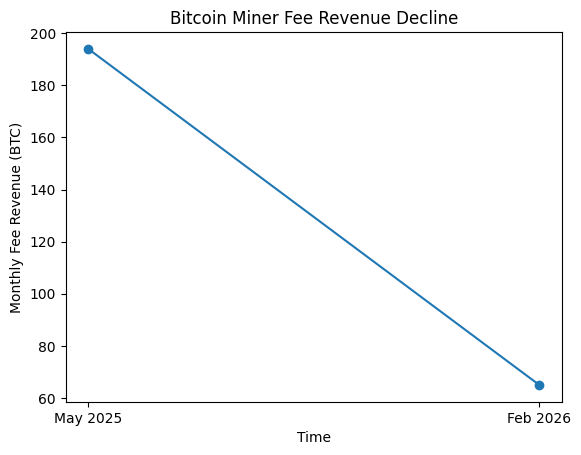
The current move reflects structural supply pressure combined with institutional deleveraging.
Against this backdrop, one corporate buyer continues to accumulate.
That is where the story begins.

What Michael Saylor Is Actually Defending
Michael Saylor is not defending Bitcoin emotionally.
He is defending a capital allocation thesis.
Through Strategy, he has built one of the largest corporate Bitcoin holdings in the world. Public disclosures indicate holdings of approximately 717,722 BTC with an average cost near $76,020 per coin.
At current market levels, the position sits below that average cost.
Yet accumulation continues.
That behavior signals one thing: the thesis operates on a decade-scale framework.
To understand why he is not giving up, we must examine three pillars:
1. Time horizon
2. Structural supply dynamics
3. Perceived versus credible threats
1. Time Horizon Arbitrage
Most market participants operate on short cycles.
Retail investors focus on weekly volatility.
ETF flows react to quarterly performance and macro headlines.
Miners respond to monthly cash flow pressures.
Strategy operates on a multi-year treasury transformation plan.
Saylor’s thesis is simple in structure:
- Fiat currencies debase over time.
- Scarce digital assets preserve purchasing power.
- Bitcoin represents engineered scarcity.
- Volatility does not negate long-term scarcity dynamics.
If the thesis holds over ten years, price drawdowns inside that window represent noise.
This does not make him correct.
It explains his behavior.
2. Miner Capitulation Is Supply Stress, Not Thesis Collapse
Miners are currently selling more Bitcoin than they accumulate.
The 46-day uninterrupted negative net position change reflects economic pressure. Fee income has compressed sharply.
When revenue falls and operating costs remain, weaker miners distribute reserves.
That increases short-term supply.
However, miner capitulation historically marks late-cycle stress phases rather than terminal breakdowns.
If supply clears and difficulty adjusts, selling pressure eventually declines.
Saylor’s framework likely interprets miner stress as cyclical rather than existential.
The question becomes whether institutional demand returns after this supply wave clears.
3. ETF Outflows Signal Tactical Risk-Off
Six consecutive weeks of ETF outflows is significant.
It reflects reduced institutional appetite in the current macro regime. Rising geopolitical tension and tariff uncertainty have pressured risk assets broadly.
Bitcoin trades as a high-beta risk asset during stress periods.
That behavior does not align with the “digital gold” narrative in the short term.
Yet ETF flows represent allocators adjusting exposure. They do not automatically signal abandonment of the asset class.
Some flow has rotated into derivatives markets rather than exiting crypto entirely.
This distinction matters.
Saylor’s thesis does not depend on uninterrupted ETF inflows. It depends on long-term adoption curves and capital migration into scarce assets.
The $60,000 Decision Point
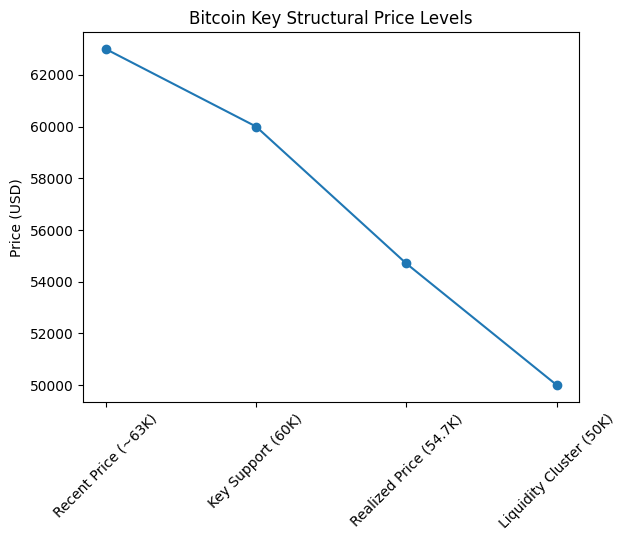
$60,000 is more than a chart level.
It is:
- The neckline of a widely watched pattern.
- A Fibonacci retracement cluster near $60,100.
- A prior stabilization zone in early February.
- A psychological anchor.
If Bitcoin holds above $60,000, stabilization becomes plausible.
If it breaks decisively below, $54,700 realized price becomes the next structural magnet.
Below that, liquidity clusters appear near $50,000.
Saylor’s conviction faces its most visible test at this zone.
Yet there is no indication of retreat.
Quantum Computing: Narrative Versus Timeline
Quantum computing has entered the mainstream crypto debate.
Some institutional commentators suggest quantum uncertainty contributes to Bitcoin’s relative underperformance versus gold.
Saylor rejects the idea that quantum computing represents an immediate threat.
His argument rests on several points:
- There is no consensus that a near-term quantum breakthrough can break current cryptographic standards.
- If such a breakthrough emerged, global financial infrastructure would face simultaneous risk.
- Coordinated software upgrades could implement quantum-resistant cryptography over time.
- Bitcoin’s development process has historically evolved across multiple versions.
This position does not deny quantum risk.
It reframes the timeline.
If the credible threat window is ten years away, today’s price action reflects narrative discounting rather than structural compromise.
For Saylor, that distinction is critical.
Corporate Treasury Strategy Under Stress
Strategy’s model converts corporate cash flows and capital raises into Bitcoin exposure.
Critics argue this amplifies volatility risk. Supporters argue it reflects disciplined conviction.
Public disclosures indicate approximately 717,722 BTC with an average cost near $76,020 per coin. If Bitcoin trades below that level for an extended period, mark-to-market accounting could intensify equity volatility. The real question is duration. Can Strategy maintain liquidity and capital access if Bitcoin remains depressed for multiple quarters? Conviction depends on solvency, not sentiment.
The real stress test involves balance sheet durability:
- Can Strategy service debt obligations during extended drawdowns?
- Can it maintain capital access if Bitcoin trades below its average cost?
- Does accounting treatment create headline risk that affects equity performance?
These are valid concerns.
However, as long as liquidity remains manageable and capital markets remain accessible, the strategy remains operational.
Saylor’s refusal to give up appears tied to balance sheet sustainability, not price denial.

Realized Price as Structural Anchor
Realized price near $54,700 reflects aggregate cost basis.
Historically, Bitcoin often finds stabilization near realized price during corrections.
This level represents a broad equilibrium of holders.
If Bitcoin approaches that zone, selling pressure from weaker hands may exhaust.
That creates a potential structural reset rather than collapse.
Saylor’s long-term view likely incorporates this historical pattern.
The Psychological Gap
Markets often confuse volatility with invalidation.
Conviction investors separate:
- Liquidity shocks
- Narrative fear
- Structural impairment
Miner selling is liquidity stress.
ETF outflows are tactical risk management.
Quantum headlines are narrative uncertainty.
None automatically invalidates scarcity.
Saylor’s thesis survives unless Bitcoin’s core properties fail.
What Would Actually Break His Thesis?
A serious analysis must include falsifiers.
- A sustained break below the realized price, combined with prolonged institutional exit.
- Structural protocol compromise without a viable upgrade path.
- Regulatory action that materially restricts global liquidity access.
- Corporate financing constraints that impair Strategy’s balance sheet.
Absent these conditions, his model remains logically intact. Price volatility alone does not alter the underlying scarcity design.
A Non-Obvious Insight
The current phase may represent a divergence:
- Miners sell because they must.
- ETFs reduce exposure because they can.
- Strategy accumulates because it is built to.
This structural divergence may define the next phase of Bitcoin ownership concentration.
If weaker participants distribute and stronger balance sheets accumulate, long-term supply dynamics tighten again.
That is the asymmetry Saylor appears willing to underwrite.
Macro Overlay
Bitcoin’s correlation with equities has increased during risk-off cycles.
Tariff tensions and global uncertainty amplify volatility.
However, macro cycles rotate.
If liquidity conditions ease or risk appetite returns, assets with fixed supply often respond sharply.
Saylor’s thesis likely embeds this macro cyclicality.
Why He Is Not Giving Up
He is not ignoring risk.
He is operating within a framework:
- Scarcity remains intact.
- Network security remains intact.
- Quantum threat timeline remains distant.
- Realized price provides structural floor reference.
- Miner capitulation reflects cyclical pressure.
- Institutional flows are reversible.
His conviction depends on structural continuity, not daily charts.
Conclusion
Bitcoin stands at a decisive technical and psychological zone near $60,000.
Miners are selling. ETFs are bleeding. Headlines are loud.
Yet Michael Saylor continues to accumulate through Strategy.
$60,000 does not determine the durability of his thesis. Structural credibility does.
If scarcity weakens, if network security breaks, or if liquidity access collapses, the model unravels.
In that context, volatility reflects duration risk within the thesis rather than structural breakdown.
The market is testing conviction.
Saylor is testing time.
That distinction will determine the outcome.
Frequently Asked Questions
1. Why is $60,000 such an important level for Bitcoin?
It aligns with a key technical neckline, prior support, and psychological anchoring.
2. What is Bitcoin’s realized price?
It represents the average cost basis of all coins in circulation, currently near $54,700.
3. What is miner capitulation?
It occurs when miners sell more Bitcoin than they accumulate, often due to financial pressure.
4. Are ETF outflows bearish for Bitcoin?
They reflect reduced institutional exposure in the short term but do not automatically signal long-term abandonment.
5. What is Michael Saylor’s average Bitcoin purchase price?
Public disclosures indicate an average cost near $76,020 per coin.
6. Does quantum computing threaten Bitcoin today?
There is no consensus that a credible quantum threat is imminent.
7. Can Bitcoin upgrade if quantum risk increases?
Historically, Bitcoin has implemented multiple software upgrades over time.
8. What would invalidate Saylor’s thesis?
Structural protocol failure, sustained liquidity collapse, or balance sheet impairment.
9. Why does Strategy keep buying during downturns?
Its treasury strategy is built around long-term scarcity assumptions.
10. Is Bitcoin currently acting like digital gold?
In the short term, it behaves more like a high-beta risk asset during macro stress.
Disclaimer
This article is for informational and educational purposes only. It does not constitute financial, investment, or legal advice. Cryptocurrency markets are volatile and carry substantial risk. Readers should conduct independent research and consult qualified financial professionals before making investment decisions.
Sources
- BeInCrypto — Bitcoin Loses $63,000 As Miner Capitulation Extends, Yet Expert Sees Hope at $60,000
https://beincrypto.com/bitcoin-price-expert-prediction-60000-support/ - BeInCrypto — Why Michael Saylor Doesn’t See Quantum Computing as Bitcoin’s Top Security Threat Yet
https://beincrypto.com/michael-saylor-bitcoin-quantum-computing-threat/ - Strategy (formerly MicroStrategy) — Official Bitcoin Holdings & Purchase History
https://www.strategy.com/purchases - Reuters — Bitcoin hoarder Strategy buys $2.13 billion in bitcoin in eight days
https://www.reuters.com/legal/transactional/bitcoin-hoarder-strategy-buys-213-billion-bitcoin-eight-days-2026-01-20/ - Glassnode — On-Chain Metrics (Miner Net Position Change, Realized Price)
https://glassnode.com - Dune Analytics — Bitcoin Network Revenue Dashboard
https://dune.com - SoSoValue — Bitcoin ETF Flow Data
https://www.sosovalue.com - Decrypt — Bitcoin ETFs Shed $410M Amid BTC’s Ongoing Slump
https://decrypt.co/358008/bitcoin-etfs-shed-410m-amid-btcs-ongoing-slump - Coin Stories Podcast — Interview featuring Michael Saylor (Quantum Discussion)
https://www.youtube.com/@CoinStories - Bitcoin Core GitHub Repository — Bitcoin Improvement Proposals (including BIP 360 reference)
https://github.com/bitcoin/bips
Why Michael Saylor Isn’t Ready to Give Up on Bitcoin at $60,000 was originally published in Coinmonks on Medium, where people are continuing the conversation by highlighting and responding to this story.