Why Managing DeFi Manually Is Slowly Becoming Impossible
 Arti3 min read·Just now
--
DeFi was supposed to make capital more efficient.
And in many ways, it did.
Anyone with a wallet can now access lending markets, liquidity pools, automated strategies, and yield opportunities that were once limited to institutions.
But there’s a problem most users eventually run into:
participating in DeFi efficiently requires constant management.
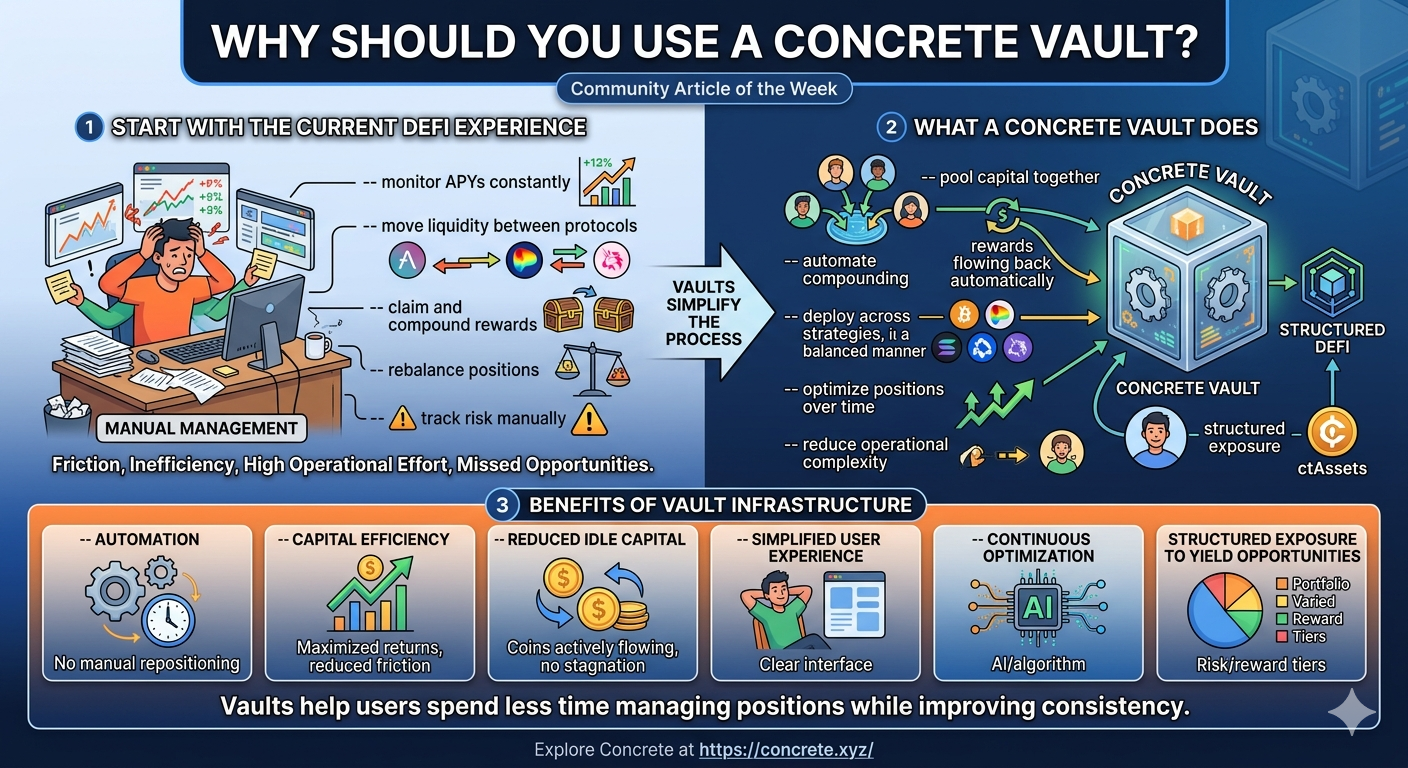
Checking APYs. Moving liquidity. Compounding rewards. Rebalancing positions. Tracking risk. Watching market conditions.
At first, this feels exciting.
Then it starts feeling like a full-time job.
The Hidden Cost of Managing Everything Yourself
One of the biggest misconceptions in DeFi is that yield is passive.
In reality, maintaining efficient exposure often requires continuous operational work.
Yields change quickly. Liquidity rotates. Incentives disappear. Execution costs accumulate.
Capital that isn’t actively managed can easily become inefficient.
And this creates a strange paradox:
DeFi gives users more opportunities than ever before — while simultaneously making those opportunities harder to manage manually.
The opportunity set keeps expanding. Human coordination does not.
Why Vault Infrastructure Matters
This is where vaults become important.
A vault is not simply a “yield wrapper”.
At its core, vault infrastructure exists to coordinate capital more efficiently than individual users can manually.
Instead of constantly moving between protocols and adjusting positions yourself, a structured vault system handles much of the operational complexity underneath.
Concrete Vaults are designed around this exact idea.
Rather than requiring users to actively manage every decision, the system helps:
- automate compounding
- coordinate allocation
- rebalance positions
- optimize deployment over time
- reduce operational friction
The result is a more organized way to participate in DeFi.
From Manual Participation → Structured Systems
A lot of DeFi today still revolves around manual repositioning.
Users constantly chase better opportunities:
moving liquidity from one protocol to another, rotating into higher APYs, trying to maintain efficiency.
But this model does not scale well.
As DeFi grows more complex, infrastructure becomes increasingly important.
That’s why the industry is gradually shifting from:
manual strategy management → structured capital systems
And vaults are becoming the interface connecting users to that infrastructure.
Concrete Vaults and Coordinated Capital
Concrete Vaults are built to improve how capital is coordinated onchain.
This includes:
- ctAssets
- automated compounding
- structured vault systems
- continuous onchain execution
Instead of treating yield opportunities as isolated positions, the system manages exposure through coordinated architecture.
That distinction matters.
Because over time, efficient capital deployment is often more important than simply finding the highest APY.
The Bigger Shift Happening in DeFi
As the ecosystem matures, the future of DeFi may not belong to users manually clicking between protocols all day.
It may belong to systems designed to coordinate capital more efficiently than humans can on their own.
Vault infrastructure represents that shift.
Not away from DeFi.
But toward a more scalable version of it.
And as complexity continues increasing, structured systems like Concrete Vaults may become the default way capital moves onchain.
Concrete: https://concrete.xyz/