Why Gas Fees Exist (And Why They Suddenly Spike)
--
Competing for the finite space.
Most people first notice gas fees when something feels off.
You try to send a small amount of crypto, and the fee is unexpectedly high. Sometimes higher than the transaction itself.
At that point, it feels arbitrary.
But gas fees are not random. They’re a direct consequence of how blockchains are designed.
What You’re Actually Paying For
When you submit a transaction, you’re asking the network to do three things:
- include your transaction in a block
- execute any required computation
- store the result in the shared state
None of this is free.
Every node in the network processes that transaction. Validators verify it. The result becomes part of a system that is replicated globally.
Gas is simply a way to measure how much work your transaction requires.
And the fee is what you pay to have that work prioritized.
Why ‘Gas’ Exists Instead of Flat Fees
In a traditional system, fees are fixed because a central server controls capacity.
In a blockchain, capacity is limited and shared.
Each block has a maximum amount of computation it can handle. On Ethereum, this is defined by the block gas limit.
So instead of charging a fixed fee, the system uses a pricing model based on:
- how much computation your transaction needs
- how much demand exists at that moment
This creates a market.
The Real Mechanism: Limited Block Space
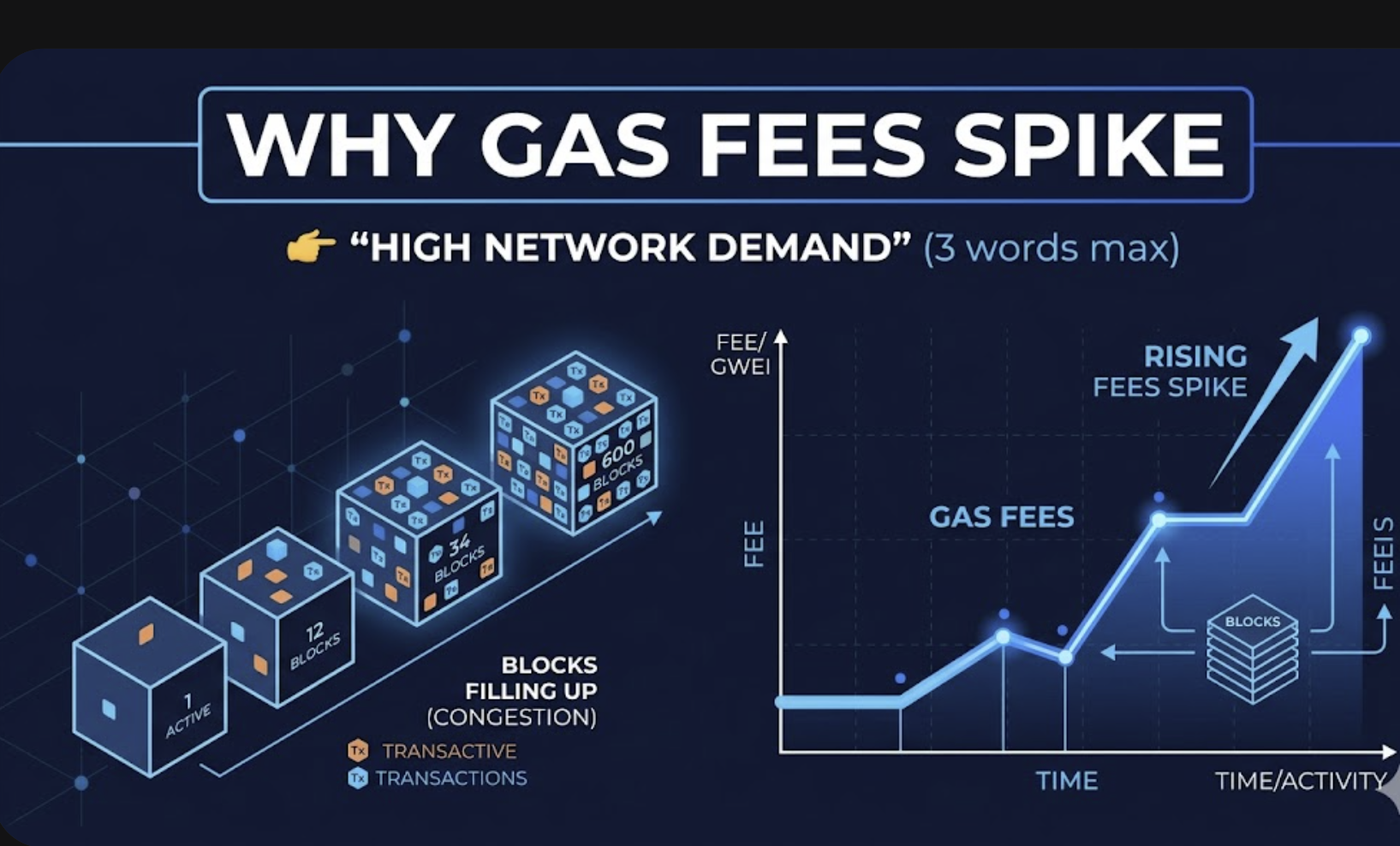
A block can only include a certain amount of gas.
That means only a limited number of transactions can fit inside it.
When you send a transaction, you’re not just submitting data.
You’re competing for space in the next block.
If demand is low:
- your transaction gets included quickly
- fees stay low
If demand increases:
- more transactions enter the mempool
- competition increases
- fees rise
Why Fees Spike Suddenly
Gas fees don’t increase gradually. They spike.
That’s because demand on blockchains is not smooth — it’s event-driven.
A few common triggers:
1. High-Activity Events
When something popular launches — like an NFT mint or token sale — thousands of users try to transact at the same time.
They all compete for the same limited block space.
2. Arbitrage and Bots
Automated systems constantly monitor price differences across platforms.
When an opportunity appears, bots submit transactions aggressively, often with higher fees to get priority.
This pushes normal users out of the next block.
3. Network Congestion
If blocks are consistently full, the mempool grows.
Transactions that don’t offer competitive fees get delayed, forcing users to increase their bids.
The Fee Structure (What You’re Actually Paying)
On Ethereum, gas fees are split into two parts:
- Base fee → determined by the network
- Priority fee (tip) → paid to validators
The base fee adjusts automatically depending on how full previous blocks were.
If blocks are consistently near capacity, the base fee increases.
If usage drops, it decreases.
This is why fees can rise quickly during sustained demand.
Why This System Exists at All
It might seem inefficient.
But without gas fees, the network would have no way to:
- prevent spam transactions
- allocate limited resources fairly
- prioritize urgent transactions
Gas fees act as both:
- a pricing mechanism
- a protection layer
The Trade-Off
Gas fees highlight a core tension in blockchain design.
The system is:
- decentralized
- transparent
- globally verifiable
But those properties come with constraints:
- limited throughput
- shared capacity
- variable costs
So instead of fixed pricing, you get a dynamic market.
Why This Feels Worse Than Web2
In most applications today, you don’t think about infrastructure costs.
They’re abstracted away.
In Web3, those costs are exposed directly to the user.
You see them every time you interact with the system.
That makes inefficiencies visible — but it also makes the system more transparent.
Where This Is Going
Most current development is focused on reducing the impact of gas fees without removing the underlying model.
This includes:
- Layer 2 networks
- batching transactions
- moving computation off-chain
The goal isn’t to eliminate fees entirely.
It’s to make them less noticeable while preserving the system’s guarantees.
The Useful Way to Think About It
Gas fees are not just a cost.
They are a signal.
They tell you:
- how much demand exists
- how limited the system’s capacity is
- how much competition there is for inclusion
Once you see it that way, sudden spikes stop feeling random.
They become predictable outcomes of a system where:
everyone is competing for the same finite space.