Switzerland is not just a beautiful country, it is one of the most strategically smart places on earth to launch a crypto exchange. The country has built a clear, business-friendly regulatory environment, a thriving fintech ecosystem in Zug (nicknamed “Crypto Valley”), and strong banking infrastructure. If you are a founder thinking about how to start a crypto exchange in Switzerland, this guide will walk you through everything, from FINMA regulations to tech choices, licensing costs, and real-world pitfalls to avoid.
By the end of this article, you will have a clear roadmap to launch a crypto exchange in Switzerland that is fully compliant, technically solid, and ready to compete in the global market.
Why Switzerland is a Global Hub for Crypto Exchanges
Switzerland’s relationship with crypto did not happen by accident. Back in 2016, the canton of Zug started accepting Bitcoin for tax payments. That small move sent a signal to the world: Switzerland was open for business. Fast forward to 2026, and Crypto Valley in Zug is home to over 1,000 blockchain and crypto companies, including some of the largest DeFi protocols and crypto exchanges in the world.
✔️ Top 3 globally, Switzerland leads in financial stability & crypto clarity
✔️ 20% corporate tax cap in Zug canton, among Europe’s lowest
✔️ FINMA - world-class regulator with clear crypto licensing frameworks
✔️ No capital gains tax - private crypto investors benefit
Beyond the tax advantages, Switzerland’s crypto exchange requirements are actually achievable for well-funded startups. The regulatory clarity from FINMA means you know exactly what you need to do, unlike many jurisdictions where the rules keep changing. That predictability is worth a lot when you are building a business.
Swiss banks like SEBA and Digital Asset Bank, both FINMA-licensed, actively serve crypto businesses. This banking access alone makes Switzerland worth serious consideration when you want to launch a crypto exchange that can accept fiat deposits from institutional and retail clients.
Switzerland’s crypto market crossed CHF 1.6 billion in trading volume in 2024, and projections for 2026 point to continued double-digit growth, driven by institutional inflows post-Bitcoin ETF approvals globally.
Key Requirements to Start a Crypto Exchange in Switzerland
Before you dive into building your platform, you need to meet several baseline Switzerland crypto exchange requirements. Missing even one of these can delay your launch by months or get your application rejected by FINMA.
- Swiss Legal Entity — You must incorporate a legal entity in Switzerland, typically an AG or GmbH (limited liability company). The AG is preferred by serious exchanges for credibility with banking partners and investors.
- AML / KYC Program — A robust Anti-Money Laundering and Know Your Customer program is mandatory. You must appoint a dedicated AML officer and have written compliance policies from day one. FINMA scrutinizes this heavily during license review.
- SRO Membership or FINMA License — You need to either join an SRO (fastest route for most startups) or apply directly for a FINMA license, depending on your business model and transaction volumes.
- Minimum Capital — Depending on your license type, you will need CHF 50,000 to CHF 10 million in minimum capital. For most new crypto exchanges in Switzerland, the realistic starting capital is CHF 100,000–500,000.
- Swiss Resident Director — At least one director or authorized signatory on your company must be a Swiss resident. This is a hard requirement for both AG and GmbH structures.
- Banking Partner — You must secure at least one Swiss bank or payment institution willing to hold fiat funds for your exchange. This is one of the hardest parts of the process.
Step-by-Step Process to Launch Your Crypto Exchange
Here is the realistic step-by-step crypto exchange development process for Switzerland. Each step builds on the previous one — skipping steps or doing them out of order is a common cause of expensive delays.
STEP 1 — Understand the Regulatory Landscape
Before anything else, understand who governs your operations:
- FINMA (Swiss Financial Market Supervisory Authority) is the primary financial market regulator,responsible for licensing crypto exchanges, issuing guidelines, and ensuring market integrity. It enforces AML rules and can act against unauthorized crypto activities.
- Self-Regulatory Organizations (SROs) are FINMA-recognized bodies that supervise non-banking financial intermediaries, including many crypto exchanges and wallet providers, monitoring their compliance with Anti-Money Laundering Act (AMLA) obligations.
- The Swiss Federal Council sets overall policy direction, including the DLT Act, which provides legal certainty for the industry.
Switzerland does not apply the EU’s MiCA regulation domestically, but if your Swiss exchange provides services to EU customers, MiCA compliance is required, and as of December 30, 2025, only authorized CASPs may legally provide crypto-asset services in the EU market.
STEP 2 — Define Your Business Model & Choose the Right License Path
Switzerland offers two main licensing pathways: membership in a Self-Regulatory Organization (SRO) or direct licensing by FINMA. This dual approach provides businesses with legal certainty, flexibility, and high-level compliance with AML and KYC requirements.
Path A — SRO Membership (most common for new exchanges) SRO membership covers activities like exchange, custody, brokerage, and payment services. There are 11 recognized SROs in Switzerland, each with its own specialization and language focus. This path typically takes 1–4 months for approval.
Path B — Direct FINMA License Obtaining a license directly from FINMA is more complex, involving significantly higher capital requirements, detailed business plans, and a stricter approach to compliance. This is required for businesses operating at larger scale, such as DLT trading venues.
Key rule of thumb: If you only develop technology (such as wallets for private use or software without control of client assets), a license or SRO membership is usually not required.
STEP 3 — Incorporate a Swiss Legal Entity
The process starts by forming a Swiss company, either a GmbH (limited liability) or AG (joint-stock company), and registering a Swiss office with a local director.
Key requirements for incorporation:
- For a joint-stock company (AG), paid-up capital of CHF 50,000 must be deposited with a Swiss bank, subject to at least CHF 100,000 authorized capital. Rue.ee
- You must have a registered business address in Switzerland (not just a mailbox).
- At least one Swiss-resident director or authorized representative is typically required.
Popular cantons to incorporate in: Cantons such as Zug (Crypto Valley), Zurich, Geneva, and Ticino offer favorable business environments: efficient tax regimes, a developed fintech community, and access to specialized professional services. Zug in particular stands out as an international hub for blockchain companies.
STEP 4 — Prepare Your Compliance Documentation
This is one of the most critical and time-consuming steps. You must prepare documents including a business plan, AML/KYC policies, and compliance manuals.
Your documentation package should include:
- Detailed Business Plan — describing your exchange model, target markets, trading pairs, revenue model, and risk management strategy
- AML/KYC Policy Manual — outlining how you identify and verify customers
- Internal Compliance Manual — covering procedures for suspicious transaction reporting, sanctions screening, and record keeping
- IT & Cybersecurity Policy — covering wallet security, hot/cold storage, penetration testing protocols
- Organizational Chart — showing ownership structure and key personnel
The AMLA and implementing regulations provide for obligations that financial intermediaries must adhere to, including verification of the identity of customers/contracting parties as well as the beneficial owners of funds held.
STEP 5 — Apply for SRO Membership (or FINMA License)
For most new exchanges, the SRO route is the starting point. Well-known SROs include VQF, ARIF, and
The application process involves:
- Submitting your company documents and compliance manuals to the chosen SRO
- Undergoing a due diligence review of your shareholders, directors, and beneficial owners
- Demonstrating your AML/KYC framework meets AMLA standards
- Paying SRO membership fees and setup costs
Costs depend on the regulatory pathway — SRO membership or direct FINMA authorization. For SRO membership, starting costs are approximately CHF 20,000 for a GmbH structure.
If you need a direct FINMA license (e.g., for a DLT trading venue): The fintech licence allows companies to accept public deposits of up to CHF 100 million or crypto-based assets, provided that these are not invested and no interest is paid on them.
STEP 6 — Open a Swiss Bank Account
Access to Swiss banking services strengthens reputational standing, enables secure fiat and cryptocurrency transactions, and facilitates the attraction of institutional capital.
This step is notoriously challenging for crypto companies — many traditional Swiss banks remain cautious. Strategies include:
- Working with crypto-friendly Swiss banks such as SEBA Bank, Sygnum, or smaller cantonal banks
- Presenting your SRO membership or in-progress FINMA application as proof of regulatory legitimacy
- Opening both operational and segregated client fund accounts
STEP 7 — Build the Technical Exchange Infrastructure
While legal steps are being completed, build or procure your exchange technology:
- Trading Engine — matching engine for order books (spot, derivatives, or both)
- Wallet Infrastructure — hot wallets for liquidity, cold wallets for the majority of funds
- KYC/AML Software — automated identity verification (e.g., Sumsub, Onfido, Jumio)
- Transaction Monitoring — blockchain analytics tools for flagging suspicious activity
- Travel Rule Compliance — required under FATF/AMLA for transfers above CHF 1,000 between VASPs
Security must be top priority - implement multi-sig wallets, DDoS protection, regular penetration testing, and ISO 27001-aligned security policies.
STEP 8 — Implement AML/KYC Operations
Before engaging in financial intermediation, companies must join a Swiss SRO. The AMLA provides for a series of obligations, including verification of the identity of customers and beneficial owners of funds held.
Your AML/KYC program must include:
- Customer Due Diligence (CDD) — identity verification at onboarding
- Enhanced Due Diligence (EDD) — for high-risk customers (PEPs, large volumes)
- Ongoing Transaction Monitoring — flagging unusual patterns
- Suspicious Activity Reports (SARs) — filed with MROS (Money Laundering Reporting Office Switzerland)
- Sanctions Screening — against OFAC, EU, UN, and Swiss lists
STEP 9 — Go Live & Maintain Ongoing Compliance
Once your SRO membership is approved and your systems are in place, you may begin operations.
Post-launch obligations include:
- Annual audits and training for compliance staff Legarithm
- Regular reporting to your SRO
- Keeping AML/KYC policies updated with regulatory changes
- Maintaining accurate records of all transactions
On taxation, individuals in Switzerland generally pay no capital gains tax on crypto, but crypto earned from mining or staking is subject to income tax, and all crypto holdings are subject to wealth tax annually. Coinpedia, Your exchange itself will be subject to corporate tax, with rates varying by canton (Zug is among the most favorable).
STEP 10 — Plan for EU Market Access (If Needed)
Since Switzerland is not in the EU, as soon as Swiss companies provide services within MiCA’s scope to customers based in the EU, they will need to comply with MiCA requirements. If you intend to serve EU retail customers, factor in an EU subsidiary or passporting arrangement from day one.
White Label vs Custom Development: What’s Better?
This is one of the most important strategic decisions you will make. Let’s compare white label crypto exchange Switzerland solutions against fully custom-built platforms.
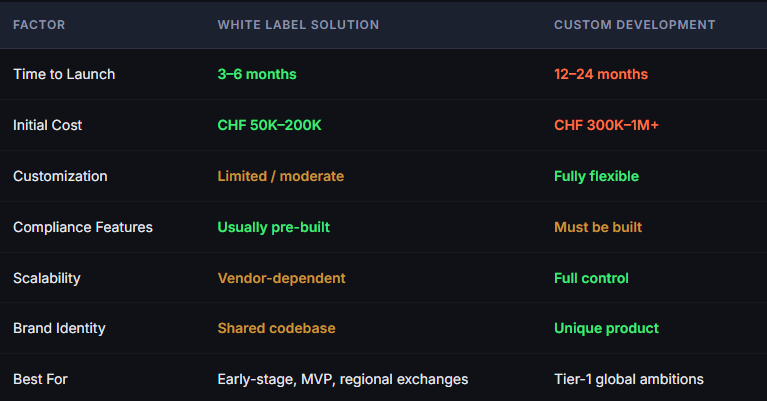
A white label crypto exchange Switzerland solution from a reputable crypto exchange development company is the right call for most founders launching in 2026. You get a proven, tested platform with built-in KYC workflows, liquidity connectors, and wallet infrastructure in a fraction of the time. You can always rebuild specific modules later when you have revenue and clearer product direction.
A turnkey crypto exchange solution makes even more sense when you factor in the regulatory environment. Swiss compliance requirements are strict and specific — buying from a crypto exchange software provider that has already gone through the Swiss compliance checklist saves enormous time and money versus building from scratch.
Key Decision FactorsIf your goal is to launch within 12 months and test product-market fit, choose a white label. If you have Series A funding, 18+ months of runway, and a clear technical moat strategy, consider custom development. Most successful Swiss crypto exchanges started with a white label and rebuilt core components over time.
Choosing the Right Technology Stack
Technology is the foundation of how you build a crypto trading platform that is fast, secure, and scalable. Here is what a production-grade crypto exchange tech stack typically looks like in 2026.
Core Trading Engine
The matching engine is the heart of your exchange. It must process thousands of orders per second with near-zero latency. Most professional exchanges use C++ or Rust for the matching engine core, with Kafka or similar for event streaming.
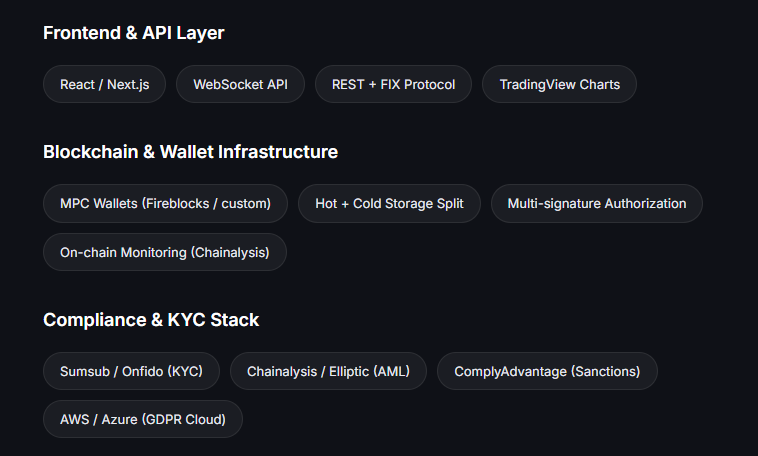
For most founders working with a crypto exchange development company, the recommendation is to use proven off-the-shelf components for wallets and KYC while building competitive differentiation in the UX and trading features. Building every layer from scratch adds 12–18 months to your timeline with no added regulatory benefit.
Cost to Launch a Crypto Exchange in Switzerland
The crypto exchange license in Switzerland cost is one of the most searched topics for founders researching this market, and for good reason. Switzerland is not cheap. Here is a realistic crypto exchange cost breakdown for a mid-tier exchange launching in 2026.
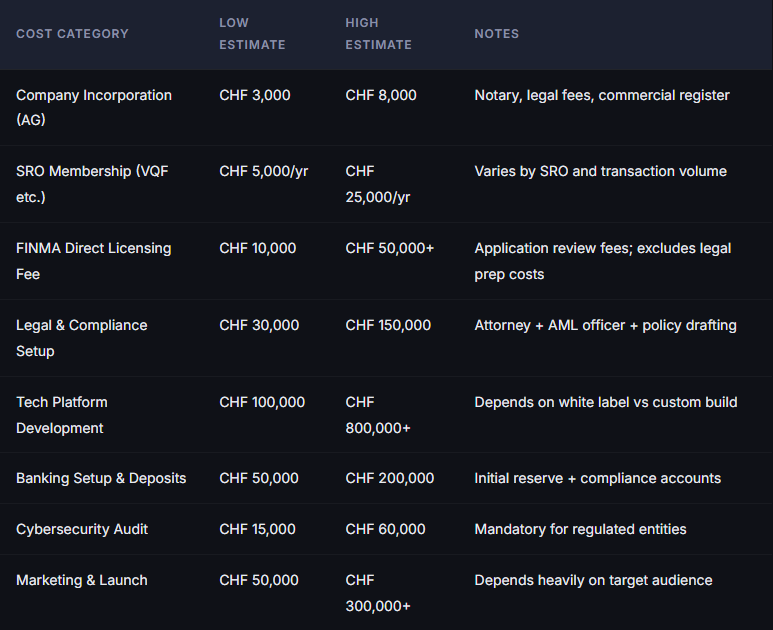
This crypto exchange license in Switzerland cost estimate assumes a mid-size exchange targeting retail and SME traders. An institutional-grade platform or one pursuing a full banking license will cost significantly more. That said, using a white-label crypto exchange platform can cut the technology cost by 40–70%, which dramatically changes the math for early-stage founders.
Banking & Payment Challenges in Switzerland
Let’s be honest: getting a bank account is the hardest part of launching a crypto exchange in Switzerland. Traditional Swiss banks remain extremely conservative about crypto businesses. Even many foreign founders with clean compliance records spend 6–12 months just finding a viable banking partner.
The key to getting banked is showing up with everything done before you ask, a full AML program, legal opinions on your token listings, FINMA or SRO documentation, and a clean founder background check. Banks want to see that you are already compliant before they let you in, not that you are planning to become compliant after opening an account.
Compliance, Security & Risk Management
Running a compliant crypto exchange in Switzerland is not a one-time checkbox, it is a continuous operational function. Here is what your ongoing compliance and security program must cover.
Regulatory Compliance
Every Swiss crypto exchange must conduct ongoing KYC and transaction monitoring, file Suspicious Activity Reports (SARs) with MROS (Switzerland’s financial intelligence unit), and submit annual compliance reports to their SRO or FINMA. You need dedicated compliance staff, this is not something you can outsource entirely or skip.
Cybersecurity
Swiss regulation requires crypto exchanges to meet ISO 27001-equivalent security standards. Practically speaking, this means annual penetration testing, 24/7 security monitoring, cold storage for at least 95% of user funds, and a documented incident response plan. Do not cut corners here is a single security breach can end your license and your business.
Insurance
Get crypto custody insurance. It is expensive, typically 1–3% of assets under custody annually, but it is increasingly required by institutional clients and is a strong trust signal to retail users.
Travel Rule Compliance
Switzerland adopted FATF’s Travel Rule, which requires Swiss crypto exchanges to share sender and recipient information for transactions above CHF 1,000. You need a compliant Travel Rule solution (like Notabene or Sygna Bridge) integrated into your platform before launch.
Final Thoughts: Is Switzerland Right for Your Crypto Exchange?
Switzerland is right for you if you are building for the long term. It is not the fastest, cheapest, or easiest jurisdiction to launch a crypto exchange in Switzerland, but it is one of the most respected, and that reputation has compounding value over time.
The combination of clear FINMA crypto regulations in Switzerland, world-class financial infrastructure, Crypto Valley networking, and Swiss brand trust creates an environment where serious exchanges can thrive. If you have the capital, the compliance mindset, and the patience to navigate the banking process, Switzerland offers an unmatched foundation for a premium crypto trading business.
Frequently Asked Questions
Q1. How long does it take to get a crypto exchange license in Switzerland?
Ans: SRO membership typically takes 3–9 months. A direct FINMA license can take 12–24 months depending on your license category and how prepared your documentation is. Parallel processes (banking, tech build) can reduce total time to launch to 12–18 months for well-prepared teams.
Q2. What is the minimum capital required for a crypto exchange in Switzerland?
Ans: The minimum depends on your license. SRO membership requires CHF 5,000 in company capital, but operational and compliance costs mean most exchanges need CHF 10,000–20,000 to operate sustainably in year one.
Q3. Can a foreigner own a crypto exchange in Switzerland?
Ans: Yes. Foreign ownership is permitted in Swiss companies. However, at least one director or authorized signatory must be a Swiss resident, and the company must be incorporated in Switzerland. Many foreign founders use a local nominee director service initially while establishing their Swiss presence.
Q4. Is a white label crypto exchange a good option for Switzerland?
Ans: Yes, for most founders it is the recommended starting point. A white label crypto exchange Switzerland solution from a reputable crypto exchange software provider cuts time to market dramatically and typically includes pre-built KYC, AML, and compliance features. It lets you focus capital on licensing and banking rather than rebuilding technology that already exists.
Q5. What is Crypto Valley and why does it matter?
Ans: Crypto Valley is the informal name for the cluster of blockchain and crypto companies in Zug, Switzerland. It matters because it represents a dense network of service providers, investors, and talent who understand the crypto space deeply. Being based there or near it accelerates introductions to banking partners, lawyers, and investors who already understand what you are building.
Q6. How does Switzerland compare to Dubai for launching a crypto exchange?
Ans: Both are strong choices in 2026. Dubai (VARA) is faster and easier to bank in, with lower initial costs. Switzerland offers greater regulatory prestige, stronger institutional credibility, and a better brand for European and global high-net-worth audiences. The right choice depends on your target market and long-term positioning goals.
Why Everyone Is Launching Crypto Exchanges in Switzerland (And How You Can Too) was originally published in Coinmonks on Medium, where people are continuing the conversation by highlighting and responding to this story.