
Member-only story
Why Every Android Developer Should Go All-In on Jetpack Compose in 2026 (And How I Wish I Had Done It Sooner)
 Ramadan Sayed7 min read·2 days ago
--
I spent 6 years writing XML layouts. Then I switched to Compose — and I’ll never go back. Here’s why 2026 is the year you can’t afford to wait any longer.
I still remember the day I opened Android Studio, stared at a ConstraintLayout XML file with 47 nested views, and thought: there has to be a better way.
That was in 2021. Jetpack Compose had just reached version 1.0, and I wasn’t sure about it. Another UI framework? Another painful migration? Another Google project that might disappear after two years?
Fast forward to today, and I’m writing this to say something that might be hard to hear: if you’re still building Android UIs with XML in 2026, you’re falling behind. Not in theory. Not just in opinion. In real, measurable ways.
Let me show you exactly why — and give you a practical roadmap to make the switch.
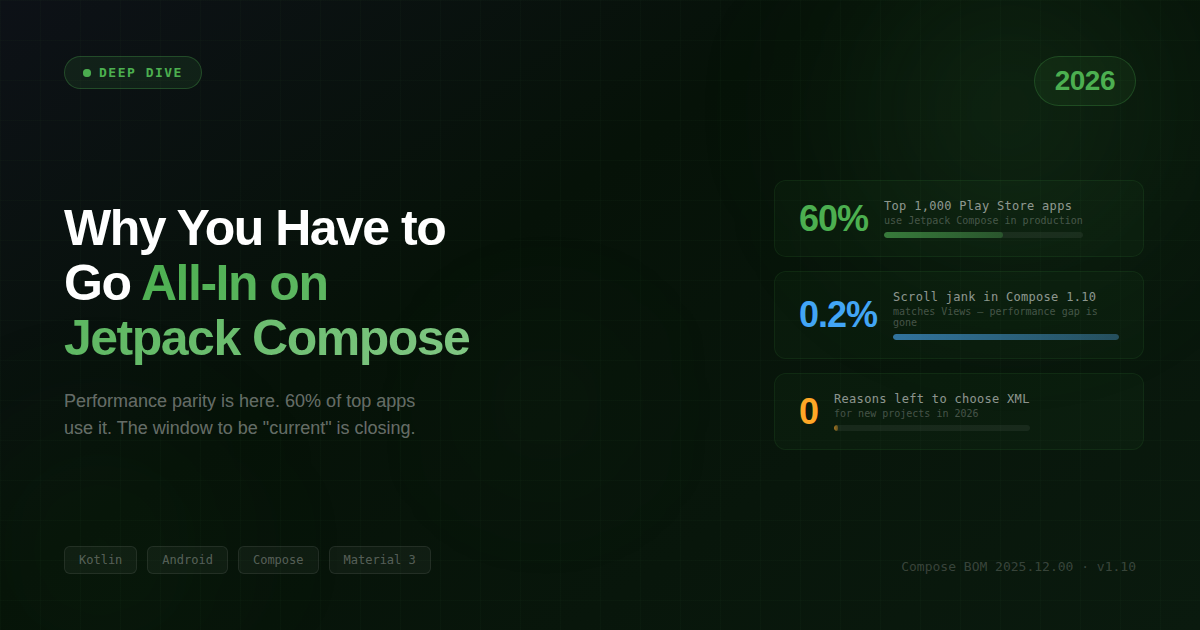
The “Compose Is Slow” Argument Is Officially Dead
For years, the number one pushback against Jetpack Compose was performance. Developers would benchmark scroll tests, point to dropped frames, and say “Views are still faster.” And honestly, for a while, they had a point.