Why DeFi Is One of the Best Public Training Grounds for Financial Systems Thinking
 Chen Xu, Ph.D, CFA4 min read·Just now
--
When people talk about DeFi, they often focus on speculation, hacks, or token prices.
What interests me is something else.
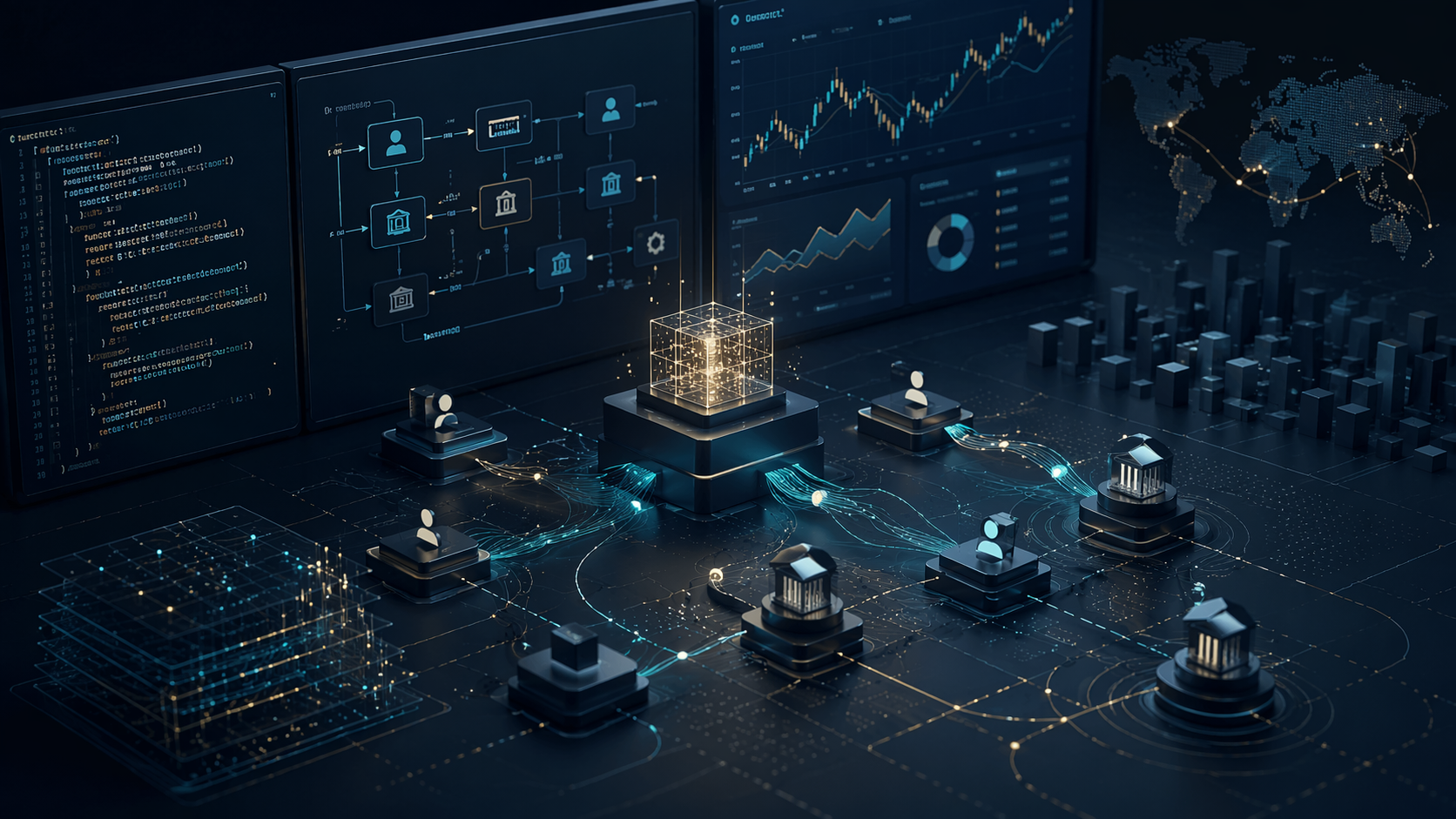
DeFi is one of the few places where a person can publicly study real production financial state machines: systems that actually hold value, move risk across users, encode economic rules in code, and remain open for inspection.
That combination is rare.
In most traditional financial systems, the most interesting code is private. The real production logic behind collateral, liquidation, risk limits, settlement, or pricing is usually hidden inside firms, exchanges, clearing systems, or internal infrastructure. You may know those systems exist, but you do not get to read them, test them, or trace their failure modes in public.
In DeFi, you often can.
That does not mean DeFi code is always better. It is not. A lot of it is rushed, copied, weakly tested, or overly dependent on trust assumptions. But the best DeFi protocols expose something unusually valuable to anyone willing to study them seriously: publicly accessible financial logic under real adversarial pressure.
That makes them extraordinary learning objects.
What makes DeFi code different
The most valuable DeFi protocols are not interesting because they are “on-chain.” They are interesting because they compress several hard things into one visible system:
- they are live production systems,
- they directly manage economic value,
- they encode accounting and risk constraints in code,
- and they can be attacked, integrated, or misused by anyone.
This changes how you read the code.
You are not just asking whether a function reverts correctly. You are asking:
- What does this variable actually represent economically?
- When is reported value different from realizable value?
- What state transition redistributes value across users?
- Which assumptions are local, and which depend on external systems?
- Is this system still coherent under adversarial inputs, fragmented execution, or delayed settlement?
Those are not just software questions. They are financial systems questions.
And unlike most financial infrastructure, they are visible.
Why this matters for a quant or financial engineer
For someone with a quantitative or financial systems background, DeFi offers something unusually concrete.
A protocol is not just “code that does finance.” It is often a compact, executable version of a market mechanism or accounting model:
- a lending protocol becomes a solvency and liquidation engine,
- an AMM becomes a continuously updated pricing and inventory system,
- an options protocol becomes a tokenized position representation problem,
- a stablecoin system becomes a live experiment in collateral quality, redemption logic, and trust boundaries.
This is why I find the space compelling.
The real value is not in hype. It is in the opportunity to repeatedly study how economic meaning is represented in state transitions.
That is a rare training ground.
The most interesting bugs are often not local bugs
One of the most important lessons from reviewing DeFi protocols is that the hardest problems are often not local code bugs.
They appear when individually reasonable components fail to remain consistent as a system.
A function may be correct in isolation.
An accounting formula may be internally coherent.
A pricing method may look conservative.
A settlement path may work on the happy path.
And yet the protocol can still become economically inconsistent.
This usually happens at boundaries:
- between internal accounting and external settlement,
- between token representation and actual claim on value,
- between solvency checks and delayed state updates,
- between one-shot execution and fragmented execution,
- between a protocol’s intended trust model and what the code really assumes.
In other words, the most important failures are often failures of mapping.
That is exactly why DeFi is such a rich place to learn.
Public financial state machines are worth studying
I do not think DeFi should be romanticized. It contains low-quality code, unsound incentives, and a great deal of noise.
But I do think serious protocols in DeFi offer one of the best publicly available environments for learning how financial systems behave under code-level constraints.
They let you inspect real mechanisms instead of just reading descriptions of them.
They let you see how accounting, risk, pricing, collateral, and adversarial behavior interact in production.
And they make it possible for independent researchers to study systems that, in most other areas of finance, would remain completely inaccessible.
That alone makes them worth studying carefully.
Closing thought
For me, the appeal of DeFi is not that it is new.
It is that it gives ordinary researchers access to something that is usually hidden: real financial machinery, expressed in public code, exposed to real risk.
That makes it one of the best public training grounds for financial systems thinking I know.
My own interest comes from a quantitative and financial systems perspective. I am less interested in “crypto” as a theme than in the opportunity to study open, adversarial, production financial mechanisms directly.