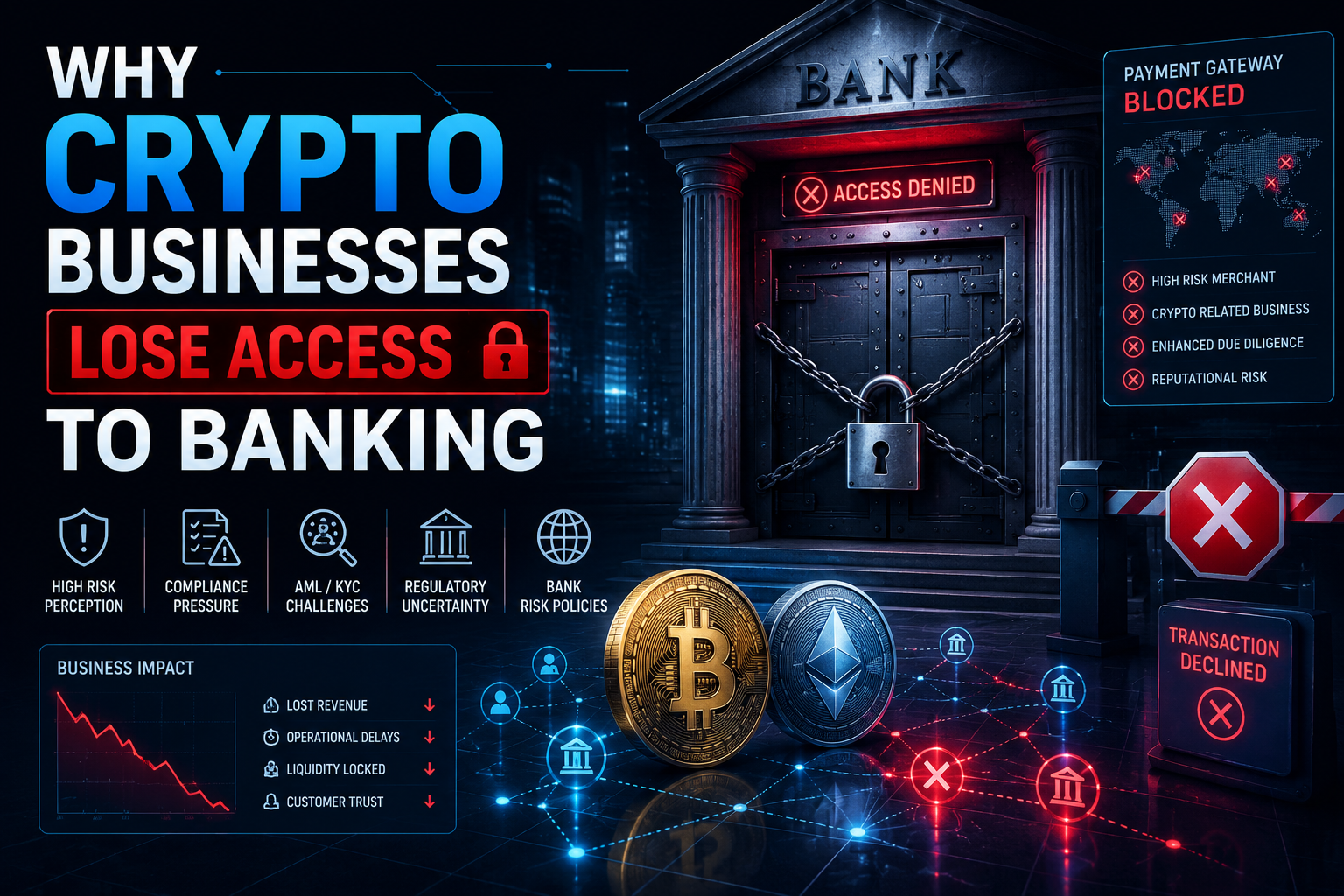
Why Crypto Businesses Lose Access to Banking
--
Banking access is the oxygen of any financial business. For crypto companies, that oxygen is being systematically cut off — not because of individual failures, but because of structural forces that are reshaping how traditional banks relate to the entire digital asset sector.
In the years between 2022 and 2024, a pattern emerged that sent shockwaves through the crypto industry. Well-capitalised, fully compliant, legally operating crypto businesses — exchanges, custodians, wallet providers, on-ramp services — began losing their banking relationships with no warning, no stated reason, and no path to reversal. Accounts were frozen. Wire transfers were returned. Correspondent relationships were severed. The affected businesses weren’t operating in legal grey areas — they were operating exactly as regulated financial businesses are supposed to operate. And they were being shut out of the banking system anyway.
This phenomenon — widely termed ‘Operation Chokepoint 2.0’ in industry commentary — represents one of the most significant structural challenges the crypto sector faces. Not volatility, not regulatory uncertainty, not technical infrastructure. Banking access. Because without banking access, even the most technologically sophisticated crypto business cannot function in the real economy. Payroll can’t be processed. Fiat customer withdrawals can’t be executed. Vendor relationships can’t be maintained. The business that cannot hold a bank account cannot survive.
Understanding why crypto businesses lose banking access — the specific mechanisms, the institutional actors, and the incentive structures that drive these decisions — is the strategic intelligence that informs how crypto businesses can protect themselves from one of the category’s most existential operational risks.
The Regulatory Pressure on Banks Serving Crypto
The most direct cause of banking access loss for crypto businesses is regulatory pressure on the banks themselves. US banking regulators — the Office of the Comptroller of the Currency, the Federal Reserve, the FDIC — have issued guidance and informal communications signalling that crypto-related business represents elevated compliance risk for the banks they supervise. These signals are not legally binding instructions to deny service to crypto companies. But they are received by bank compliance teams as strong guidance to limit crypto exposure, because the cost of non-compliance in banking regulation is severe and the cost of being overly cautious is minimal.
The regulatory guidance focuses primarily on anti-money laundering (AML) and sanctions compliance risk. Crypto transactions, particularly those involving unhosted wallets, DeFi protocols, and cross-border asset movements, present transaction monitoring challenges that banks’ existing AML infrastructure is not well-equipped to address. When a banking regulator examines a bank’s AML program and finds that the bank cannot adequately monitor the transaction flows of its crypto business customers, the bank faces examination findings and potential enforcement action. The response is predictable: reduce or eliminate the crypto customer base to eliminate the compliance gap.
This regulatory dynamic creates a structural problem that individual crypto businesses cannot resolve through improved compliance posture alone. Even a crypto company with exemplary AML controls faces banking risk because its banking provider — not the crypto company itself — bears the regulatory exposure. The bank’s decision about whether to serve the crypto company is not primarily a function of the company’s compliance quality. It is a function of the bank’s own regulatory examination risk and the bank’s assessment of whether its examiners will accept crypto-related business as manageable within the bank’s overall compliance program.
Correspondent Banking’s De-Risking Cascade
For crypto businesses operating internationally — and most meaningful crypto businesses do — the banking access problem extends beyond their direct banking relationships to the correspondent banking layer that enables cross-border fiat settlement. Large US and EU correspondent banks, under their own regulatory pressure, have progressively restricted the types of business their respondent banks can facilitate. A smaller regional bank that is willing to serve crypto customers may find that its correspondent bank — the institution that clears its international wire transfers — will not accept transaction flows related to crypto businesses, effectively limiting what the smaller bank can offer its crypto customers even if the smaller bank itself has no objection.
This correspondent banking de-risking cascade amplifies the direct regulatory pressure to create a broader banking access problem than any individual bank’s compliance decision would produce alone. Crypto businesses that successfully navigate the direct banking access challenge by finding willing domestic banks may still face settlement limitations, international wire restrictions, and correspondent banking gaps that constrain their operational capabilities even when their primary banking relationship is intact.
Reputational Risk and the Guilt-by-Association Problem
Beyond regulatory pressure, many banks decline crypto business relationships based on reputational risk calculations that have nothing to do with individual company compliance quality. The crypto sector’s association with high-profile failures — FTX, Celsius, Voyager, and others — has created a reputational environment in which any association with digital assets carries contagion risk in the minds of bank leadership, board members, and institutional stakeholders. A bank that holds accounts for a responsible, well-run crypto custody business may find its crypto association becoming a public liability when the next sector-wide crisis produces negative headlines.
This reputational risk calculation is entirely disconnected from the quality of the individual crypto business. It is a sector-level assessment that penalises well-run companies for the failures of poorly-run ones — the same structural unfairness that high-risk merchants in other categories experience. And like those other categories, the only reliable protection is building multiple banking relationships across different institutions and different jurisdictions, so that no single bank’s reputational risk calculation can terminate all banking access simultaneously.
Strategies for Protecting Banking Access
Crypto businesses that have successfully maintained stable banking access share several common practices. Jurisdictional diversification is the most fundamental: maintaining banking relationships in multiple jurisdictions — not just the business’s home country — so that regulatory pressure in one jurisdiction doesn’t eliminate all banking options simultaneously. Crypto-friendly banking jurisdictions including Switzerland, Liechtenstein, the UAE, and certain Central American and Caribbean financial centres provide banking infrastructure that is less subject to the specific regulatory dynamics driving US and EU banking de-risking.
Proactive compliance demonstration is the second critical practice. Crypto businesses that provide their banking partners with detailed, regular reporting on their AML controls, their transaction monitoring capabilities, their customer due diligence processes, and their regulatory standing consistently report better banking stability than those that provide minimum required documentation. Banks that understand their crypto clients deeply — that have been educated about the compliance infrastructure the business maintains — make better-informed de-risking decisions and are more likely to maintain relationships through industry-level pressure events.
Payment processor and fintech bridge relationships — using licensed payment processors and fintech intermediaries as a buffer between the crypto business and the direct banking layer — provide an additional protection layer for businesses that cannot establish or maintain direct banking. These intermediaries, who have established compliance frameworks acceptable to their banking partners, can facilitate fiat settlement and payment processing for crypto businesses that face direct banking access challenges. The intermediary model carries its own risks — intermediary termination produces the same access loss as direct bank termination — but well-structured multi-intermediary relationships provide meaningful resilience compared to single-bank dependency.
Banking access for crypto businesses is not simply a compliance problem to be solved through better internal processes. It is a structural challenge rooted in regulatory pressure on banks, correspondent banking dynamics, and sector-level reputational risk that requires strategic responses at the infrastructure level — not just at the compliance level.
The crypto businesses that maintain durable banking access are those who have built banking infrastructure with the same intentionality and redundancy they apply to their technology infrastructure. Multiple relationships, multiple jurisdictions, proactive compliance communication, and intermediary diversification are not optional risk management enhancements. They are the minimum viable infrastructure for a crypto business that intends to remain operational through the regulatory and reputational turbulence that continues to characterise the sector’s relationship with traditional finance.