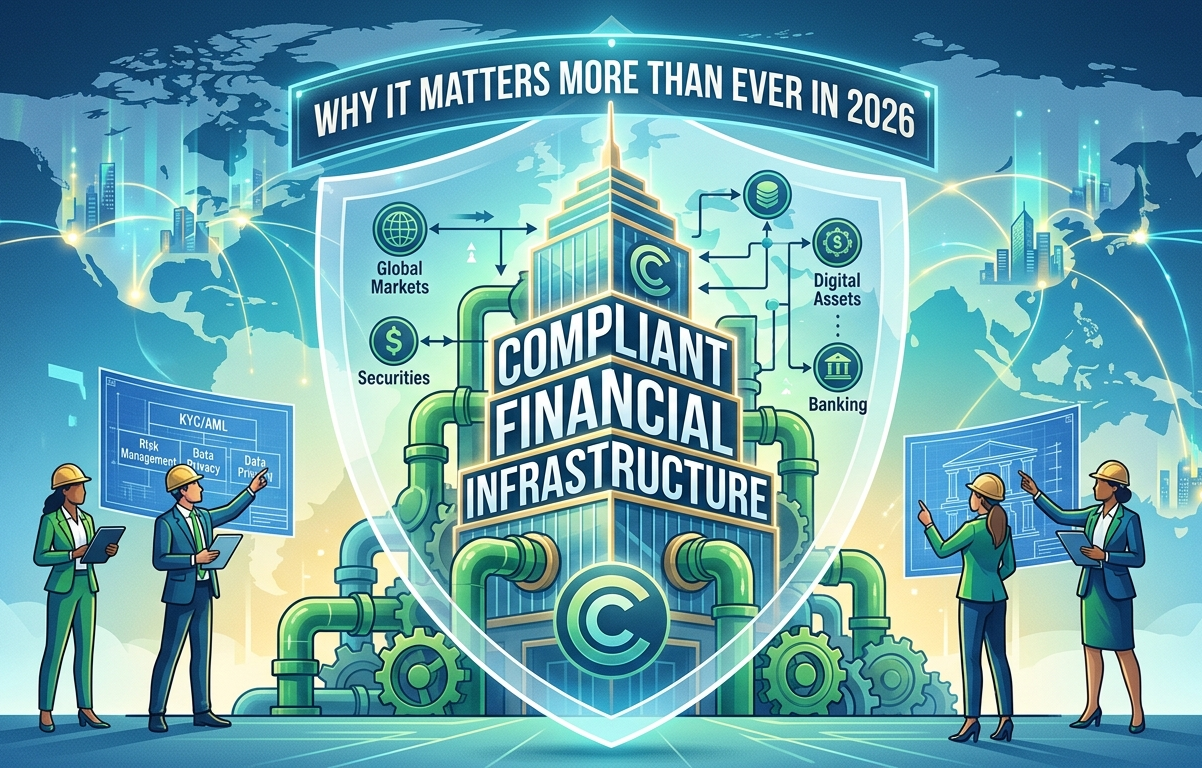
Why Building a Compliant Financial Infrastructure Matters More Than Ever in 2026
--
In 2026, launching a fintech product is easier than ever. With the rise of APIs, embedded finance, and white-label solutions, businesses can now introduce payment systems, digital wallets, and financial services faster than at any point in the past.
But while technology has simplified product development, it has also created a dangerous misconception: that fintech is easy to build.
The reality is very different.
Behind every successful financial product lies a complex structure of licensing, compliance, and infrastructure. And in today’s regulatory environment, these elements are not optional — they are foundational.
The Layer Most Founders Don’t See
From the outside, a fintech product often looks simple. A clean interface, a few features, and a seamless user experience.
But underneath that surface, every transaction passes through a system that must meet strict legal and operational standards.
This includes:
- Regulatory licensing
- AML (Anti-Money Laundering) frameworks
- KYC (Know Your Customer) procedures
- Transaction monitoring systems
- Banking and payment partnerships
Without these components, a fintech product cannot function in a real-world environment.
In earlier years, some startups delayed dealing with these requirements. In 2026, that approach no longer works. Regulators expect compliance from the beginning, not as an afterthought.
The Risk of Building Without Structure
Speed is often seen as a competitive advantage in startups. Launch quickly, test the market, and improve over time.
That approach works in many industries. It does not work well in fintech.
When businesses prioritize speed over structure, they often face problems such as:
- Difficulty securing banking partnerships
- Rejection from payment processors
- Regulatory warnings or penalties
- Costly delays in expansion
- Loss of credibility with investors
In many cases, companies are forced to pause operations and rebuild their systems to meet compliance requirements. What seemed like a shortcut at the beginning becomes a major obstacle later.
Licensing Is Not Just a Requirement — It’s a Strategy
Every financial service operates under a specific regulatory framework. This framework is defined by the type of license a business holds.
Depending on the model, this may include:
- Money Services Business (MSB) registration
- Electronic Money Institution (EMI) licensing
- Virtual asset or crypto licensing
Each option comes with its own responsibilities, costs, and limitations. Choosing the right path is not simply about approval — it directly affects how a business can operate, scale, and expand.
For example, a company focused on payments may require a different structure than one dealing with digital assets or cross-border remittances. Misalignment at this stage can lead to restrictions that are difficult to fix later.
This is why many founders now explore structured guidance early, reviewing how providers like 7BaaS approach licensing and infrastructure before making foundational decisions.
Infrastructure Defines Scalability
Beyond licensing, infrastructure plays a critical role in determining whether a fintech business can grow.
Modern financial platforms rely on:
- API-driven systems
- Payment processing integrations
- White-label banking capabilities
- Risk and compliance monitoring tools
The challenge is not accessing these tools — it is integrating them into a system that works cohesively and meets regulatory expectations.
Many startups attempt to assemble infrastructure piece by piece. While this may work initially, it often creates fragmentation, inefficiencies, and compliance gaps over time.
A more effective approach is to design infrastructure as a unified system, aligned with both business operations and regulatory requirements. This is why integrated solutions, such as the structured offerings available through 7BaaS services, are becoming more relevant for businesses aiming to scale without rebuilding later.
The Shift Toward Structured Fintech Development
The fintech industry is maturing. As competition increases and regulations become stricter, businesses are moving away from experimental models toward more structured approaches.
This shift includes:
- Planning licensing before product development
- Building compliance frameworks into core operations
- Designing infrastructure with scalability in mind
- Prioritizing long-term sustainability over short-term speed
Companies that adopt this approach may take longer to launch, but they are better positioned for growth, partnerships, and expansion.
Why External Expertise Is Becoming Essential
For many founders, navigating the complexities of licensing, compliance, and infrastructure can be overwhelming.
These are not areas where trial and error is cost-effective. Mistakes can lead to delays, financial losses, and regulatory consequences.
As a result, businesses increasingly turn to specialized providers for guidance.
For instance, companies entering regulated markets often require support with specific processes such as MSB registration. Understanding how services like MSB Registration are structured can give founders a clearer picture of what compliance actually involves in practice.
Rather than relying on assumptions, this allows businesses to align their strategy with real regulatory expectations.
The Competitive Advantage of Doing It Right
In a crowded fintech market, the difference between success and failure is often determined by what happens behind the scenes.
A well-structured business is more likely to:
- Build strong relationships with financial institutions
- Meet regulatory requirements without disruption
- Expand into new markets with fewer obstacles
- Earn trust from users and investors
On the other hand, businesses that overlook compliance and infrastructure often face recurring challenges that slow growth and limit opportunities.
The Reality of Fintech in 2026
The fintech landscape is no longer in its early stages. It is an established, competitive industry with clear expectations.
Regulators are more active.
Banks are more selective.
Customers are more aware.
This means that building a financial product today requires a higher level of precision and planning than ever before.
It is not enough to have a good idea or a well-designed app.
Success depends on building a system that works reliably within a regulated environment.
Final Thoughts
Fintech in 2026 is defined by more than innovation. It is defined by execution.
The businesses that succeed are not just those that move quickly, but those that build with clarity, structure, and long-term vision.
Licensing, compliance, and infrastructure may not be the most visible parts of a financial product, but they are the most critical.
Ignoring them creates risk.
Understanding them creates opportunity.
And in a market where trust and reliability matter more than ever, building a compliant financial infrastructure is no longer a technical detail — it is the foundation of the entire business.