Why are major stock exchanges adopting tokenized asset trading?
 Quinn Donovan5 min read·Just now
--
Major stock exchanges are undergoing a significant transformation as they integrate blockchain technology into traditional financial systems. One of the most notable developments is the adoption of tokenized asset trading, where traditional securities such as stocks and exchange-traded funds are represented as digital tokens on blockchain networks.
This shift is not experimental anymore. It is driven by real market demand, regulatory progress, and the need for more efficient financial infrastructure. Exchanges like Nasdaq and New York Stock Exchange are actively building tokenized trading systems, signaling a broader industry transition.
The move toward tokenization is reshaping how assets are issued, traded, and settled, making markets more accessible, transparent, and efficient.
What is Tokenized Asset Trading?
Tokenized asset trading refers to the process of converting traditional financial assets into blockchain-based digital tokens. These tokens represent ownership in real-world assets and can be traded similarly to conventional securities.
For example, a stock listed on a traditional exchange can also exist as a tokenized version on a blockchain. These tokenized shares maintain the same rights, including dividends and voting power, ensuring parity with traditional holdings.
Unlike cryptocurrencies, tokenized assets are tied to real-world value and operate within regulated frameworks, making them attractive to institutional investors.
The Rise of Tokenization in Stock Exchanges
Recent developments show that tokenization is becoming central to modern financial markets.
The U.S. Securities and Exchange Commission approved Nasdaq’s plan to enable tokenized trading of stocks and ETFs, marking a major milestone.
Tokenized securities can now be traded alongside traditional shares, using the same infrastructure and rights.
The New York Stock Exchange is developing a 24/7 blockchain-based trading platform for tokenized assets.
Financial institutions are launching tokenized cash systems to support real-time trading and settlement.
These developments clearly show that tokenization is no longer a theoretical concept but a practical evolution of capital markets.
Key Reasons Why Stock Exchanges Are Adopting Tokenized Asset Trading
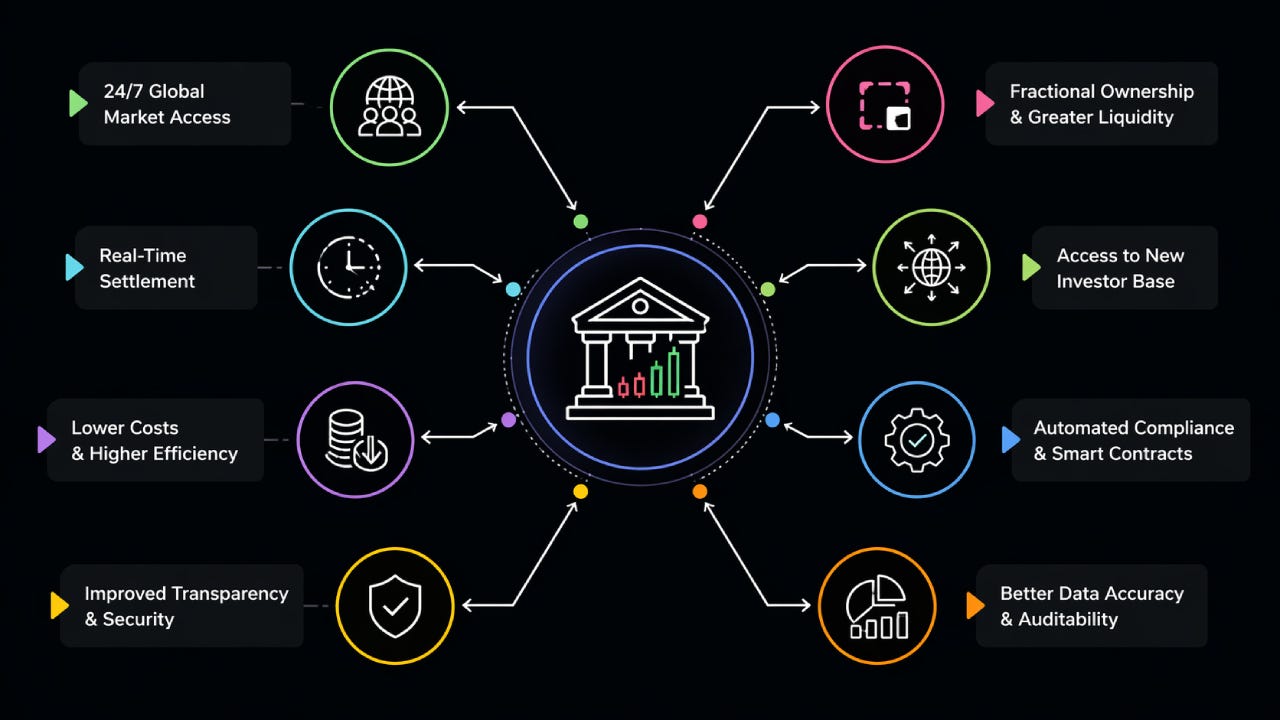
1. Faster Settlement and Reduced Costs
Traditional stock trading relies on settlement cycles such as T+1 or T+2, meaning trades take one or two days to finalize. Tokenization enables near-instant settlement through blockchain networks.
Tokenized trades can be executed and settled in real time, reducing counterparty risk and operational costs. This efficiency is one of the strongest drivers behind adoption.
2. 24/7 Market Access
Traditional stock markets operate during fixed hours, limiting accessibility for global investors. Tokenized trading allows markets to function continuously.
Exchanges are actively working toward round-the-clock trading systems. This shift enables investors from different time zones to participate without restrictions.
3. Increased Liquidity
Tokenization enhances liquidity by enabling fractional ownership of assets. High-value securities can be divided into smaller units, making them accessible to a broader investor base.
This increased participation leads to more active trading and improved market efficiency.
4. Global Accessibility
Tokenized assets can be accessed by investors worldwide without the limitations of traditional financial systems.
Blockchain technology removes geographical barriers, allowing seamless cross-border transactions. This is especially important for emerging markets where access to global equities is limited.
5. Integration with Existing Financial Systems
One of the key reasons stock exchanges are adopting tokenization is its compatibility with existing infrastructure.
Tokenized securities are designed to function alongside traditional assets, using the same trading systems and settlement mechanisms.
This hybrid approach ensures a smooth transition without disrupting current market operations.
6. Enhanced Transparency and Security
Blockchain technology provides an immutable record of transactions, improving transparency and reducing fraud.
Every transaction is recorded on a distributed ledger, making it easier to track ownership and verify asset authenticity.
This level of transparency builds trust among investors and regulators.
7. Institutional Demand for Innovation
Institutional investors are increasingly interested in blockchain-based financial solutions. Tokenization offers new ways to manage assets, optimize capital, and improve efficiency.
Major financial institutions and exchanges are investing heavily in tokenized infrastructure to stay competitive in a rapidly evolving market.
8. Regulatory Support and Clarity
Regulatory developments are playing a crucial role in accelerating tokenization adoption.
The approval of tokenized trading frameworks by regulatory bodies provides legitimacy and encourages participation from traditional financial institutions.
This regulatory clarity reduces uncertainty and fosters innovation.
9. Bridging Traditional Finance and Blockchain
Tokenization acts as a bridge between traditional finance and decentralized systems.
By integrating blockchain technology into existing markets, exchanges can offer the benefits of decentralization while maintaining regulatory compliance.
This hybrid model is essential for widespread adoption.
10. Competitive Pressure Among Exchanges
Stock exchanges are competing to lead the next phase of financial innovation.
With multiple exchanges developing tokenized trading platforms, the race to adopt blockchain technology is intensifying.
This competition is driving rapid advancements and encouraging further investment in tokenization.
Real-World Examples of Tokenized Trading
Nasdaq Tokenization Initiative
Nasdaq has received regulatory approval to enable tokenized trading of stocks and ETFs. These tokenized assets maintain the same rights as traditional securities and are traded on the same platform.
NYSE Blockchain Platform
New York Stock Exchange is developing a blockchain-based trading system that supports 24/7 trading and instant settlement.
Institutional Tokenized Cash Systems
Banks like Bank of Montreal are launching tokenized cash platforms to support continuous trading and improve capital efficiency.
Challenges in Tokenized Asset Trading
Despite its advantages, tokenized trading faces several challenges.
Regulatory Complexity
Different countries have varying regulations, making global adoption complex.
Technical Infrastructure
Blockchain systems must handle large-scale trading volumes efficiently.
Security Risks
Smart contract weaknesses and potential cyberattacks still pose significant risks.
Market Adoption
Traditional investors may be hesitant to adopt new technologies.
Future of Tokenized Stock Trading
The future of tokenized trading looks promising as technology and regulation continue to evolve.
✦More exchanges will adopt blockchain-based systems
✦Tokenized assets will expand beyond equities to bonds and derivatives
✦Interoperability between platforms will improve
✦Institutional participation will increase
Tokenization is expected to redefine capital markets by making them more efficient, inclusive, and accessible.
Conclusion
Stock exchanges are adopting tokenized asset trading to modernize financial markets and meet the demands of a digital economy. The benefits of faster settlement, global accessibility, and enhanced transparency make tokenization a powerful tool for innovation.
With strong backing from regulators, institutions, and technology providers, tokenized trading is becoming a core component of the financial system.
As adoption continues to grow, tokenization will play a key role in shaping the future of global markets, bridging the gap between traditional finance and blockchain-driven ecosystems.