Why a $200M RWA Issuer Rebuilt Their Tokenization Stack 14 Months After Launch
 Ancilar | Blockchain Services6 min read·Just now
--
The week three things broke at once
Picture the scenario. A real-world asset issuer with roughly $200M in tokenized credit on-chain. Launch was 14 months ago. The audit was clean. The first quarter ran smoothly with around 800 verified investors and quiet quarterly redemptions.
Then three things hit in the same fortnight. KYC volume jumped 6x as a new institutional channel onboarded. A regulated venue listed the token for secondary trading. And the lead jurisdiction’s regulator opened a routine audit of transfer records and beneficial ownership.
The stack didn’t fail loudly. It failed silently, in three places at once. Onboarding queued for days because identity registry writes were serialized. Half the trades on the new venue silently reverted because compliance rules referenced a stale jurisdiction list. The regulator asked for a beneficial-ownership reconstruction at a specific historical block, and the team realized the on-chain state didn’t preserve enough metadata to produce one.
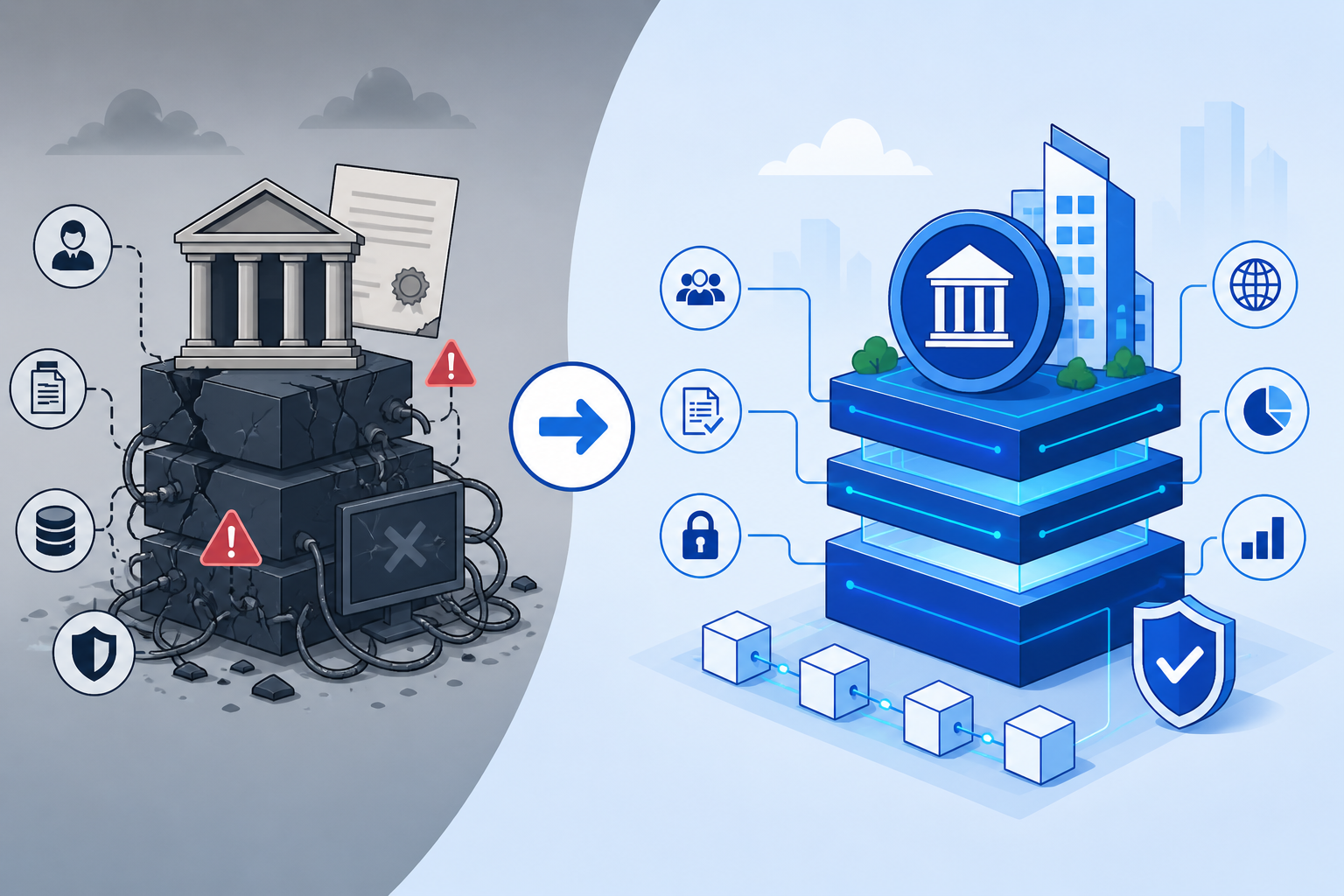
The team rebuilt the stack. Not because the original was incompetent, but because it was designed for the launch state, not the load state. Here’s what they got wrong, why these mistakes only surface under combined pressure, and what to design for from day one.
The architectural mistakes that only surface under combined pressure
1. Identity registry treated as a single contract
Most RWA stacks start with a single IdentityRegistry contract holding the address-to-identity mapping. At 800 investors and one onboarding partner, this is fine. At 5,000 investors, three KYC providers, and a venue trying to settle thousands of intra-day trades, every transfer read becomes a hot path against a contract that was never sharded or cached.
The deeper issue is structural. In the standard ERC-3643 reference architecture, identity verification, compliance rule evaluation, and the claim issuer registry all sit on the transfer path:
function transfer(address to, uint256 amount) public override returns (bool) {
    require(identityRegistry.isVerified(to), "receiver not verified");
    require(compliance.canTransfer(msg.sender, to, amount), "compliance rejected");
    require(!frozen[msg.sender] && !frozen[to], "frozen");
    return super.transfer(to, amount);
}
Each of those calls touches separate contracts and registries. Under low load this is elegant. Under combined load, the per-transfer gas cost becomes the rate limiter on the entire secondary market.
2. Compliance rules hardcoded into the token contract
The fastest way to ship a tokenized asset is to bake the jurisdiction list, lockup periods, and holder limits straight into the token contract. The fastest way to discover this was a mistake is when a regulator changes a sanctions list at 4 PM on a Friday.
ERC-3643’s modular design exists specifically to separate policy from token logic, but plenty of in-house implementations collapse this for simplicity:
function _beforeTokenTransfer(address from, address to, uint256 amount) internal {
    require(!sanctionedCountries[identityRegistry.country(to)], "sanctioned");
    require(holderCount < MAX_HOLDERS, "holder cap");
    require(block.timestamp > lockupEndsAt[from], "locked");
}
When that list needs to change, you’re either redeploying the token (which breaks every integration that hardcoded the address) or shipping a frantic upgrade. Under regulator audit timelines, neither is survivable.
3. No async redemption path
Treating tokenized credit or real estate like an ERC-20 with a redeem function works until redemption volume exceeds the off-chain liquidation rate of the underlying asset. ERC-7540 exists precisely because real-world settlement is slower than block time. Issuers who skip the asynchronous redemption pattern end up with either a stuck queue that locks user funds or a forced fire-sale of underlying assets to cover instant withdrawals.
4. On-chain state insufficient for regulator audits
This is the one almost nobody plans for. A regulator does not ask “show me current holders.” A regulator asks “produce the holder list and beneficial ownership chain as it existed on March 14 at 18:00 UTC, with supporting KYC artifacts and the compliance decision for every transfer in that 24-hour window.”
If your contracts emit lean events, your KYC claims live in an off-chain database that has been re-indexed since March, and your compliance rules have been updated three times without versioning, that report takes weeks. Sometimes it cannot be produced at all.
5. Secondary-market integration assumed permissionless settlement
Listing on a regulated venue sounds like a clean win until you realize the venue’s settlement layer expects atomic transfer with retry semantics, while your compliance contract returns a generic revert on any rule miss. Trades fail with no signal, market makers pull liquidity, and your token's secondary spread blows out within 48 hours.
6. Proof-of-reserve treated as a quarterly PDF
Sophisticated institutional buyers in 2026 expect on-chain attestations of underlying collateral, refreshed at SLA-defined intervals, signed by multiple parties. A quarterly PDF posted to the issuer’s website reads as a red flag, not a reassurance.
Why these only surface together
Each of these mistakes is survivable in isolation. A slow identity registry under low onboarding volume is invisible. Hardcoded compliance rules under stable regulation are convenient. Lean event logs are cheap until someone asks for a historical reconstruction.
The reason the rebuild happens at month 14 and not month 2 is that real-world assets follow a predictable load curve. Year one is dominated by primary issuance and a small set of relationships. Year two is when secondary markets, institutional channel volume, and regulator scrutiny arrive simultaneously. That simultaneity is what exposes the design, and by then the cost of rebuild is dramatically higher than the cost of designing correctly upfront.
The Ancilar RWA design checklist
This is the checklist we run through with every RWA team during pre-build architecture review. None of it is optional if you intend to scale past pilot.
Identity layer
- Identity registry separated into storage and access contracts so storage can be migrated or sharded without breaking integrations.
- Multiple trusted-issuer support from day one, with claim revocation and expiry built into the read path.
- PII never on-chain. Only hashes, signatures, and references.
Compliance layer
- Compliance modules separated from token contract. Policy upgrades must not require token redeployment.
- Versioned compliance rules with explicit effective-from and effective-to timestamps for every rule.
- Structured revert reasons so venues and integrators can distinguish “user not verified” from “jurisdiction blocked” from “lockup active.”
Redemption and settlement
- Async redemption flow (ERC-7540 pattern) for any asset class with off-chain settlement latency.
- Per-block and per-window withdrawal caps with explicit pause authority.
- Forced-transfer authority documented, scoped, and timelocked. Used only for legal orders.
Auditability
- Events emit enough state to reconstruct holder set, compliance decisions, and beneficial ownership at any historical block.
- KYC claim artifacts archived with cryptographic links to the on-chain claim hash.
- Compliance rule changes governed by a contract that emits versioned events.
Proof of reserve
- Multi-party attestations, not single-source.
- SLA-defined freshness with on-chain enforcement that flags stale proofs.
- Tamper-evident structure (Merkle roots, signed timestamps) verifiable by third parties.
Secondary market readiness
- Transfer interface tested against the specific settlement semantics of every venue you intend to list on.
- Compliance gas budget profiled at 100x current load.
- Integration runbooks for adding and removing venues without redeploying.
How Ancilar fits in
We work with RWA issuers in two windows. The first is pre-build, when the tokenization stack is still on a whiteboard and getting the architecture right costs a fraction of what a rebuild costs. The second is at the inflection point above, when the team has shipped, scaled, and realized something will break before the next institutional channel goes live.
Either way, the work is the same: architecture review against the checklist above, threat modeling for KYC scaling and regulator audit scenarios, invariant testing for compliance and accounting, and a written design memo your auditors and your future self can actually use.
For founders raising right now, this work doubles as institutional due diligence material. Allocators evaluating RWA platforms read architecture memos the way credit committees read covenants.
If you’re between pilot and scale, or you’ve already started seeing the early signals, that’s the conversation we’re set up to have.
Schedule a pre-build or rebuild review with Ancilar: www.ancilar.com/services/smart-contract-audit