
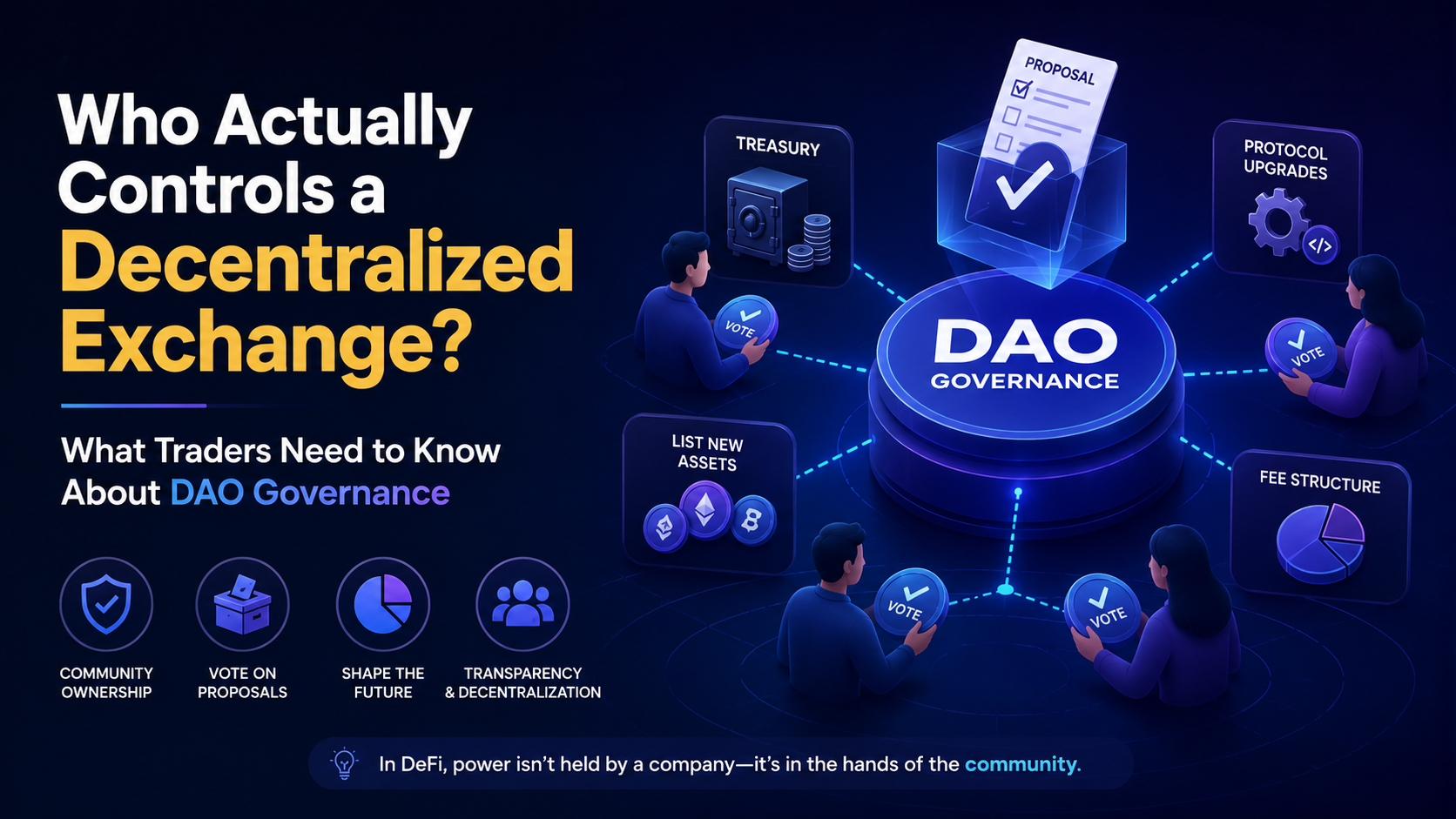
Who Actually Controls a Decentralized Exchange? What Traders Need to Know About DAO Governance
Decentralized in Theory, Concentrated in Practice
 Divyesh Patel7 min read·Just now
--
No company is making decisions behind the scenes when you trade through a decentralized exchange (DEX). Changes to fees are not voted on by the board of directors. No CEO is a decision maker as to which tokens are listed or delisted. Rather, those decisions are up to a DAO, or Decentralized Autonomous Organization, where decisions are made by the protocol’s governance token holders.
That framework is a very simple democratic structure. In reality it is much more complex. For those who trade on a decentralized trading platform using real money, this is more important than most people realize and understanding how it works and where it might fail is relevant.
What DAO Governance Actually Does on a DEX
DAO governance is simply a system of on-chain voting that can be used to reach collective decisions about a protocol. Proposals are submitted by token holders, discussed publicly, voted and when a proposal is a success, it is executed through a smart contract which is then locked for a while before it is activated. Once execution triggers, no human override is allowed.
On a decentralized exchange platform, the governance of the platform normally includes fee structure, programs that incentivize liquidity, new pairs supported, treasury funding, and major protocol updates. These are not fashion decisions. Liquidators or token holders benefit from a fee switch vote. A Treasury allocation vote is a crucial decision that can make or break a protocol in a deep bear market. An upgrade vote decides if the security patch is deployed or delayed.
The tokens of holders of the MKR token dictate the allocation of funds in the MakerDAO treasury, which holds more than $1 billion in assets, with $100 million voted to back real-world assets and $50 million to fund growth initiatives recently. Aave DAO is the governance body for a lending service that works on several networks where AAVE members dictate interest rates, collateral needs, and additional markets. These are important investments that are decided by token-weighted voting mechanisms and the consequences that impact on all of those that use those platforms.
The Concentration Problem
The problem of DAO governance is that there is a theory of broad community participation, and then there is the reality of how the power of voting is distributed.
The average turnout for voters in DeFi DAOs is around 17%. In some protocols, it is less than 10%. This is the case with critical decisions on multi-million dollar treasuries and live trading infrastructure made by a small minority that is very active. Since most DAO systems are based on the one-token-one-vote principle, the minority that votes the most tends to be the minority with the most tokens.
In 2024, the research revealed that 73% of the votes that were at stake were affected by the people with more than a third of the supply. What this does not imply, however, is that the result is a bad one; large holders have incentive to make decisions that benefit the long term value of the protocol, but this is a governance system that isn’t really democratic.
DAO governance had started to take a more professionalized course by 2025. Proposal counts fell. Delegation intensified. A few professional parties, or people and entities, who can coalesce the votes of the passive token holders became the main actors in the governance process for the big protocols. One active delegate from Aave, Lido and multiple other protocols stated that they cast 725 votes, with more than 8 million votes cast across 18 protocols in one year.
This concentration enhances execution and governance stability, which is important for institutional investors. But this also implies that the influence of casual token holders is much reduced in the direction of the protocols they control.
How Governance Shapes the Decentralized Exchange You Trade On
On decentralized exchanges, the implications of governance are very real and impactful for traders.
Prices are regulated. A protocol that imposes a fee switch means that it is taking a percentage of trading fees and sending it to the token holders instead of solely to the liquidity providers, which alters the economics of providing liquidity to that protocol. If they are paid less, some liquidity providers may leave. The more liquidity that decreases, the more slippage traders will encounter. One decision by the governors could make the difference between competitive trading fees and sustainable liquidity incentives.
There are provisions for protocol upgrades. A major upgrade, be it a new AMM architecture, supported chains or new routing system goes through a governance process when it is deployed on a decentralized trading platform. A weak or ineffective governance process can create delays in delivering critical security updates. In 2025, governance discussions were held for weeks within several protocols, on matters that had to be acted on quickly.
Expansion across chains is regulated. When protocols start to support cross-chain trading, they’re going through token holders, building out the cross-chain trading mechanisms, what does that involve? Build the cross-chain trading mechanisms, what does that involve? The chains to support, the bridges to integrate, the allocation of the treasury resources to incentivize liquidity across chains… it’s all on the ballot. In a decentralized exchange that is cross chain, the governance quality directly impacts how fast and good its cross chain is.
What Healthier Governance Looks Like
The DeFi ecosystem has tried a few different approaches to enhance the quality of governance, which doesn’t revolve around just token voting.
Quadratic voting is a voting system that implements a weighting of each new vote that makes it more costly the more votes cast. This makes it very costly to a large holder to control the votes on all the issues, but still allows for strong preferences to be expressed by a small holder. The total growth for quadratic voting was 30% from 2024 to 2025 on all DeFi governance systems.
Passive token holders can cast their vote via a delegate without relinquishing their token ownership. This allows participation rates to be improved by giving people who don’t have time to check each proposal, someone who does to represent them.
Time-locked execution introduces a time lag between passing and execution of a proposal, allowing time for the community to look for issues within the logic of the proposal before it is implemented. This is an important protection because governance proposals are not solely a piece of text; they are transactions that depend upon real protocol contracts.
43% of DAOs also adopted AI tools to aid governance, with most using them to summarize complicated proposals and pinpoint risks, enabling token holders to make multi-million dollar decisions without reading through pages of technical documentation.
The factors to consider when choosing a DEX trading platform
When considering a dex trading platform, traders should look at governance transparency as an indicator to consider in addition to security audits and liquidity.
Participation, proposal history, and how voting power is divided can be revealed by publicly available voting records, such as those provided by Tally or Snapshot. The risk of a platform with 40% of all votes being controlled by a single wallet will be different to a platform where the top ten wallets hold 30% of the total votes.
There is evidence of active governance with regular proposals and ongoing community discussion, suggesting a protocol is being maintained and developed. When proposals are infrequent and participation in them is low, dormant governance can suggest a scenario in which essential governance is taking place without the use of on-chain protocols that offer accountability.
The type of treasures is also important. The DAOs that have significant stablecoin staking positions and native tokens can sustain their operations during bear markets. When the entire treasury is in their own token, a circle of risk exists: if the price of the token decreases, the treasury becomes less valuable when it’s needed the most.
In the case of a cross chain crypto exchange, governance quality has an impact on the speed of its response to vulnerabilities, as well as to the adoption of new chains and to the modification of liquidity incentives at ecosystem level. The infrastructure for cross-chain is more complex than that of single-chain DEX, and the governance system must also be adaptable and responsive to the complexity of cross-chain.
Governance Is Not an Abstract Concern
Traders are generally used to thinking of governance as a secondary consideration, one that’s there but doesn’t really impact them. That’s the wrong perspective on how much of the decentralized exchange platform is determined by one or more governance decisions made weeks, or even months, ago.
Everything, from fee structures to chain support, the time of security upgrades, liquidity incentive programs to bridge integrations, it all comes through governance. The quality of the decisions made in these processes will render the quality of the trading environment you interact with each time you connect a wallet and make a swap.
To determine the trustworthiness of a platform, you need to know who is in charge, how they are in charge, and if they are a functional platform or not. With Decentralized Finance, there is no separation between governance and the product. It’s a part of the infrastructure.