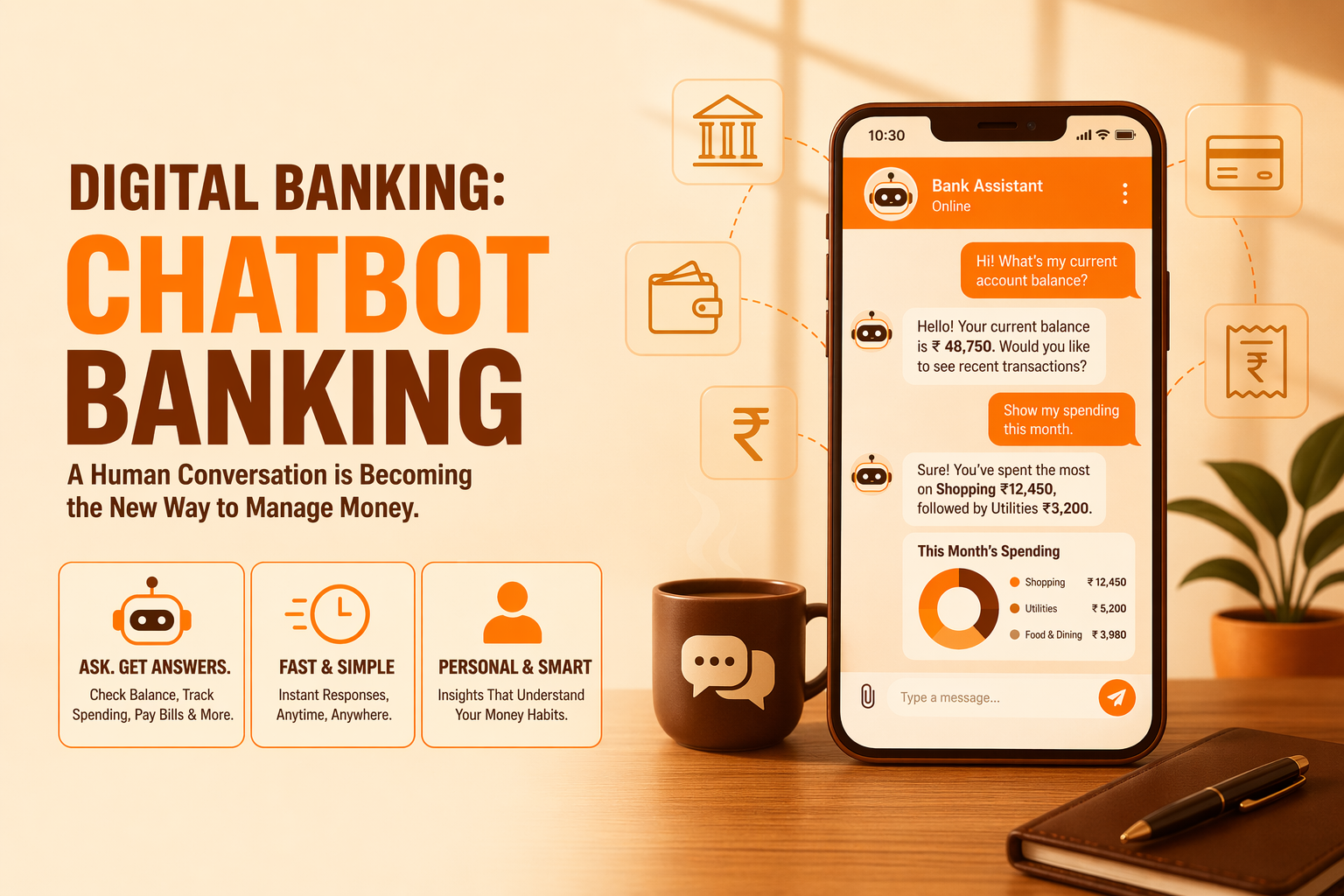
When Your Bank Starts Talking Back: The Quiet Rise of Chatbot Banking
Human conversations are becoming the new interface for money, reshaping how we understand and manage our finances.
 Valeriya An6 min read·Just now
--
The Moment Banking Became a Conversation
It usually begins with a simple question.
“Where did I spend the most this month?”
Not long ago, answering that meant logging into an app, navigating through tabs, downloading statements, and doing the math yourself. Today, it can be answered in seconds by typing a sentence or even speaking it out loud. The response comes back instantly, almost like a conversation with someone who already understands your habits.
This is not just a feature upgrade. It is a fundamental shift in how people interact with money.
Why Traditional Digital Banking Still Feels Broken
For decades, banking has been built on structure, forms, and systems. It has asked users to adapt to its logic. Chatbot banking reverses that relationship. It allows banking to adapt to human behavior instead.
The problem it addresses is deeply human.
People do not think in menus and dashboards. They think in questions, concerns, and moments. They worry about bills at midnight. They check balances during a commute. They want reassurance before making a big payment. Traditional digital banking, despite all its progress, still forces users into predefined flows that often feel rigid and impersonal.
This friction has consequences. It slows down decision making. It creates confusion. It quietly distances users from actively managing their finances. And for many, it reinforces a subtle anxiety around money because clarity feels just out of reach.
How Chatbot Banking Changes the Game
Chatbot banking steps into this gap by making financial interaction feel natural. Instead of searching for information, users simply ask. Instead of navigating, they converse.
At its core, this shift is powered by a simple idea. If banking can understand intent, it can respond meaningfully.
This leads to a set of practical transformations that go beyond surface level convenience.
Understanding intent becomes the foundation of better service. A user asking “Can I afford a trip this month?” is not just looking for a balance figure. They are seeking insight, reassurance, and sometimes even guidance.
Modern chatbot systems analyze spending patterns, recurring obligations, and savings behavior to provide contextual answers that feel relevant.
Personalization becomes dynamic rather than static. Instead of generic notifications, users receive responses tailored to their financial behavior. The system learns over time, refining its suggestions and insights with every interaction.
Accessibility improves dramatically. For users who are not comfortable navigating complex interfaces, a conversational model lowers the barrier to entry. It makes banking more inclusive, especially for those who may feel intimidated by traditional systems.
Speed becomes intuitive. Transactions, queries, and support requests can be handled within a single conversational flow. There is no need to switch between sections or wait for assistance.
What Users and Banks Gain From This Shift
The outcomes of this transformation are already visible.
Users feel more in control because information is accessible in a language they understand. Decision making becomes faster because insights are delivered in context. Engagement increases because the experience feels less like a task and more like a conversation.
For financial institutions, this translates into deeper user relationships. When interactions become frequent and meaningful, trust builds naturally. And trust, in the world of finance, is everything.
The Challenges Behind the Convenience
However, this transformation is not without its challenges.
Accuracy remains a critical concern. A chatbot that misunderstands intent or provides incorrect information can quickly erode trust. The margin for error in financial conversations is extremely small.
Security is another layer of complexity. Conversations often involve sensitive data, and ensuring that every interaction is secure requires robust encryption, authentication, and monitoring mechanisms.
There is also the challenge of balancing automation with human touch. While chatbots can handle a wide range of queries, there are moments when users need empathy, reassurance, or nuanced understanding that only a human can provide. Designing seamless transitions between automated and human support is essential.
Finally, there is the question of over reliance. As systems become more capable, there is a risk that users may depend entirely on automated guidance without fully understanding their financial decisions. Maintaining transparency and encouraging informed choices is crucial.
A Deeper Shift in the Fintech Ecosystem
Beyond the technology, there is a deeper shift unfolding within the financial ecosystem.
Decision making is becoming more data driven, yet it must remain human centered. Innovation is accelerating, but it requires thoughtful implementation. Growth opportunities are expanding, but they come with the responsibility of maintaining trust and integrity.
In this evolving landscape, success is not defined by who builds the most advanced system, but by who builds the most meaningful experience.
The mindset required here is subtle. It is about listening more than speaking. It is about understanding behavior rather than just processing transactions. It is about designing systems that feel intuitive rather than impressive.
Key Features Powering Chatbot Banking
From a feature perspective, chatbot banking is evolving rapidly.
Real time transaction assistance allows users to initiate and complete payments within a conversation. Financial insights are delivered proactively, helping users understand their spending patterns without having to ask. Automated reminders and alerts keep users informed about upcoming obligations. Integration with other services enables a seamless flow between banking and everyday activities.
These features, when combined, create an ecosystem where banking is no longer a separate activity. It becomes an integrated part of daily life.
Market Growth and the Road Ahead
Looking ahead, the market trajectory for chatbot banking is strong.
As digital adoption continues to rise, users are increasingly expecting instant, intuitive interactions. Advances in natural language processing and artificial intelligence are making conversations more accurate and context aware. Financial institutions are investing heavily in conversational interfaces as a way to differentiate themselves in a competitive market.
There is also a growing emphasis on cross platform experiences. Users want to start a conversation on one device and continue it on another without losing context. This continuity is becoming a key factor in user satisfaction.
The global expansion of digital services further amplifies the importance of scalable, conversational banking solutions. In regions where traditional banking infrastructure may be limited, chat based interfaces can provide a more accessible entry point into the financial system.
Real World Use Cases That Show the Impact
Real world applications of chatbot banking are already shaping user experiences.
A small business owner can quickly check cash flow and receive recommendations on managing expenses. A young professional can set savings goals and receive personalized insights on how to achieve them. A traveler can get instant support for international transactions without navigating complex menus.
These scenarios highlight a simple truth. When banking becomes conversational, it becomes more human.
Final Thought: Banking That Feels Human Again
In the end, the rise of chatbot banking is not just about technology. It is about redefining the relationship between people and their finances. It is about making interactions simpler, clearer, and more meaningful.
Money has always been deeply personal. Now, the way we interact with it is becoming personal too.
If this shift continues, the future of banking may not be defined by apps or branches, but by conversations that feel natural, responsive, and quietly empowering.
Join the Conversation
If this perspective resonated with you, consider following the publication for more insights on the evolving world of fintech. Applaud the story if it added value to your understanding. Share your thoughts in the comments and engage in the conversation. There is always more to explore, and your perspective adds to the collective learning. Collaboration and contribution are what shape meaningful discussions, and there is space for every thoughtful voice.