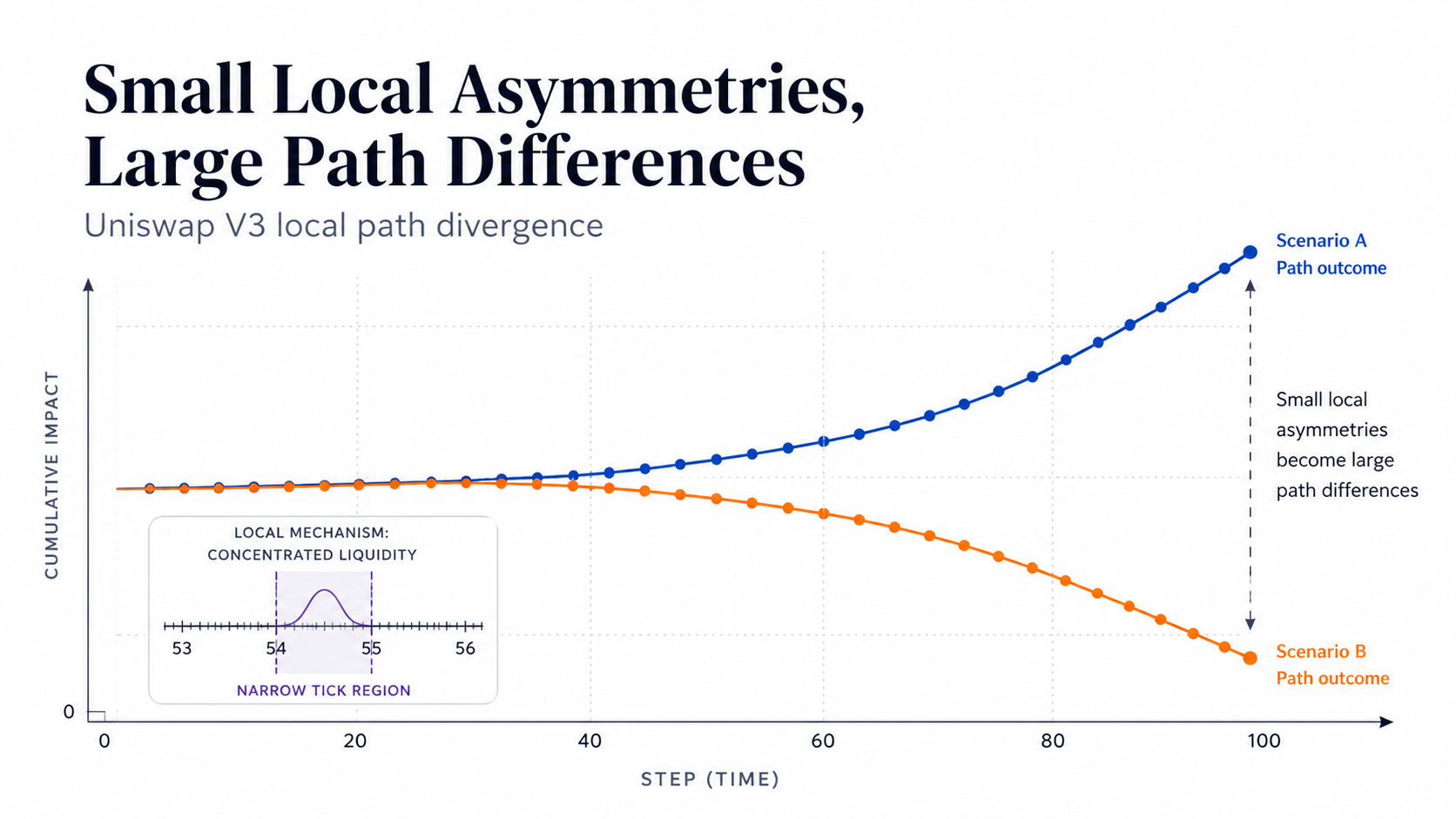
When Small Local Asymmetries Become Large Path Differences in Uniswap V3
 Chen Xu, Ph.D, CFA4 min read·Just now
--
Repeated local bias, path divergence, and inventory drift under concentrated liquidity.
A small local asymmetry does not always stay small.
In one Uniswap V3 experiment, I compared two repeated swap paths that looked similar at first glance. After enough steps, they no longer looked similar at all: one remained in a two-tick oscillation, while the other collapsed into a one-sided tick regime. The divergence also appeared in cumulative token flow and gas.
This note is about how a small local mismatch can become a much larger path-level effect.
Two paths that look similar at first
The experiment is simple.
I start from the same local baseline in a small Uniswap V3 setup near ticks 54 and 55. Then I compare two repeated two-step paths.
The first path is token0-anchored:
swapExact0For1(1e14)swap1ForExact0(1e14)
The second path is a more naive exact-input path:
swapExact0For1(1e14)swapExact1For0(1e14)
At first glance, these paths do not look radically different. Both are short alternating patterns, and both operate in the same local region. It would be easy to assume that repeated execution should produce roughly similar local behavior.
That assumption turns out to be wrong.
Divergence in tick path
The first difference appears in the tick path itself.
For the token0-anchored path, the pool keeps oscillating between ticks 54 and 55. The path remains locally balanced in the discrete sense: it keeps stepping down and back up.
For the naive exact-input path, that does not happen. It drops to tick 54 almost immediately and then stays there for almost the entire run.
So the repeated paths do not just differ by a small local offset. They enter different discrete regimes.
One remains in a two-tick oscillation. The other effectively gets pinned to one side.
That is already enough to make the main point of this note: a small local asymmetry can become a structurally different path under repetition.
Divergence in cumulative token flow
The second difference shows up in cumulative token flow.
The token0-anchored path may look locally balanced in tick space, but it is not economically neutral. Over repeated steps, it accumulates a meaningful negative token1 drift.
The naive exact-input path accumulates token flow differently. It does not just follow a different tick path; it produces a different inventory trajectory.
This matters because the path is no longer just a sequence of local moves. It becomes a process that reshapes inventory over time.
That is the deeper point. In concentrated liquidity, a local asymmetry does not have to stay local. Once repeated, it can accumulate into a persistent inventory effect.
Divergence in cumulative gas
The third difference appears in cumulative gas.
The two paths do not just differ in tick behavior and token flow. They also differ in execution cost. Repeating a slightly different local pattern leads to a different cumulative gas footprint.
This is not the main result, but it strengthens the broader picture. The divergence is not confined to one metric. It shows up across discrete state, inventory, and cost.
Why this happens
The intuition is straightforward.
Uniswap V3 combines a continuous price state with a discrete tick structure. That creates threshold effects: a move that looks only slightly different in one step can land on a different side of a local boundary, which changes the effective starting state of the next step.
Under repetition, that small mismatch compounds. What first looked like a local asymmetry becomes a path-level divergence.
In other words, this is not just about one swap being slightly different from another. It is about state dependence under repetition.
What this means
This experiment is small, but the lesson is broader.
In Uniswap V3, local asymmetries do not necessarily stay small. Under repetition, they can evolve into much larger differences in path, inventory, and cost.
That is one reason static intuition is not enough for concentrated liquidity. A single local picture may look harmless. But repeated execution can push the system into a meaningfully different regime.
The interesting part is not only that the paths differ. It is that they start from something that looks almost negligible.
That is exactly why local mechanism research matters: what looks negligible in one step may become structurally important under repetition.