What Makes a DeFi Strategy Actually Sustainable?
--
DeFi makes yield easy to see.
Open any dashboard and you’ll find numbers everywhere — APYs updating in real time, returns compounding, opportunities rotating faster than you can track them.
But if you’ve been around long enough, you start noticing a pattern.
A new protocol launches.
Yields are high.
Capital rushes in.
Then slowly:
Yields compress.
Liquidity moves.
The opportunity fades.
And the cycle repeats.
So the real question isn’t:
“Where is the highest yield right now?”
It’s:
“What actually lasts?”
The Pattern We Keep Ignoring
Most DeFi strategies follow the same lifecycle.
They begin with incentives — token emissions, liquidity mining, rewards designed to attract capital quickly.
At first, it works.
Returns look incredible. Early users benefit. Attention builds.
But over time, those incentives dilute. More capital enters the same strategy. The edge disappears.
And just like that, what looked like a “high-yield opportunity” becomes average — or worse, unprofitable.
This isn’t failure.
It’s a natural cycle.
But it raises an important question:
Why do most strategies fade so quickly?
What “Sustainable” Actually Means
In DeFi, sustainability isn’t about chasing peaks.
It’s about durability.
A sustainable strategy should:
- Generate consistent returns over time
- Avoid reliance on temporary incentives
- Remain viable across different market conditions
It doesn’t need to be the highest yielding.
It needs to survive.
Because in the long run, consistency compounds more effectively than spikes.
Real Yield vs Temporary Yield
Not all yield is created equal.
Some strategies generate returns from real economic activity:
- Trading fees
- Lending interest
- Arbitrage opportunities
Others rely heavily on incentives:
- Token emissions
- Reward programs
- Liquidity mining campaigns
The difference is critical.
Incentive-driven yield often looks attractive — but it’s temporary by design. Once rewards decline, so does the strategy.
Real yield, on the other hand, comes from actual usage.
It’s tied to demand.
And that makes it far more sustainable.
The Role of Liquidity and Market Conditions
Sustainability doesn’t exist in isolation.
It depends on the environment.
A strategy might perform well only when:
- Liquidity is high
- Volatility is strong
- Demand is concentrated
Change those conditions, and performance can drop instantly.
Sustainable strategies are different.
They adapt.
They don’t rely on a single scenario to work — they evolve with the market.
The Hidden Costs Most People Ignore
On paper, many strategies look great.
But real performance tells a different story.
Because yield isn’t just about returns — it’s about net returns.
And that includes:
- Execution costs
- Slippage
- Rebalancing frequency
- Changing correlations
A strategy showing 20% APY might deliver far less once these factors are accounted for.
Sustainability means understanding the full picture — not just the headline number.
From Opportunities to Systems
This is where DeFi starts to mature.
Instead of chasing isolated opportunities, capital begins to move through systems.
Sustainable strategies are built with:
- Diversification across multiple approaches
- Continuous monitoring and adjustments
- Dynamic allocation based on conditions
- Focus on risk-adjusted yield
It’s no longer about reacting.
It’s about managing.
Where Concrete Vaults Fit In
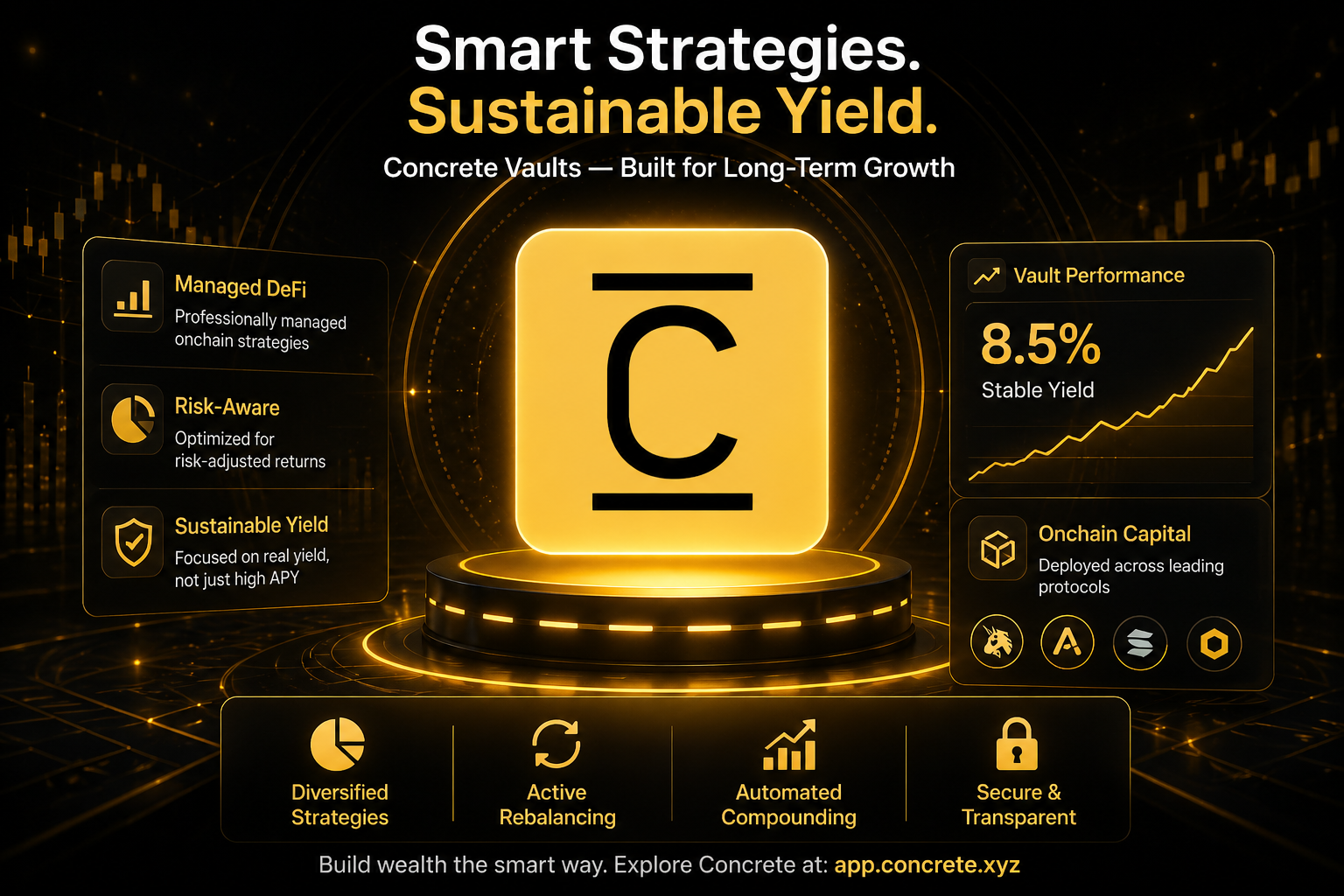
This shift is exactly what platforms like Concrete are designed for.
Instead of chasing short-term spikes, Concrete vaults aim to:
- Prioritize sustainable yield sources
- Allocate capital across multiple strategies
- Adapt as market conditions change
- Reduce reliance on temporary incentives
This is what managed DeFi looks like.
Less noise. More structure.
A Real Example: Concrete DeFi USDT
Take something like Concrete DeFi USDT.
At ~8.5% yield, it might not look as exciting as a 50% APY farm.
But that’s the point.
Because over time:
- Stability compounds
- Risk is reduced
- Capital stays longer
And in many cases, consistent returns outperform volatile ones.
Sustainable yield doesn’t always look impressive.
But it works.
The Bigger Shift in DeFi
DeFi is evolving.
We’re moving from:
Short-term yield chasing → Long-term capital strategies
Incentives → Infrastructure
Hype → Durability
The future won’t belong to the highest APY.
It will belong to the strategies that continue working when everything else stops.
Because in the end:
Sustainable yield isn’t about how much you can earn today.
It’s about how long you can keep earning tomorrow.
🚨 Explore Concrete: https://app.concrete.xyz/earn 🚨