What Makes a DeFi Strategy Actually Sustainable?
--
DeFi has a pattern—and if you’ve spent any time onchain, you’ve seen it play out over and over again.
A new protocol launches with eye-popping APY.
Capital floods in.
Returns begin to compress.
Liquidity rotates out.
And just like that, the opportunity fades.
This cycle isn’t an exception—it’s the norm. Which raises a more important question than most investors are asking:
Why do most DeFi strategies fail to last?
Beyond the Hype: Defining Sustainable Yield
In a space obsessed with peak returns, sustainability often gets overlooked.
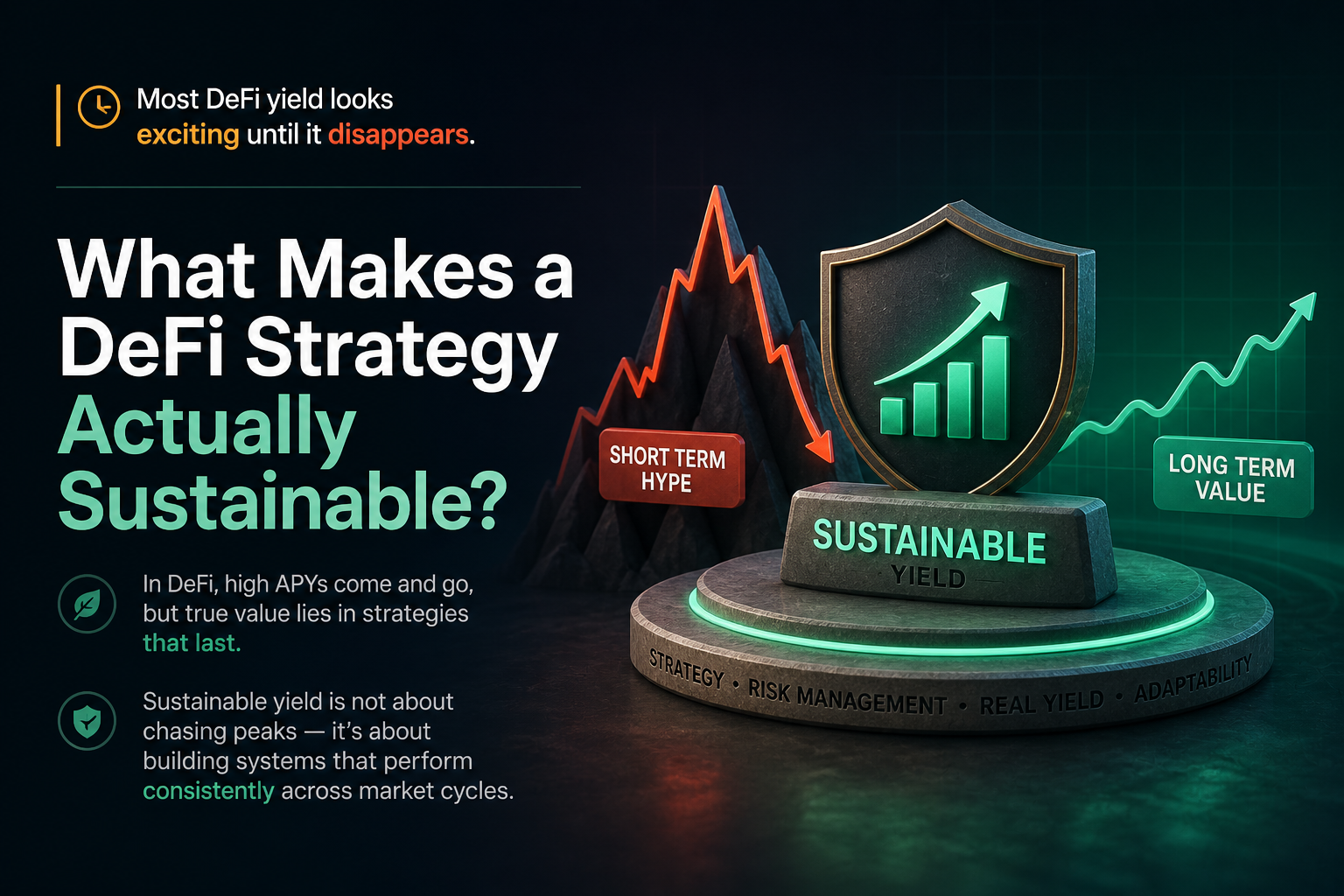
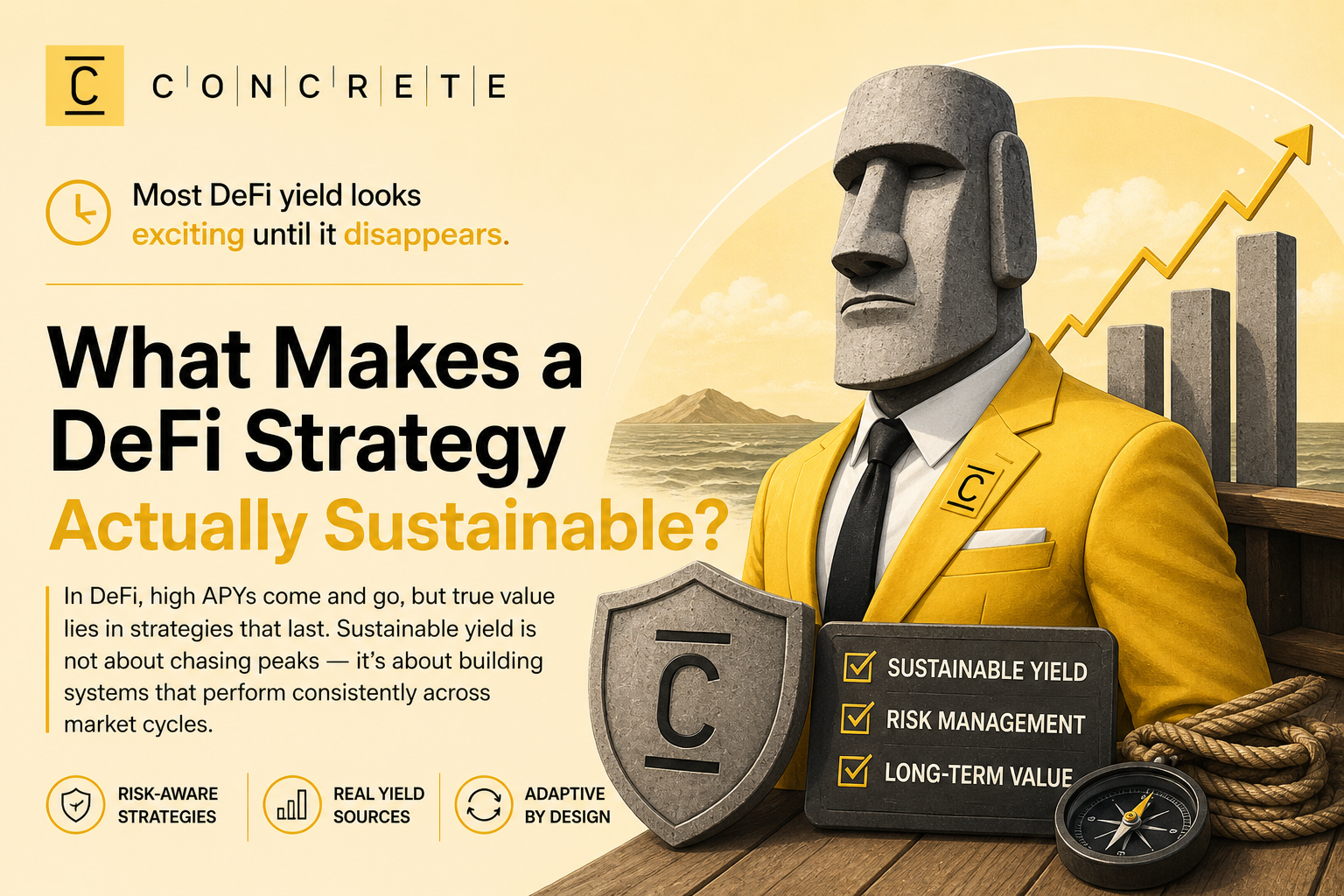
A sustainable yield isn’t about who offers the highest APY this week. It’s about what continues to perform across weeks, months, and even market cycles.
A truly sustainable DeFi strategy should:
- Deliver consistent, risk-adjusted yield over time
- Avoid heavy dependence on token incentives or emissions
- Remain viable across both bullish and bearish conditions
In other words, it prioritizes durability over short-term performance.
Real Yield vs Temporary Yield
Not all yield is created equal.
Some returns are generated from real economic activity—trading fees, lending demand, arbitrage opportunities. These are tied to actual usage and tend to be more stable.
Others are driven by emissions and incentives—protocols distributing tokens to attract liquidity. While attractive at first, these yields often decline as emissions slow or token prices drop.
This distinction matters.
Emissions-driven yield is often temporary
Activity-driven yield is more sustainable
Understanding this difference is key to identifying which DeFi strategies are built to last.
Liquidity, Demand, and Market Conditions
Sustainability doesn’t exist in isolation—it depends on the environment.
A strategy’s longevity is shaped by:
Liquidity depth – shallow liquidity increases volatility and slippage
- User activity – real demand sustains real yield
- Market volatility – some strategies thrive in movement, others don’t
- Underlying demand – is there a reason this strategy should exist long-term?
Some opportunities only work under perfect conditions. Others are designed to adapt.
The latter is where sustainable yield lives.
The Hidden Costs That Erode Returns
High APY numbers often ignore the realities of execution.
Over time, performance is impacted by:
- Transaction fees
- Slippage during entry and exit
- Rebalancing costs
- Changing correlations between assets
A strategy that looks strong on paper can quietly degrade once these factors are accounted for.
That’s why risk-adjusted yield—not headline APY—is the metric that matters.
Designing for Longevity, Not Spikes
Sustainable DeFi strategies don’t happen by accident—they’re designed.
They often include:
- Diversification across multiple strategies
- Active monitoring and adjustment
- Adaptability to shifting market conditions
- Focus on net returns, not gross yield
At this level, DeFi starts to resemble a system—not a series of isolated opportunities.
This is the foundation of managed DeFi.
Where Concrete Vaults Fit In
This is exactly the approach taken by Concrete vaults.
Rather than chasing the latest high-yield trend, these vaults aim to:
- Prioritize sustainable yield sources
- Actively manage capital across evolving strategies
- Reduce dependence on short-term incentives
- Optimize for consistency and durability
They’re designed with one goal in mind: long-term performance over short-term hype.
A Real Example: Stability That Compounds
Take Concrete DeFi USDT as an example.
Offering up to ~8.5% yield, it may not compete with the most aggressive APYs in the market—but that’s the point.
Because over time:
- Stable, consistent returns often outperform volatile spikes
- Predictability attracts long-term onchain capital
- Lower volatility reduces compounding risk
This is what institutional DeFi begins to look like—measured, reliable, and built for scale.
The Bigger Shift in DeFi
DeFi is evolving.
The early phase was defined by yield chasing—fast capital, fast exits, and unsustainable incentives.
The next phase is about strategy.
- Capital is becoming more disciplined
- Investors are prioritizing risk-adjusted returns
- Infrastructure is being built for longevity
Because in the long run, the winners won’t be the protocols that offered the highest APY for a week—
They’ll be the ones that kept delivering when the hype disappeared.
Ready to Earn Smarter, Not Just Faster?
The future of DeFi belongs to strategies that last.
If you’re ready to move beyond short-term yield chasing and explore sustainable, managed DeFi, now’s the time to act.
Explore Concrete and start earning today: https://app.concrete.xyz/earn
Because the smartest capital isn’t asking “What’s highest?”
It’s asking:
“What still works tomorrow?”