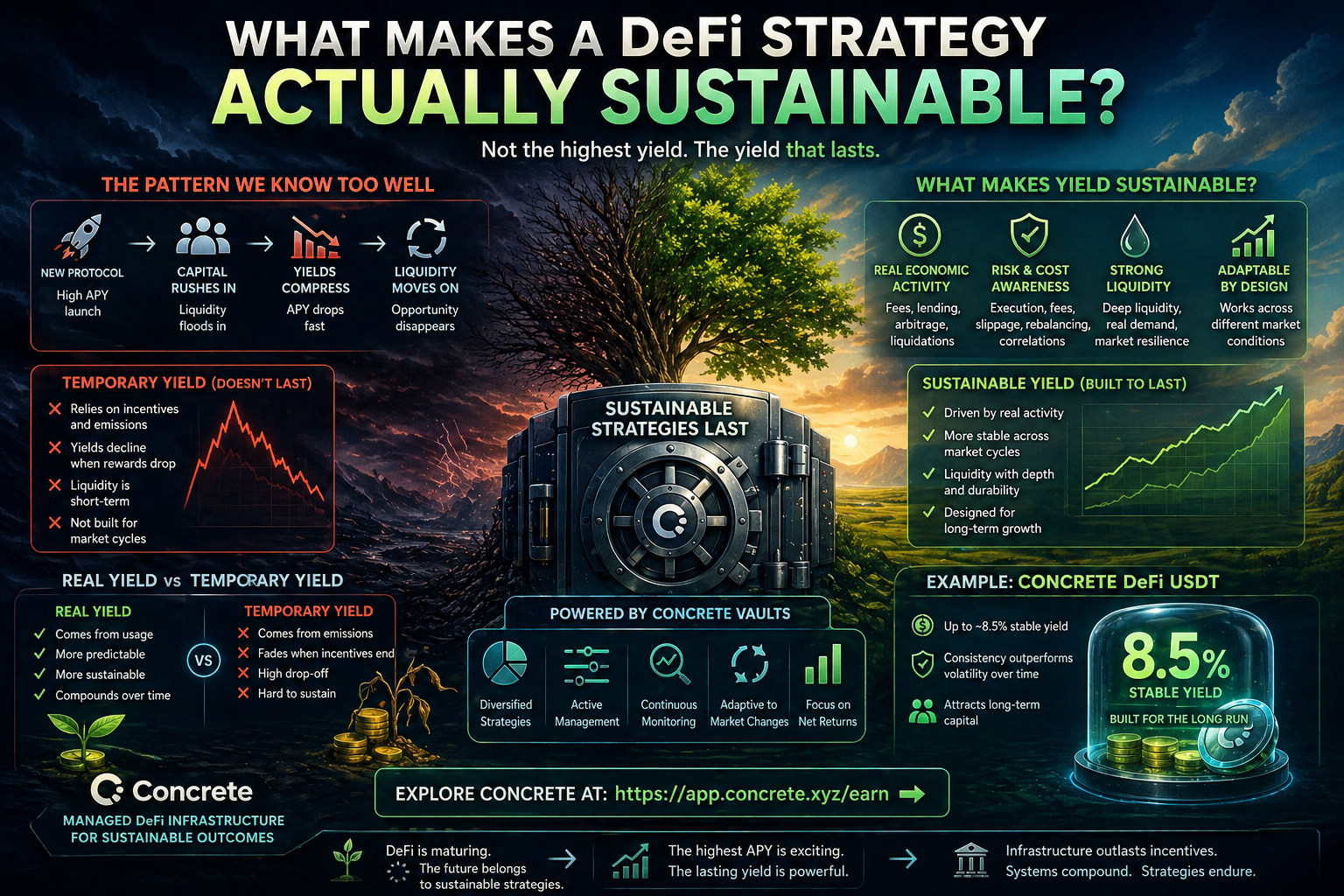
What Makes a DeFi Strategy Actually Sustainable ?
--
The Yield Trap Reality: Why Lasting Returns Beat the Hype
We have all been there. You wake up, check your favorite aggregator, and see a new protocol offering 150% APY. The group chats are buzzing, the TVL (Total Value Locked) is climbing by the millions, and you feel the pressure to move your stablecoins before the “opportunity” evaporates.
Two weeks later, the yield has compressed to 4%, the protocol’s governance token is down 60%, and you realize you’re paying more in gas fees to unstake than you earned in interest.
This isn’t just bad luck; it’s the standard lifecycle of DeFi strategies driven by emission-based marketing rather than economic reality. If we want to build a system that actually works for individual investors, we have to stop asking How much? and start asking How?
The Anatomy of a Short-Term Strategy
The lifecycle of most high-yield protocols follows a brutal, repetitive pattern:
- The Incentive Spike: A protocol launches, printing its own governance token to “bribe” liquidity providers.
- The “Mercenary” Rush: Capital flows in, not because the protocol provides value, but because it’s giving away “free money.”
- The Dilution: As more people jump in, the rewards per user plummet.
- The Exodus: The yield drops, the token price craters, and the liquidity which was never loyal flees to the next launch.
For the average DeFi user, this is a losing game. You are constantly chasing a moving target, eroding your principal through slippage, taxes, and the simple stress of manual rebalancing.
What “Sustainable” Actually Looks Like
Sustainability isn’t a buzzword; it’s a standard of risk-adjusted yield.
Take Sarah, an independent crypto-trader who spent years losing capital to “farm-and-dump” protocols. She shifted her focus from headline APY to real yield money generated by legitimate trading fees, decentralized lending interest, or verified arbitrage.
She realized that a strategy is only sustainable if:
- It doesn’t rely on token printing: If the rewards come from selling a token that has no utility, it’s a countdown, not a yield.
- I thrives in “bored” markets: If a strategy only works when volatility is at 300%, it will fail the moment the market stabilizes.
- It accounts for friction: Real returns include the cost of gas, the price of slippage, and the “time-cost” of management.
Concrete Vaults: The Professional Approach
Institutional DeFi is beginning to normalize, and the standard is shifting toward managed DeFi. This is where Concrete vaults come into play. Instead of leaving you to navigate the volatility alone, these vaults act as a filter.
When we look at Concrete DeFi USDT, we aren’t chasing the 200% dream. We are looking at a consistent ~8.5% stable yield.
For someone like Mark, a portfolio manager looking to allocate onchain capital, that 8.5% is more valuable than a volatile 50%. Why? Because he can model it, predict it, and sleep at night knowing the underlying assets aren’t tied to a collapsing incentive scheme.
The Future: Infrastructure Over Incentives
DeFi is growing up. The era of “yield farming” as a hobby is giving way to the era of professional-grade DeFi strategies.
Sustainability is the only competitive advantage that matters in the long run. The protocols that provide transparent, consistent, and managed returns will be the ones that hold the most liquidity when the market turns.
We aren’t just looking for the next moonshot. We are looking for the strategies that will still be providing value five years from now.
Are you tired of chasing the exit?
Explore a different way to grow your capital at: https://app.concrete.xyz/earn
What has been your experience with “high-yield” strategies versus consistent, managed approaches?