What Makes a DeFi Strategy Actually Sustainable?
--
DeFi has a rhythm. If you’ve spent any time onchain, you’ve felt it.
A new protocol launches with eye-catching APYs. Capital rushes in like a flash flood. Yields begin to compress as liquidity deepens. And just as quickly as it arrived, capital rotates out in search of the next opportunity.
Then the cycle repeats.
Again. And again. And again.
This raises a more important question than most people are asking:
Not “Where is the highest yield right now?”
But “What actually lasts?”
The Pattern Everyone Recognizes
The lifecycle of most DeFi strategies is almost predictable:
- High incentives attract early liquidity
- Returns look extraordinary at the start
- More capital dilutes the opportunity
- Incentives taper off or lose value
- Liquidity exits
- The strategy fades into the background
This pattern isn’t a flaw. It’s a feature of an open, competitive system.
But it exposes a deeper truth: most yield in DeFi is temporary by design.
So what separates fleeting opportunities from durable ones?
Defining “Sustainable” in DeFi
A sustainable DeFi strategy isn’t the one that shines brightest for a week. It’s the one that keeps producing over time.
At its core, sustainability means:
- Consistent returns across time
- Minimal dependence on external incentives
- Resilience across different market conditions
This is about durability, not just performance.
In other words, a strategy shouldn’t collapse the moment incentives dry up or market sentiment shifts.
Real Yield vs Temporary Yield
Not all yield is created equal.
There are two broad categories:
1. Temporary Yield (Incentive-Driven)
- Token emissions
- Liquidity mining rewards
- Short-term promotional APYs
These are powerful tools for bootstrapping growth. But they often come with a built-in expiration date.
As emissions decrease or token prices fluctuate, yields tend to fall sharply.
2. Real Yield (Activity-Driven)
- Trading fees
- Lending interest
- Arbitrage opportunities
- Market-making spreads
This type of yield is generated by actual economic activity.
It’s not dependent on continuous subsidies. It’s supported by users who are willing to pay for a service.
That makes it inherently more stable.
Sustainable yield is almost always rooted in real demand.
The Role of Liquidity and Market Conditions
Even strong strategies don’t exist in a vacuum.
Sustainability depends on:
- Liquidity depth — Can the strategy scale without eroding returns?
- User activity — Is there consistent demand driving fees or interest?
- Market volatility — Does the strategy benefit from movement, or require stability?
- Capital flows — Is liquidity sticky or opportunistic?
Some strategies only thrive in bull markets. Others perform best in volatility. A few are designed to adapt across cycles.
The most sustainable approaches are not static. They evolve with the market.
The Hidden Layer: Risk and Cost
This is where many strategies quietly break down.
On paper, a yield might look attractive. But reality introduces friction:
- Execution costs
- Slippage
- Rebalancing overhead
- Changing asset correlations
These factors eat into returns over time.
A strategy that advertises high APY can slowly degrade into mediocrity once these costs are accounted for.
That’s why risk-adjusted yield matters more than headline numbers.
What you keep is more important than what you’re promised.
From Opportunities to Systems
Sustainable DeFi strategies aren’t built by chasing isolated opportunities. They’re designed as systems.
Key principles include:
- Diversification across multiple strategies
- Continuous monitoring and adjustment
- Adapting to shifting market conditions
- Focusing on net returns, not raw APY
This is where DeFi begins to resemble traditional portfolio management, but with onchain transparency and automation.
It’s the shift from reactive trading to managed DeFi.
How Concrete Vaults Approach Sustainability
This is the philosophy behind Concrete vaults.
Instead of optimizing for short-term spikes, they aim to:
- Prioritize sustainable yield sources
- Actively manage capital across strategies
- Adapt allocations as conditions change
- Reduce reliance on temporary incentives
In essence, Concrete vaults treat DeFi not as a series of bets, but as a continuously evolving system.
The goal is simple: durability over hype.
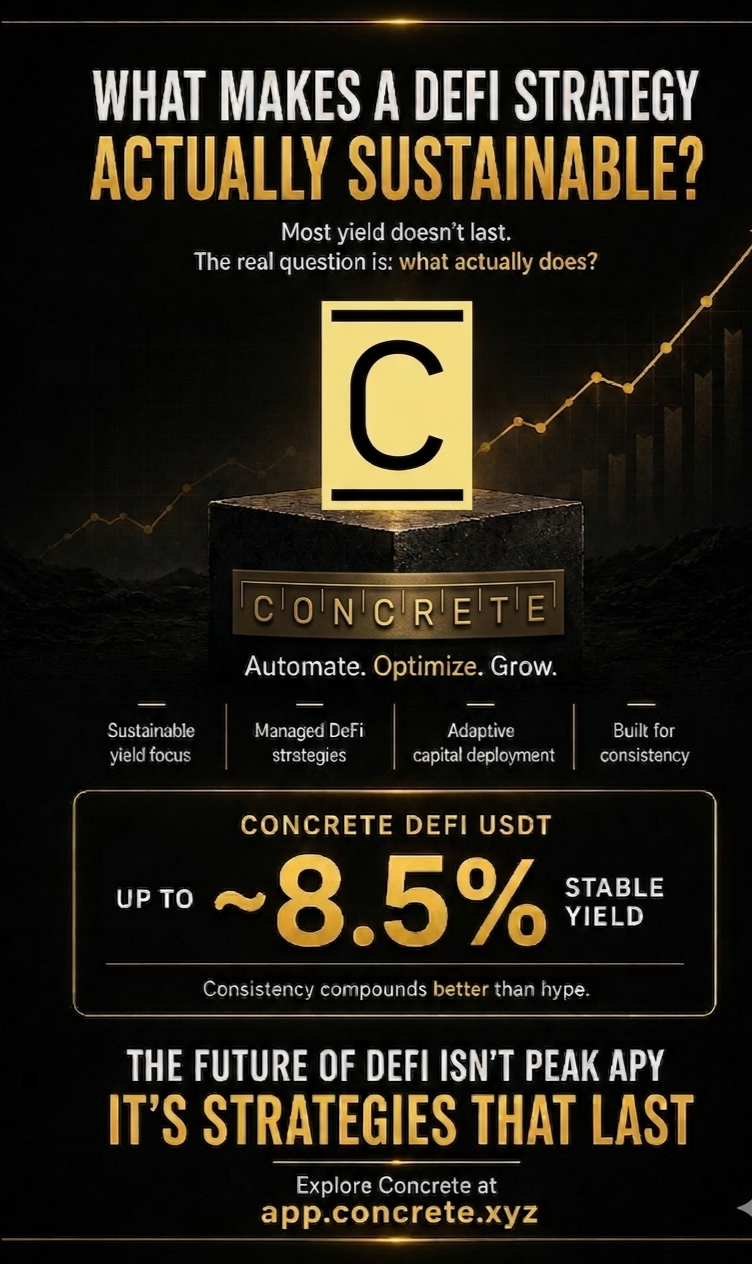
A Practical Example: Concrete DeFi USDT
Consider Concrete DeFi USDT.
It offers up to ~8.5% yield. At first glance, that may not seem as exciting as triple-digit APYs elsewhere.
But look closer.
- The yield is stable and consistent
- It is designed to be risk-aware
- It focuses on long-term sustainability
Over time, a steady 8.5% can outperform volatile strategies that spike and collapse.
Consistency attracts a different kind of capital.
Not tourists chasing yield, but participants thinking in cycles.
The Bigger Shift in DeFi
DeFi is maturing.
The space is moving:
- From short-term yield chasing
- Toward long-term capital strategies
From:
- Incentive-driven growth
- To infrastructure-driven sustainability
The future of DeFi will not be defined by the highest APY on a dashboard.
It will be defined by:
- Sustainable yield
- Risk-adjusted yield
- Resilient DeFi strategies
- Scalable DeFi vaults
- Institutional DeFi adoption
Because in the end, capital doesn’t just seek returns.
It seeks reliability.
Explore Concrete at: https://app.concrete.xyz/earn