What Makes a DeFi Strategy Actually Sustainable?
 xst4 min read·Just now
--
What Makes a DeFi Strategy Actually Sustainable?
DeFi is full of yield.
New strategies launch every week.
APYs spike.
Capital flows in.
And then, almost predictably, everything fades.
Yields compress.
Liquidity rotates.
Opportunities disappear.
This cycle isn’t an anomaly. It’s the default behavior of most DeFi strategies.
So the real question isn’t:
“What has the highest yield?”
It’s:
“What actually lasts?”
The Pattern Everyone Ignores
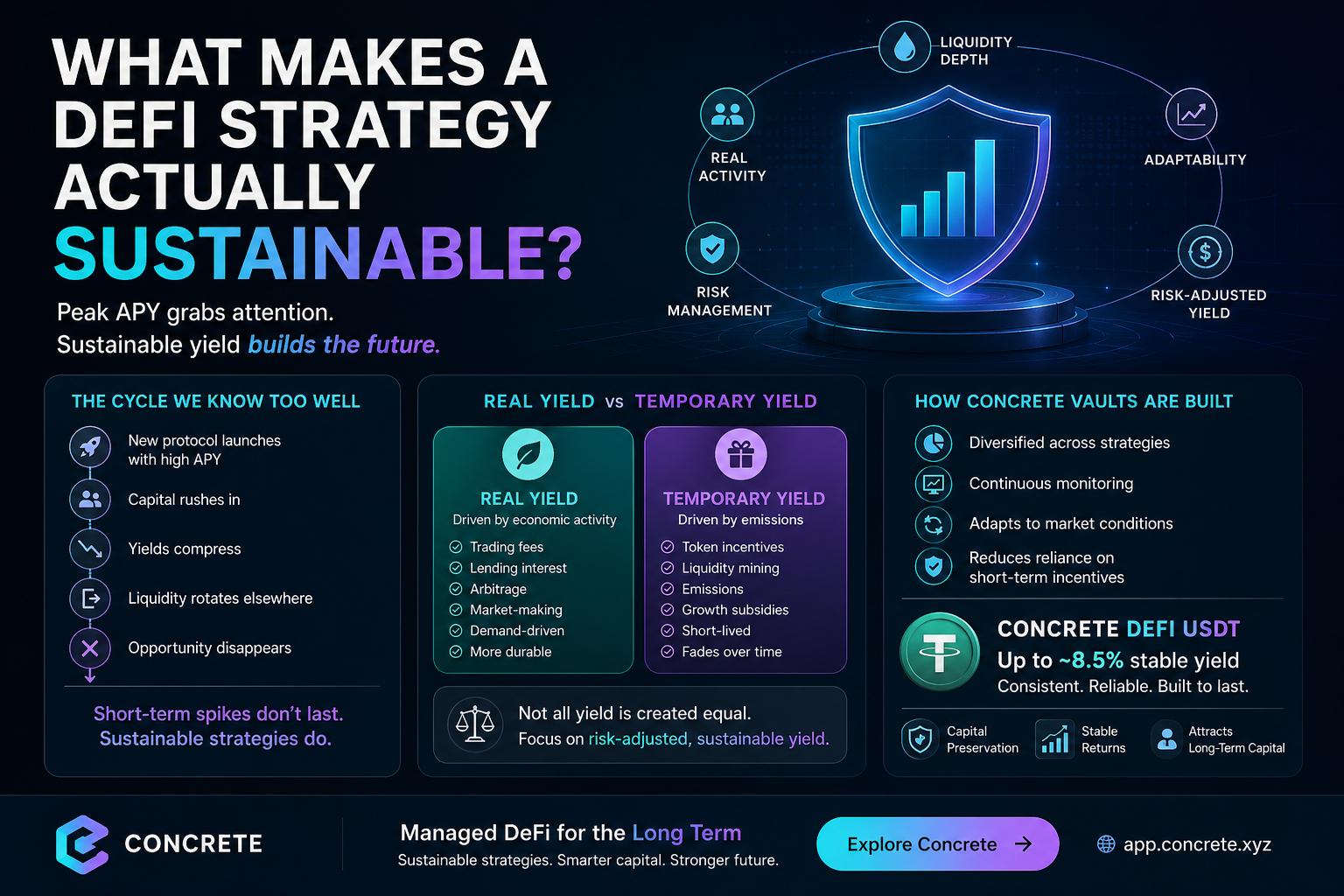
We’ve all seen it:
A new protocol launches with aggressive incentives.
Triple-digit APY appears overnight.
Liquidity floods in.
For a moment, it looks like free money.
But that moment doesn’t last.
As more capital enters:
- rewards get diluted
- emissions lose impact
- exit liquidity becomes the only strategy left
Capital leaves just as quickly as it arrived.
Then the cycle repeats somewhere else.
The problem isn’t that these strategies fail.
It’s that they were never designed to last in the first place.
What “Sustainable” Actually Means
A sustainable DeFi strategy isn’t defined by peak performance.
It’s defined by durability.
At a minimum, it should:
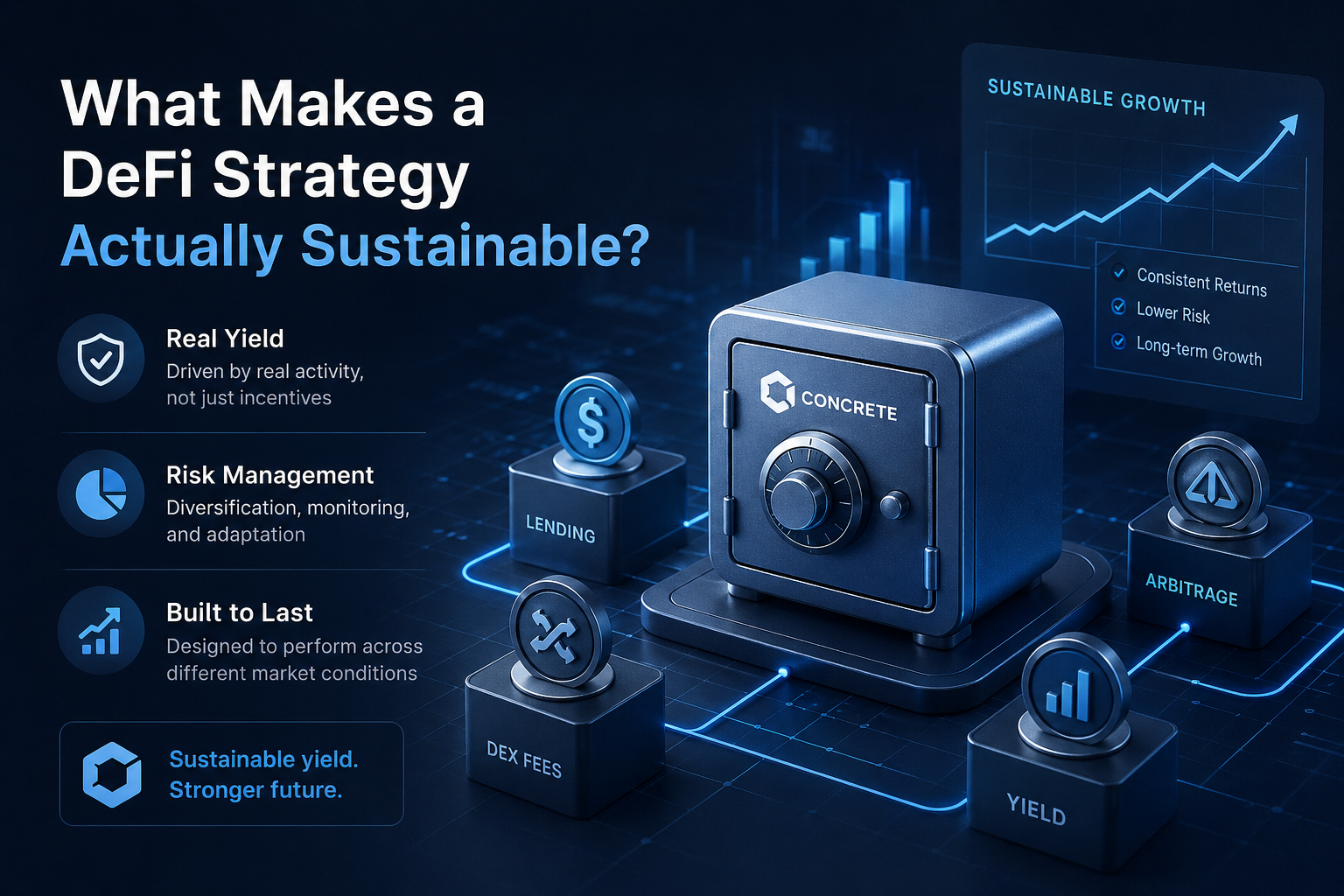
- generate consistent returns over time
- operate independently of temporary incentives
- remain viable across different market conditions
This is the difference between chasing yield and building sustainable yield.
Short-term performance can be engineered.
Long-term survivability cannot be faked.
Real Yield vs Temporary Yield
Not all yield is created equal.
There are two fundamentally different sources:
1. Temporary Yield
Driven by:
- token emissions
- liquidity mining incentives
- protocol subsidies
These are designed to attract capital — not sustain it.
As incentives decline, so does the yield.
2. Real Yield
Generated from:
- trading activity
- lending demand
- arbitrage opportunities
- actual market inefficiencies
This is tied to real economic activity.
And that’s the key difference:
- temporary yield decays
- real yield persists
If a strategy depends entirely on emissions, it has an expiration date.
Liquidity, Market Conditions, and Adaptability
Sustainability isn’t static. It’s conditional.
A strategy’s performance depends heavily on:
- liquidity depth
- user participation
- volatility levels
- demand for the underlying mechanism
Some strategies only work in bull markets.
Others only work in high volatility.
Many collapse when conditions shift.
The few that last are not rigid.
They adapt.
This is where most DeFi strategies fail, not because they are wrong, but because they are too narrow.
The Hidden Killers: Risk and Cost
On paper, many strategies look profitable.
In reality, they degrade.
Why?
Because of factors often ignored:
- execution costs
- slippage
- rebalancing frequency
- gas fees
- shifting correlations
A strategy showing high APY can still deliver poor risk-adjusted yield once these are included.
This is where sophistication matters.
Sustainability isn’t just about returns, it’s about net returns after friction.
Designing Strategies That Actually Last
Sustainable strategies don’t rely on a single opportunity.
They behave more like systems.
Key characteristics include:
- diversification across multiple DeFi strategies
- continuous monitoring and adjustment
- dynamic capital allocation
- prioritization of risk-adjusted yield over headline APY
This is where DeFi starts to evolve into something closer to institutional finance.
Not just opportunities, but managed DeFi systems.
Where Concrete Vaults Fit In
This shift is exactly what platforms like Concrete are built for.
Instead of chasing isolated opportunities, Concrete vaults focus on:
- sourcing sustainable yield
- managing onchain capital deployment across strategies
- adapting to changing market conditions
- reducing dependence on short-term incentives
The goal isn’t to capture the highest yield at a single moment.
It’s to maintain consistent performance across cycles.
This is a fundamentally different approach to DeFi strategies.
A Real Example: Stability Over Hype
Take Concrete DeFi USDT as a case study.
It offers up to ~8.5% yield.
At first glance, that may seem modest compared to aggressive DeFi plays.
But that’s the point.
Because over time:
- volatile yields collapse
- unstable strategies fail
- capital seeks consistency
A stable, repeatable return often outperforms erratic high APY when viewed across full market cycles.
This is what attracts long-term capital.
Not spikes, but reliability.
The Bigger Shift in DeFi
DeFi is maturing.
The industry is moving:
- from yield chasing → to capital management
- from short-term incentives → to long-term infrastructure
- from isolated strategies → to integrated systems
In this environment:
- sustainability matters more than peak returns
- risk-adjusted yield becomes the real benchmark
- infrastructure outlasts incentives
The future of DeFi won’t be defined by the highest APY.
It will be defined by the strategies that survive.
Final Thought
The question is no longer:
“Where is the highest yield right now?”
But:
“Which strategies will still be here in the next cycle?”
Because in the long run,
durability compounds harder than hype.
🚨 Explore Concrete at app.concrete.xyz 🚨