What Makes a DeFi Strategy Actually Sustainable?
 Naza7 min read·Just now
--
DeFi is a playground of high yield promises. We’ve all seen the pattern. A new protocol launches. The APY is staggering, sometimes four digits. Yield farmers move fast. Capital pours in within hours. The Discord fills up. The token pumps.
Then, quietly, the math catches up.
More capital chases the same underlying returns. Yields compress. The early movers rotate out. Liquidity thins. Within weeks, sometimes days, the strategy that looked like an edge becomes just another crowded trade. The protocol is still running. The yield is just gone.
This cycle has repeated across DeFi since its earliest days. Liquidity mining on Compound. The Curve wars. Ponzi-adjacent farm-and-dump tokens. Cross-chain incentive programs. Each generation discovers the same law: you cannot print sustainable yield from nothing. Eventually, the music stops.
So the real question isn’t where yields are highest today. It’s why most opportunities disappear and what makes the rare few persist.
What Sustainable Actually Means
Sustainability is a word DeFi loves to borrow but rarely defines. In traditional finance, a sustainable strategy is one that generates returns from durable economic activity, not from accounting tricks, not from subsidies, not from the next person buying in.
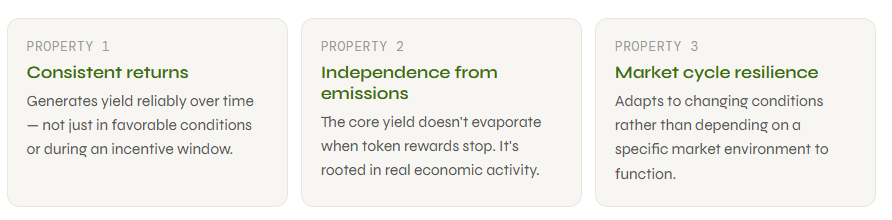
In DeFi, the definition is the same. A genuinely sustainable strategy generates consistent returns over time, doesn’t depend entirely on incentives to function, and remains viable across different market conditions. This is about durability, not just performance. A sustainable strategy doesn’t have to be the highest performing strategy in any given week. It has to be the one still standing when others have faded.
In onchain capital, consistency compounds in ways that peak APY simply cannot.
Real Yield vs. Manufactured Yield
At the core of the sustainability question is a distinction that gets lost in the noise: where does the yield actually come from?
Real yield flows from genuine economic activity. A lending protocol earns interest because borrowers pay for capital access. A DEX earns fees because traders need liquidity. A basis trade earns a spread because different markets price the same asset at different rates. These sources exist because they solve a real problem. They don’t vanish when incentive programs end.
Manufactured yield is different. It comes from emissions tokens minted and distributed to depositors to attract liquidity. The protocol subsidizes your return, hoping that the activity it attracts will eventually generate real revenue. Sometimes it does. More often, the subsidy attracts mercenary capital that leaves the moment returns normalize.
The collapse of emissions-driven yield isn’t a flaw, it’s a structural feature. Every token emitted as an incentive dilutes existing holders. Every new depositor splits the reward pool further. The economics are self-terminating by design.
Real economic activity doesn’t work that way. Trading volumes fluctuate, but the fee mechanism persists. Borrowing demand cycles, but the interest rate model adjusts. The underlying source of yield responds to market conditions rather than collapsing under its own weight. Not all yield is created equal and the difference between real yield and manufactured yield is the difference between a durable DeFi strategy and a trade with an expiration date.
Why Liquidity and Market Conditions Matter More Than You Think
Even strategies built on real yield can fail if the conditions that enable them disappear. Sustainability isn’t just about yield source. It’s about the environment the strategy lives in.
Consider liquidity depth. A strategy that generates 12% APY in a deep, liquid market might generate nothing or losses when liquidity thins. Slippage eats into rebalancing. Large exits move prices against you. The strategy that looked elegant in the spreadsheet becomes unworkable in the real market.
Market volatility adds another layer. High-volatility periods create opportunities for certain hedging strategies that disappear entirely in calm markets. Low-volatility regimes favor stable yield approaches that would underperform during expansions. User activity shapes things further, some strategies only work when there is sufficient two-sided demand for the underlying mechanism. When that demand dries up, so does the yield.
The most durable DeFi strategies don’t just perform in one regime. They adapt to multiple regimes without catastrophic failure in any of them. That adaptability is a feature that is very hard to build and very easy to overlook when everything is going up.
The Costs That Kill Returns Slowly
Perhaps the most overlooked dimension of DeFi strategy sustainability is the cost structure. A strategy that appears to generate 15% annually might deliver 6% once all the friction is accounted for and most retail participants never run the full calculation.
Gas fees for rebalancing are the obvious cost. But there are subtler ones: slippage on entry and exit, opportunity cost of idle capital between redeployments, changing token correlations that erode hedge ratios over time, and protocol fees that look small per transaction but accumulate across thousands of positions.
Then there is what might be called strategy decay. As more capital discovers an edge, the edge compresses. A risk-adjusted yield opportunity that returned 18% with $10M deployed might return 8% with $100M deployed in the same space. The strategy didn’t change. The market did.
This is why institutional DeFi increasingly focuses on net returns rather than gross yields. The headline number attracts attention. The net number tells the truth. Sustainable managed DeFi is built around minimizing the gap between those two figures and any honest evaluation of a DeFi strategy has to start there.
How Sustainable Strategies Are Actually Built
When you look at what separates durable DeFi strategies from short-lived ones, a few design principles emerge consistently.
The first is diversification across yield sources, not just across assets. A strategy that generates returns from lending, trading fees, and structured positions simultaneously is less exposed to any single source drying up. When one opportunity compresses, others sustain the overall return.
The second is continuous monitoring and reallocation. DeFi markets move faster than any static strategy can adapt to. The strategies that last are the ones with mechanisms automated or systematic for rotating capital toward the best available risk-adjusted opportunities rather than staying locked in a position that has already run its course.
The third is an orientation toward net returns over headline yield. Every allocation decision in a sustainable strategy starts with: what does this actually return after costs, after slippage, after rebalancing friction? That discipline is what separates managed DeFi from simple yield chasing.
Taken together, these principles point to something larger: DeFi is slowly evolving from a collection of disconnected opportunities into a system of capital allocation with real infrastructure. The strategies that will define the next era aren’t the ones built on the best single opportunity, they’re the ones built on the best systems.
How Concrete Vaults Approach the Sustainability Problem
Concrete vaults are designed around exactly these principles, not as a theoretical framework, but as an operational reality. Rather than locking capital into a single strategy or protocol, Concrete’s vaults route deposits intelligently across the best performing lending markets and yield sources, continuously and with risk management built into the core logic.
The vault architecture prioritizes sustainable yield sources over emissions driven incentives, automates capital routing across strategies and chains, and reduces reliance on short-term incentive programs that fade the moment subsidies end. ERC4626 vaults with transparent, audited performance tracking mean that users can see exactly what they’re earning and where it’s coming from.
The goal isn’t peak yield. It’s institutional-grade, risk-managed performance that holds up across market cycles, the kind of yield that long-term capital can actually plan around. In a space where most DeFi vaults optimize for launch week numbers, Concrete is optimized for durability.
Why Concrete DeFi USDT Is Worth Looking At
The Concrete DeFi USDT vault illustrates the sustainability thesis in concrete terms. Approximately 8.5% on a stablecoin is not the highest number in DeFi at any given moment. But it represents something more valuable than a headline APY: a yield that is consistent, that draws from real lending activity, and that doesn’t require constant active management or risk-on exposure to volatile assets.
Consider the compounding math. A volatile strategy that averages 30% in bull conditions but loses ground in downturns will frequently underperform a strategy that steadily returns 8–9% across all conditions. Consistency compounds. Drawdowns don’t.
This is why sustainable yield often looks less exciting than the alternatives and why it attracts a different kind of capital. Long-term allocators, institutional participants, and anyone managing serious onchain capital eventually discovers that reliable returns beat spectacular ones over any meaningful time horizon. Stability is not a consolation prize. In the right hands, it’s the whole strategy.
The Bigger Shift Already Underway
DeFi is growing up. Not in a way that’s visible in a single week’s APY data, but in the structural shift happening beneath the surface of the market.
The protocols that are building lasting positions in the ecosystem aren’t the ones with the most aggressive incentive programs. They’re the ones with the most robust infrastructure, the ones that can route capital efficiently, manage risk systematically, and deliver real returns to users who aren’t watching their positions every hour.
The capital that is accumulating in DeFi is increasingly long-term capital. Institutional participants don’t chase 200% APY farms. They allocate to strategies with a track record, a risk framework, and a sustainable yield source. As that capital grows as a share of total onchain assets, it will reward the protocols built for durability, not the ones built for the next launch cycle.
The future of DeFi will not be defined by the highest APY anyone ever offered. It will be defined by the strategies still generating real returns five market cycles from now, the infrastructure that outlasted the incentives, the vaults that survived the drawdowns, and the capital that understood the difference between a trade and an allocation.
Sustainable yield looks boring by design. That’s the point.
Explore concrete at https://app.concrete.xyz/earn