What Makes a DeFi Strategy Actually Sustainable?
 Frankday4 min read·1 hour ago
--
DeFi has a rhythm. Not a gentle one, more like a drumline that sprints.
A new protocol launches.
APYs flash like neon signs.
Capital pours in.
Yields compress.
Liquidity vanishes as quickly as it arrived.
Then the cycle resets.
We’ve all watched this loop play out across countless DeFi strategies. The surface story is always yield. The underlying story is something else entirely: durability. So the real question isn’t “what pays the most today?” It’s “what’s still standing tomorrow?”
The Pattern: Fast Money, Faster Decay
Short-term yield opportunities in DeFi behave like seasonal markets. They bloom quickly, attract attention, and fade just as fast.
Why?
Because most are engineered for attraction, not longevity. Incentives create gravity, but once emissions slow or capital saturates the trade, the edge disappears. The strategy wasn’t built to last, it was built to bootstrap.
This is why the same lifecycle keeps repeating. The mechanism hasn’t changed. Only the branding has.
What “Sustainable” Actually Means
A sustainable DeFi strategy isn’t defined by peak performance. It’s defined by endurance.
At its core, sustainable yield means:
- Returns that persist across time, not just moments
- Independence from constant external incentives
- The ability to function in both calm and chaotic markets
It’s less about chasing upside and more about resisting decay.
Sustainability is not exciting. It is steady. And in capital markets, steady compounds quietly while noise burns out loudly.
Real Yield vs Temporary Yield
Not all yield is born equal. Some is earned. Some is manufactured.
Temporary yield often comes from emissions, token rewards, or subsidized incentives. It looks attractive upfront but tends to decline as supply increases and demand stabilizes.
Real yield, on the other hand, comes from actual economic activity:
- Trading fees
- Lending interest
- Arbitrage opportunities
- Market-making spreads
This kind of yield is tied to usage, not marketing. As long as users interact with the system, the yield has a reason to exist.
Temporary yield attracts attention. Real yield sustains capital.
Liquidity, Conditions, and Adaptability
A strategy doesn’t exist in isolation. It breathes through market conditions.
Sustainability depends on:
- Liquidity depth: Thin liquidity breaks strategies under pressure
- User activity: No users, no fees, no yield
- Volatility: Some strategies thrive in motion, others collapse
- Demand: Without demand, even well-designed strategies stall
Some strategies are fragile, they only work under perfect conditions. Others are adaptive, adjusting their exposure as markets shift.
The difference is survival.
The Hidden Layer: Risk and Cost
On paper, many strategies look flawless. In reality, they leak.
Execution costs, slippage, rebalancing friction, and shifting correlations quietly eat into returns. A strategy showing double-digit APY can degrade significantly once these factors are accounted for.
This is where risk-adjusted yield becomes critical.
It’s not about what you earn. It’s about what you keep after everything else takes its cut.
Ignoring costs is like measuring rainfall without noticing the holes in your bucket.
Designing for Durability
Sustainable strategies don’t rely on a single edge. They are systems.
They are built through:
- Diversification across multiple yield sources
- Continuous monitoring and adjustment
- Flexibility to rotate as conditions change
- Focus on net returns, not headline APY
This is where DeFi starts to mature. It shifts from isolated opportunities to managed frameworks.
From chasing yield to engineering it.
Enter DeFi Vaults: Systems Over Strategies
This evolution is where DeFi vaults come into play.
Instead of asking users to manually chase opportunities, vaults manage capital dynamically:
- Allocating across multiple strategies
- Adjusting to market conditions in real time
- Prioritizing sustainable yield sources
- Reducing reliance on short-term incentives
Concrete vaults are built with this philosophy. They treat DeFi not as a series of trades, but as an ecosystem to navigate.
The goal isn’t to win the week. It’s to survive the cycle.
A Practical Example: Concrete DeFi USDT
Take Concrete DeFi USDT as a grounded example.
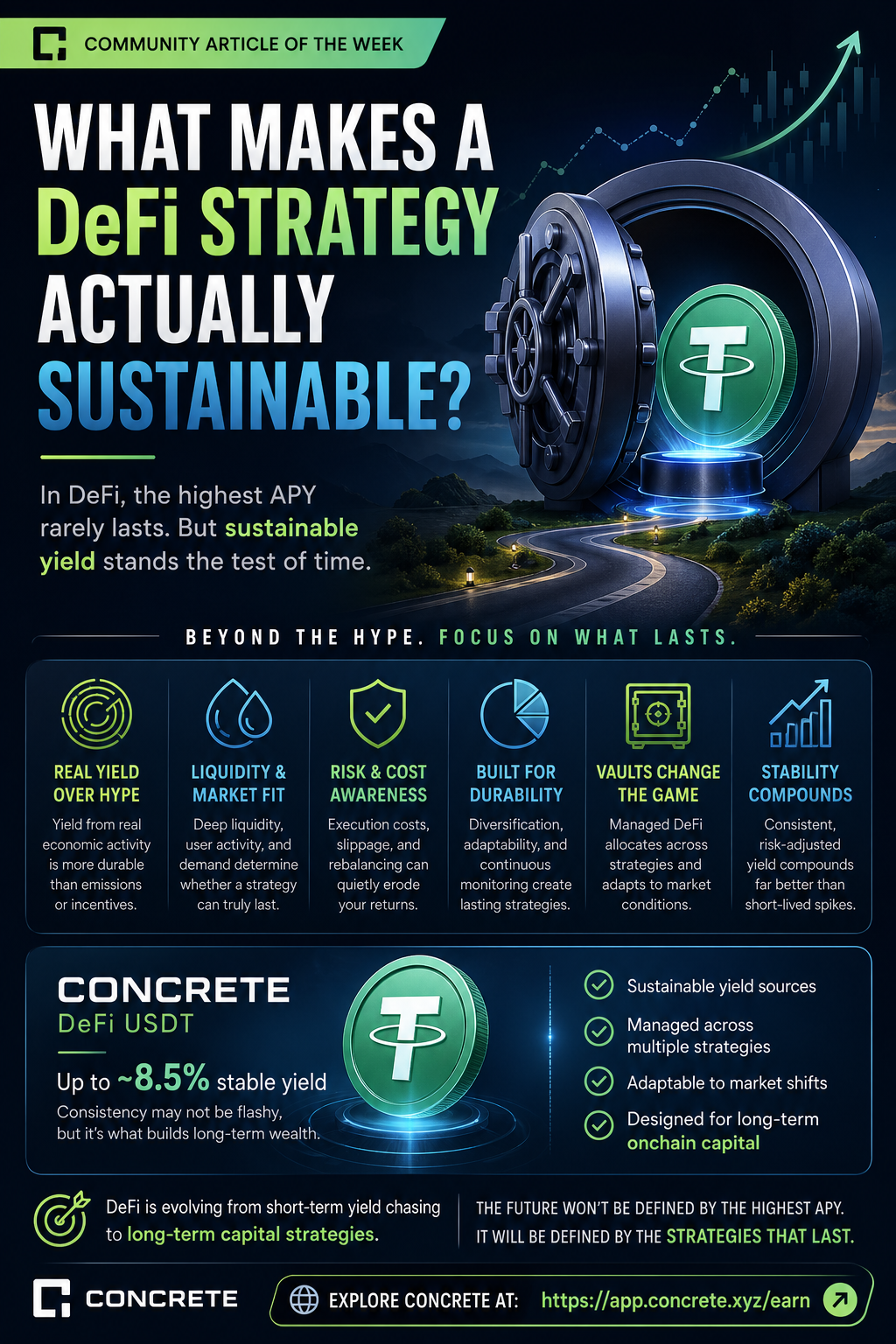
Offering up to ~8.5% stable yield, it may not compete with the flashiest APYs on the surface. But that’s precisely the point.
Consistency often outperforms volatility over time.
While high-yield opportunities spike and collapse, stable strategies continue compounding. For long-term onchain capital, reliability becomes more valuable than excitement.
This is what attracts more serious capital. Not the promise of peaks, but the confidence of persistence.
The Bigger Shift
DeFi is evolving.
It’s moving away from short-term yield chasing and toward long-term capital strategy. The focus is shifting from maximizing returns in isolation to optimizing them across time.
Sustainability will matter more than peak performance.
Risk-adjusted yield will matter more than raw APY.
Infrastructure will matter more than incentives.
The future of DeFi won’t be defined by the highest number on a dashboard.
It will be defined by the strategies that refuse to disappear.
Explore Concrete at: https://app.concrete.xyz/earn